All right, it's a slow day -- I'm here in my office so that students can hand in their papers to me, and beyond that I don't have much to do (well, actually, I have a lot to do, but I'm taking this time to take a deep breath before a rather insane 48 hours of essay grading). So I thought I'd write a blog entry.
Aaaaaannd it got a little away from me. So if you're about to start reading, be warned that it goes on for quite a while. So go get a coffee, maybe a snack. Do you like music when you read? Perhaps you should turn some on.
Are you sitting comfortably? Then we'll begin ...
--------------------------------------
Well, on the heels of my last post ranting about the egregious idiocy of Bill O'Reilly seems as good a time as any to write a post on something that's been rattling around my head for a while now. I blogged a little while back in passing about right-wingnut David Horowitz and his book The Professors: The 101 Most Dangerous Academics in America. In and of itself, the book is yet more pap emerging from the conservative think tanks south of the border, and not really worth mentioning. I certainly couldn't do a better job of debunking the book than Michael Berube does on a regular basis on his blog (of course, as someone actually listed as one of the 101 most dangerous professors, Berube is in an ideal position to take on Horowitz, and does so with elan and ironic humour, something his shrill and thin-skinned opponent is notably lacking. For an example of what I mean, see here).
No, what's been sort of rattling around in my head lately has to do with some recent efforts on the far right in the States to recuperate Senator Joseph McCarthy's reputation. Granted, this does tend to come from the more hysterical of the pundits (Anne Coulter is perhaps the Senator from Wisconsin's greatest advocate these days, though there are some revisionist histories in the works as well), but the fact that it rather neatly parallels the entire Bush-wiretapping issue is somewhat disturbing.
It is still a fairly significant insult to be accused of "McCarthyite" tactics, and so the good Mr. Horowitz bristles rather quickly when anyone ventures to suggest that his book is all about "naming names," though he is quite glib when it comes to accusing his detractors of tactics similar to those of Tailgunner Joe.
With the frequency with which McCarthy's name gets tossed around by people on both the left and the right, it's only good and proper that we hear it with a grain of salt and see it for what it is most of the time: namely, a reified term that simply connotes a bad guy in a black hat, a cartoon villain whose identification as a bombastic crypto-fascist buffoon tends to go largely unexamined and unquestioned in the popular imagination -- much in the same way that a Stephen Spielberg film uses Nazis as the bad guys, because they come with a whole series of qualities and traits that require no thought to decipher.
The problem is that Horowitz's tactics are genuinely McCarthyite. The Professors, in and of itself, is a joke, a punchline, that is not only poorly researched and reads like a cut-and-paste from some uberconservative version of Wikipedia, but also evinces a laughable ignorance of the realities of university life. A pervasive conspiracy on the part of over 50,000 professors to "purge" the academy of conservatives?? Please. Anyone who's ever sat in on a faculty meeting and watched a group of professors try to agree on changing the wording for an entry in the course calendar would have a good chuckle over that one. "Herding cats" is the phrase that comes to mind -- any conspiracy by academics would be stillborn at the first meeting during the fight that would ensue over what to name the cabal.
Further, the basis for Horowitz's book is the idea that these professors are "dangerous" not so much for personal politics as for their indoctrination of their students into leftist and anti-American sentiments. So: that being said, one would think that a key component of the book would be testimonials from students who were browbeat into writing Marxist essays, failed for articulating conservative ideas, and generally forced into a leftist mold, right? Not so much -- just the aforementioned brief bios. There is in fact no evidence offered at all that any of the 101 professors use their classes as soapboxes. I imagine that some probably do -- it is hard in any classroom context, never mind the humanities, not to let one's personality show through. But to suggest that this process is something akin to brainwashing gives professors way to much credit and students not enough. I can attest -- based on both class experience itself and course evaluations -- that in any given classroom context, a portion of the students think that what you say is brilliant, a portion think you're full of shit, and a (probably the largest) portion copy down what you say rather indifferently, spit it back on essays and exams, and promptly forget the keynotes of the course in a post-exam binge.
Hm. Look at that -- I had not intended a sustained critique of The Professors, and yet couldn't help myself. Sorry about that. Anyway, as I was saying, Horowitz's tactics are in fact eminently McCarthyite. The Professors is merely symptomatic, and in and of itself not worth talking about (except insofar as it makes me mad and liable to rant). More troubling, and what gives rise to this post, is the website DiscoverTheNetwork.org. Better than me explaining it, go and check it out. I'll wait.
Back? Disturbed yet? My favourite page is the list of individuals, laid out helpfully along a grid. More on this in a moment.
DiscoverTheNetwork was launched in 2005, spearheaded by Horowitz and various cronies from ultraconservative think tanks and publications. The overall premise of this site is that there exists a "network" of people, groups and organizations left of center who (a) sympathize with terrorists, (b) are anti-American, and (c) constitute a "shadow-party" influencing the Democrats.
I wish this site had been around while I was writing my thesis: it is pretty much a paradigm of conspiratorial thinking. Like most conspiracy theories, or manifestations of which Richard Hofstadter famously termed "the paranoid style in American politics," it proceeds from flawed deductive reasoning. When we think about it, conspiracy in its actual, documented forms as a criminal charge (conspiracy to commit murder, conspiracy to defraud) is something that is investigated and uncovered using inductive reasoning -- that is, working from the particulars to a general rule (investigators uncover evidence, find connections, establish which connections are valid, and arrive at the shape of the conspiracy). Deductive reasoning, conversely, works from a general rule to particular instances (the famous example being All men are mortal, Socrates is a man, ergo Socrates is mortal). What happens in conspiratorial thinking is that the theorist ("paranoid spokesman," to again cite Hofstadter) assumes the conspiracy's existence from the outset and then formulates connections whose existence is predicated on -- what? Well, there is a conspiracy, therefore there must be connections. Something of a tautology, yes.
Senator Joseph McCarthy pretty much perfected this strategy. Starting with his infamous declarations in the Senate -- "There are [x number of] card-carrying communists in the state department!" -- he then proceeded in the HUAC hearings to defame individuals based on the flimsiest of conjectures and associations. The entire process was predicated on the acceptance of his basic premise: that the U.S. government and other high-profile organizations were riddled with communist agents actively working toward the demise of capitalism and apple pie. Or something.
Today, those intent on exhuming McCarthy invariably point to the fact that there were communists at large in America, and that some were exposed by the hearings ... Alger Hiss being the most notorious example.
This is true enough. Also undeniable however is the collateral damage done by HUAC to people whose only crime had been attending a meeting out of curiosity in the 1930s, or owning albumns by Paul Robeson, or having a next-door neighour who had confessed to marxist sympathies -- people whose jobs were lost, who found themselves faced with the impossible choice of naming names they knew to be innocent or getting blacklisted.
The point of the McCarthyite conspiracy theorizing however was manifestly not uncovering actual card-carrying communists so much as attacking the vestiages of 1930s-era, New Deal-style politics as manifested in the figure that so fired McCarthy's hatred: the east-coast, Ivy League liberal intellectual. Actual card-carrying communists were not all that hard to find: the American Communist Party never actually went underground, and remained in visible (if occasionally tenuous) existence throughout the most egregious years of McCarthy's inquisitions. The hapless individuals handing out pamphlets on streetcorners and harranguing factory workers were not his target.
Nor was actual ideology ever a point of questioning. Communism was not the object of inquiry, it was the weapon. The tireless "rooting out of traitors" proceeded along oblique and suggestive lines. The now-notorious "Are you now, or have you ever been, a member of the Communist Party?" was followed by questions about books the witness owned, their associations with liberal groups, the magazines to which they subscribed; "Your next-door neighbour admitted to attending a communist meeting in 1937" is the kind of bludgeon those called before the committee could expect.
Communism was thus figured not as a series of political philosophies so much as personal proclivities. McCarthy's most striking characterization was the commie-as-queer: spitting vitriol about "Whiny egg-sucking phony liberals," he established a series of associations starting with the limp-wristed intellectual and cringing liberal, connecting these to New Deal politics, New Deal liberalism with socialism, and socialism with communism. Not only was “Communism” divorced from theory, philosophy and ideology, but the imputation of intellectualism itself became a sign of Communist tendencies. It followed essentially the same logic as that which once stipulated that good girls don't chew gum -- because a girl who chews gum will smoke, a girl who smokes will drink, and a girl who drinks! Well, everyone knows what a girl who drinks will do ...
Turning back to DiscoverTheNetwork, let's look again at the page labelled "Individuals." Here is Horowitz's defense of it: "The picture grid is not a list of anything, except a small fraction of the raw contents of the site. It is an enticement not a thesis. It does not suggest any connections between these individuals, except in the sense that they all belong in a database about the left."
To claim that this grid does not suggest any connections here is simply disingenuous. Of course Horowitz cannot claim that Barbara Streisand is in cahoots with Sami Al-Arian, someone actually brought up at one point on terrorism charges: I'm hazy on libel laws, but I'm pretty sure that would be close to the line. Articulating concrete charges is not what this site is about: it is about establishing suggestive links between the left's own wingnuts -- our equivalents of Anne Coulter and Pat Robertson -- and the liberal mainstream. The classifications at the top of the page, I would argue, are designed to be incidental. The real point of the grid is imagistic rather than prescriptive: it works by proximity, not argument. Hence, we have an array (the grid is itself suggestive of a non-arbitrary ordering principle, a gesture to Weberian rationality) of individuals with less to do with each other than apples and oranges. We have apples and sea otters. Yet, the continuum proceeds by increments, taking us from idiots like Professor Ward Churchill (who called the victims of 9/11 "little Eichmanns") or a dictator like Fidel Castro, through well-respected academics like Cornell West or populist filmmakers like Michael Moore, to such innocuous celebrities like Streisand, Bruce Springsteen and Martin Sheen (the picture of Sheen, incidentally, is cropped from a publicity still from The West Wing).
This particular page is, effectively, the entire site in microcosm. Horowitz's protestation that it is "not a list of anything, except a small fraction of the raw contents of the site," ignores the fact that the rest of the site is more or less organized according to the same principle. Significantly lacking is anything outlining the structure of the "network" -- we are invited instead to "discover the network" for ourselves (interesting, in this respect, that Horowitz calls the Individuals page an "enticement"). Hence, we are invited to collapse the gulfs that lie between Sheik Omar Abdel and Howard Dean, Fidel Castro and George Clooney, Louis Farrakhan and Garrison Keillor (because, as we all know, the author of Lake Wobegone Days constitutes a serious threat to American national security); between the ACLU and the IRA; between the Black Panthers and the Rainforest Alliance.
The temptation to laugh at the sheer absurdity this site represents is immense; as blogger Rox Populi quips, "I haven’t had this much fun since I was handed a Lyndon LaRouche tract that tied the Hapsburgs to the Challenger explosion." I could add dozens of comparable examples that I encountered while researching my thesis, all just as absurd and laughable. It is the logic however informing this web site that makes me uneasy ... coupled with the knowledge that, in hindsight, Senator McCarthy was just as laughable. The student of a colleague, upon seeing Good Night, and Good Luck apparently liked the film, but thought the guy playing McCarthy was "overacting" (the film used actual footage of the Senator, not an actor) ... but McCarthy was believable back in the day, and the fact that certain elements are now trying to exhume his bones gives me pause.
Monday, April 10, 2006

Wednesday, April 05, 2006
The giant head strikes again
I make a concerted effort not to let the idiocy of the Fox News pundits get to me ... otherwise, I would spend my life in an infuriated fog of disbelief at the stuff that comes out of the collective mouth of Hannity, Coulter, et al. Life's too short. But then every so often one of them will say something that so far surpasses the bounds of decency, so defies belief, or exhibits such a flagrant disregard for truth, history and actuality that I simply cannot pass it by without comment.
Well, this time it's Bill O'Reilly, or as Keith Olbermann calls him, "the big giant head." In response to a caller's assertion that the deep racial rifts between black and white in the U.S. and the problems that plague the African-American community are rooted in decades of enslavement, O'Reilly denied that this was the case. His evidence? Well, the Irish were oppressed by the British, but emigrated to America overcame that injustice. Ergo, the African-American community has no recourse to blaming slavery -- since the Irish prevailed, then the same opportunity has been afforded blacks in America:
"My people came from County Cavan in Ireland. All right? And the British Crown marched in there with their henchman, Oliver Cromwell, and they seized all of my ancestors' lands, everything. And they threw them into slavery, pretty much indentured servitude on the land. And then the land collapsed, all right? And everybody was starving in Ireland. They had to leave the country, just as Africans had to leave -- African-Americans had to leave Africa and come over on a boat and try to make in the New World with nothing. Nothing."
I'm not certain if I'm more aghast at O'Reilly's apparent attempt to claim some sort of twisted solidarity with black America (echoes of The Commitments -- "The Irish are the blacks of Europe!"), or with this bizarre rewriting of history in which the Irish diaspora is placed on par with the violent kidnapping and enslavement of thousands of Africans. In O'Reilly's revisionist account, it sounds like the "emigration" of the Africans had some element of choice involved.
Africans did not cross the Atlantic to start a new life with nothing. They were forcibly relocated from the lives they were living. And they didn't have nothing -- they had less than nothing. At least the Irish owned themselves.
Arrgh.
Well, this time it's Bill O'Reilly, or as Keith Olbermann calls him, "the big giant head." In response to a caller's assertion that the deep racial rifts between black and white in the U.S. and the problems that plague the African-American community are rooted in decades of enslavement, O'Reilly denied that this was the case. His evidence? Well, the Irish were oppressed by the British, but emigrated to America overcame that injustice. Ergo, the African-American community has no recourse to blaming slavery -- since the Irish prevailed, then the same opportunity has been afforded blacks in America:
"My people came from County Cavan in Ireland. All right? And the British Crown marched in there with their henchman, Oliver Cromwell, and they seized all of my ancestors' lands, everything. And they threw them into slavery, pretty much indentured servitude on the land. And then the land collapsed, all right? And everybody was starving in Ireland. They had to leave the country, just as Africans had to leave -- African-Americans had to leave Africa and come over on a boat and try to make in the New World with nothing. Nothing."
I'm not certain if I'm more aghast at O'Reilly's apparent attempt to claim some sort of twisted solidarity with black America (echoes of The Commitments -- "The Irish are the blacks of Europe!"), or with this bizarre rewriting of history in which the Irish diaspora is placed on par with the violent kidnapping and enslavement of thousands of Africans. In O'Reilly's revisionist account, it sounds like the "emigration" of the Africans had some element of choice involved.
Africans did not cross the Atlantic to start a new life with nothing. They were forcibly relocated from the lives they were living. And they didn't have nothing -- they had less than nothing. At least the Irish owned themselves.
Arrgh.
Saturday, April 01, 2006
On the healing power of a sunny day
 I don't think I quite appreciated my vitamin D deficiency until stepping out into today's brilliant sunshine. It was so glorious, I began to suspect a divine April Fool's Day joke.
Walking from my place down to Water Street for my typical Saturday lunch at Nellie's over the G&M (and the new Harper's, which was the icing on the cake) was itself remarkably restorative. Most picturesque of all were the many rivulets of water from the runoff of melting snow, trickling in wide swathes down the hills toward the harbour -- all warmed by the sunshine on the black roads, and in contact with the brisk cool breeze emitting shallow gusts of mist so that the streets themselves looked like steaming new asphalt. It all contributed to a long-overdue euphoric sense of well-being. Life is good ... the semester winds down, and my two and a half month sojourn in Southern Ontario feels for the first time like it's in striking distance.
Friday, March 31, 2006
Remember remember the Fifth of November ...
 ... Gunpowder, treason, and plot!
Saw V for Vendetta last night, one result of which is that I now have that rhyme running endlessly through my head. "I see no reason why gunpowder, treason / Should ever be forgot."
I wasn't sure what to expect, especially considering I have not read the original graphic novel. I knew the broad strokes -- a dystopian post-apocalyptic England set twenty-odd years in the future, in which a fascist-religious party has seized power and rules with an iron fist. Into the mix comes a vigilante in a Guy Fawkes mask determined to bring revolution to England and throw out the totalitarian regime.
This being the Wachowski brothers' first major project since The Matrix trilogy, I was expecting a lot of flash and style ... and certainly wasn't disappointed on that front. Among other things, the film is a pretty big hunk of eye-candy, with many shots and sequences (perhaps unsurprisingly) very reminiscient of The Matrix. Plus, the character of V is voiced by Hugo Weaving, aka Agent Smith, so there are some resonances there as well.
On the balance, I thought this was a good film, and independent of academic considerations, I really enjoyed it -- I suspect it's one of those films you'll either buy into and let it push your buttons, or instinctively resist and end up hating it.
The simple enjoyment factor is not what I'm concerned with, however ... I do think that this is a film that should be talked about. It is by no means a a straightforward indictment of the Bush Administration, as some critics have interpreted it: though the basic framework has been retooled such that the "apocalypse" of the original series, which was a nuclear war, is now the implosion of the "war on terror." The global state of affairs in the film -- in which England has been purged of "undesirables" and the U.S. has devolved into civil war -- is pretty specifically rooted in the current Iraq war. The suggestion (never stated explicitly) is of an untenable escalation of hostilities to the point where the western powers overextend themselves and collapse. Into the vacuum in England steps the quasi-Nazi "Norsefire" party, who are essentially allowed by the people to establish a regime of fear and intimidation replete with Orwellian surveillance, concentration camps and gestapo-tactics.

The key element of the film, and what makes it worth discussion, is the figure of V himself, who enjoins the people of England to recognize that "something is wrong with this country" and throw off the fear that has allowed the regime to maintain total control. From what I understand, the film is not nearly as nuanced as the graphic novel (big surprise), and the filmmakers cleaned up V so that he lacks the nastier qualities he posesses in the original. Still, there is enough ambivalence in his character to make this film worth a watch and to make it a point of discussion.
There are a significant number of problems I have with the story: first and foremost is the suggestion that revolution and change are necessarily violent. V's tactics are ruthless, and he acknowledges his own identity as, in part, a monster. If history teaches us anything, it is that the more violent the revolution, the more violent the backswing; one only has to look at events like the French Revolution to see how quickly they become their own antitheses. Arguably, the most profound change comes with non-violent but inexorable pressure like that exerted by Gandhi in India, or the Civil Rights movement in the U.S. And there is a climactic moment of this sort in V for Vendetta, but it is capped by a massive explosion.
There is also the suggestion that torture is a somehow clarifying, purging experience.
And I'm pretty certain I'm uncomfortable with the embracing of Guy Fawkes as a great hero and martyr.
On the other hand, it is these very ambivalences that make the film interesting to me -- if nothing else, it is a point from which to start reconsidering language and symbols reified and emptied of referents in the service of power, and the ways in which fear becomes a political tool in a massive game of bait-and-switch played out in the White House press room. In an odd way, I think this film makes a suitable companion piece to Ian McKellen's Richard III, in which Shakespeare's play is reinvented along the lines of an alternative history that sees a rise of fascism in 1930s England. Richard's oily right hand Buckingham plays the fear card at a crucial moment that facilitates the seizure of the throne:
Marry, my lord, lest, by a multitude,
The new-heal'd wound of malice should break out,
Which would be so much the more dangerous
By how much the estate is green and yet ungovern'd ...
At any rate ... a film, I think, well worth seeing. And more importantly, worth talking about.
Thursday, March 30, 2006
Things that were never a factor in Ontario
From one of the several new posts we receive over email every day here at MUN:
"Campus Enforcement and Patrol has discovered a large piece of whale vertebrae in a snow bank adjacent to the Arts and Administration Building. Anyone missing this piece is asked to contact CEP."
Yes. I read that twice before it registered. A large piece of whale vertebrae.
No wonder whales are facing extinction. What kind of hope does a species have when it gets drunk, wanders inland, and leaves significant portions of its bone structure in snowbanks?
At least they don't get rowdy and pick fights. That would have to be one big-ass paddy-wagon.
"Campus Enforcement and Patrol has discovered a large piece of whale vertebrae in a snow bank adjacent to the Arts and Administration Building. Anyone missing this piece is asked to contact CEP."
Yes. I read that twice before it registered. A large piece of whale vertebrae.
No wonder whales are facing extinction. What kind of hope does a species have when it gets drunk, wanders inland, and leaves significant portions of its bone structure in snowbanks?
At least they don't get rowdy and pick fights. That would have to be one big-ass paddy-wagon.
Monday, March 27, 2006
Snow Day
 I'd like to think that this is winter's last gasp, but I fear that might be speaking too soon ... but at least I'm getting a half-day off (so far) out of it. I'm learning -- slowly, but I'm learning. DO NOT wander out of the apartment without checking all weather sources and notice boards! Yes, I have finally clued in to the fact that this university is actually quite resonable about shutting things down in the face of unreasonably inclement weather.
So here I sit, cozy with coffee, until the next notice to be posted at eleven o'clock, and thinking that I have been delinquent this past week with my blog. But without anything much on my mind this morning except the conflicting annoyance with weather / delight at a morning off, I figured this was an ideal time to do some blog housekeeping. I haven't been very good at updating my list of links, largely because it involves going into the template and mucking about with the code ... but I think I've hit critical mass, and it is necessary to make some changes.
All things being equal, it's not a monumental change or anything, but there are a few things I want to draw everyone's attention to. The first is my colleague Brad Clissold's site -- Brad is doing some very cool research on the postcard as a uniquely modernist form of communication, and has a blog in which he invites people to contribute their own ideas/anecdotes/etc involving postcards.
I've also put up my new favourite blog, which my friend Matt turned me onto -- that of Michael Berube, a professor of English and Cultural studies at Penn State. Berube is a very prominent and well-published scholar, whose blog is both prolific and entertaining. He's listed under "The Liberal Media" as opposed to the academic links because much of what he writes is about the so-called "culture wars," in which the American academy is under fairly consistent attack from right-wing elements who believe universities to be hotbeds of anti-American Marxist terrorism sympathizers. Berube's principal opponent on this front is the somewhat hysterical self-styled defender of academic freedom David Horowitz, whose recent book The Professors: The 101 Most Dangerous Academics in America has been making the rounds of late. The Professors is an extended screed against the supposed "leftist indocrtrination" to which the balance of academics ostensibly subject their students in the classroom. The book is composed of 101 profiles of liberal, left-leaning, leftist and Marxist professors ranging from Noam Chomsky (of course), Fredric Jameson, Eve Kosofsky Sedgwick, and Berube himself.
I'll post at greater length on Horowitz and his hysteria at a later date -- suffice it to say, Berube (who has frequently gone head-to-head with Horowitz) deals with all this with intelligence and, more importantly, a great sense of humour ... something Horowitz entirely lacks, and further cannot take even the slightest criticism without getting his back up. Very amusing to follow, in fact.
On that front, I've also posted some of my favourite websites that respond to the conservative domination of the American airwaves (liberal media, my ass). Most notable is Media Matters for America, aka Bill O'Reilly's nemesis. This is a great website that takes the various misrepresentations surfacing in the news on a daily basis and debunks them. It is a very carefully done, fair bit of reporting -- more often than eschewing commentary altogether and just providing the full transcripts for the readers' benefit.
That's all for now.
Saturday, March 18, 2006
Some reads, new and old
I remember writing way back when, when my blog was still in its infancy and I was still new to Newfoundland (a newfie newbie, as it were), that I was in a reading rut. Not so much right now -- never mind the endless articles, essays, and parts of books that all get funnelled into whatever I happen to be writing, I have been running through a fairly large number of books for both teaching purposes and for my own pleasure and entertainment. I have been striking a nice little balance between books I love that I have been rereading, and new stuff.
I guess that this is one of the small payoffs of working through my various degrees and into this job -- both of my courses this semester have reading lists assembled to a large extent based on books I love. So I have had the exquisite pleasure of immersing myself back into narratives that were deeply affecting the first read-around, and have lost nothing for their familiarity -- quite the opposite, in fact. It is like renewing acquaintances with old friends. Here's Elizabeth Bennet and Mr. Darcy in Pride and Prejudice; the screechings of Mrs. Bennet and the wry interjections of Mr. Bennet, the obsequious pomposity of Mr. Collins and the imperious absurdity of Lady Catherine DeBourgh. I felt anew a sentimental triumph when Mr. Darcy rounds on Elizabeth in frustration and declares, "You are too generous to trifle with me. If your feelings are still what they were last April, tell me so at once. My affections and wishes are unchanged, but one word from you will silence me and this subject for ever."
Too cool.
Or the surreal, nightmarish southern gothic of William Faulkner's Absalom, Absalom!, where one is never certain where the nightmare ends and the reality begins, where the doomed Quentin Compson desperately tries to unravel the tortured tapestry of his family's history and the history of the South.
The haunted scarecrow faces of the migrants in The Grapes of Wrath -- Steinbeck's sustained howl of rage at the indignities visited by humans on one another, which is yet eminently hopeful in the depiction of community and commitment.
We begin Time's Arrow next week in my first year class, speaking of howls of rage. There's novel that loses nothing upon rereading: Martin Amis' backward narrative implicitly agrees with Theodor Adorno's statement that "there can be no poetry after Auschwitz" by running time backward -- from the death of a Nazi death-camp doctor, through a baffling world in which everything runs in reverse and where the world does not make sense until we are back in the camps ... and then the Germans call down the souls of the Jews from the smoke-filled skies to be made whole in the ovens, and where for the first time the doctor appears to heal his patients rather than inflicting wounds on them and sending them back out through the doors of the emergency rooms in which he worked under assumed names in America.
This was, I think, my fifth reading of Amis' novel -- and, having finished it just this morning, I am still in the haze of shock that my first reading gave me some ten or twelve years ago.
I have also recently had my first-ever encounter with Ian McEwan in the form of his most recent novel Saturday, which follows the events in a single day in the life of a London doctor; it is February, 2003, on the eve of the invasion of Iraq and the day of the massive protest that marched through London. We follow the doctor as he runs errands and prepares for a family dinner, and are carried by his thoughts as he muses on the imminent war and the change in the world since 9/11. McEwan has a remarkable talent for depicting the mundane: though there is action and conflict at points, the most compelling parts of the novel (for me) are the quotidian details.
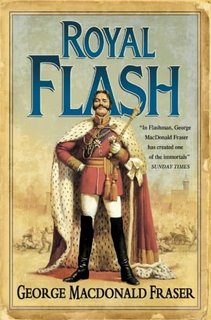 On a lighter and more humorous note, I've also recently finished Royal Flash, the second instalment of the "Flashman Papers," a series of historical novels that follow the eventful life of Harry Flashman -- war hero, raconteur, world traveler and acquaintance of kings, lords, ladies, politicians and generals. Decorated by Queen Victoria, known to the Duke of Wellington, Otto von Bismark, Robert E. Lee, and a host of other historical luminaries. Except that these papers are his personal candid memoirs: written in his eighties and not discovered until the mid-twentieth century, they reveal that Flashman was, in reality, a coward, a cad, a drunk, a womanizer and general rotter. Our hero cheerfully recounts his failings and his many escapades in which he unscrupulously stole, wheedled, lied, seduced, fled, and occasionally murdered his way through almost every major conflict and historical upheaval of the nineteenth century, and somehow managed not only to come through these rather terrifying adventures without revealing to the world his true nature, but actually comes out smelling like a rose and covered in glory.
In Royal Flash, good old Flashy gets himself embroiled in a series of German intrigues masterminded by no one less that Otto von Bismark himself. All seems bleak for our hero: but with his usual cowardly vim, he manages to flee danger whenever it rears its ugly head (though he does get caught up in some unavoidable swordplay), as well as add a few more notches to his already well-notched bedpost.
I was first turned on to these books by my friend Sean, and I have in turn gotten my father hooked. A lot remains to be read: Royal Flash is only the second book in a series now up to its twelfth instalment. That's a lot of fleeing from danger, drinking to excess and womanizing to get through ... but I'm sure our man Flash is up to it.
I guess that this is one of the small payoffs of working through my various degrees and into this job -- both of my courses this semester have reading lists assembled to a large extent based on books I love. So I have had the exquisite pleasure of immersing myself back into narratives that were deeply affecting the first read-around, and have lost nothing for their familiarity -- quite the opposite, in fact. It is like renewing acquaintances with old friends. Here's Elizabeth Bennet and Mr. Darcy in Pride and Prejudice; the screechings of Mrs. Bennet and the wry interjections of Mr. Bennet, the obsequious pomposity of Mr. Collins and the imperious absurdity of Lady Catherine DeBourgh. I felt anew a sentimental triumph when Mr. Darcy rounds on Elizabeth in frustration and declares, "You are too generous to trifle with me. If your feelings are still what they were last April, tell me so at once. My affections and wishes are unchanged, but one word from you will silence me and this subject for ever."
Too cool.
Or the surreal, nightmarish southern gothic of William Faulkner's Absalom, Absalom!, where one is never certain where the nightmare ends and the reality begins, where the doomed Quentin Compson desperately tries to unravel the tortured tapestry of his family's history and the history of the South.
The haunted scarecrow faces of the migrants in The Grapes of Wrath -- Steinbeck's sustained howl of rage at the indignities visited by humans on one another, which is yet eminently hopeful in the depiction of community and commitment.
We begin Time's Arrow next week in my first year class, speaking of howls of rage. There's novel that loses nothing upon rereading: Martin Amis' backward narrative implicitly agrees with Theodor Adorno's statement that "there can be no poetry after Auschwitz" by running time backward -- from the death of a Nazi death-camp doctor, through a baffling world in which everything runs in reverse and where the world does not make sense until we are back in the camps ... and then the Germans call down the souls of the Jews from the smoke-filled skies to be made whole in the ovens, and where for the first time the doctor appears to heal his patients rather than inflicting wounds on them and sending them back out through the doors of the emergency rooms in which he worked under assumed names in America.
This was, I think, my fifth reading of Amis' novel -- and, having finished it just this morning, I am still in the haze of shock that my first reading gave me some ten or twelve years ago.
I have also recently had my first-ever encounter with Ian McEwan in the form of his most recent novel Saturday, which follows the events in a single day in the life of a London doctor; it is February, 2003, on the eve of the invasion of Iraq and the day of the massive protest that marched through London. We follow the doctor as he runs errands and prepares for a family dinner, and are carried by his thoughts as he muses on the imminent war and the change in the world since 9/11. McEwan has a remarkable talent for depicting the mundane: though there is action and conflict at points, the most compelling parts of the novel (for me) are the quotidian details.
 On a lighter and more humorous note, I've also recently finished Royal Flash, the second instalment of the "Flashman Papers," a series of historical novels that follow the eventful life of Harry Flashman -- war hero, raconteur, world traveler and acquaintance of kings, lords, ladies, politicians and generals. Decorated by Queen Victoria, known to the Duke of Wellington, Otto von Bismark, Robert E. Lee, and a host of other historical luminaries. Except that these papers are his personal candid memoirs: written in his eighties and not discovered until the mid-twentieth century, they reveal that Flashman was, in reality, a coward, a cad, a drunk, a womanizer and general rotter. Our hero cheerfully recounts his failings and his many escapades in which he unscrupulously stole, wheedled, lied, seduced, fled, and occasionally murdered his way through almost every major conflict and historical upheaval of the nineteenth century, and somehow managed not only to come through these rather terrifying adventures without revealing to the world his true nature, but actually comes out smelling like a rose and covered in glory.
In Royal Flash, good old Flashy gets himself embroiled in a series of German intrigues masterminded by no one less that Otto von Bismark himself. All seems bleak for our hero: but with his usual cowardly vim, he manages to flee danger whenever it rears its ugly head (though he does get caught up in some unavoidable swordplay), as well as add a few more notches to his already well-notched bedpost.
I was first turned on to these books by my friend Sean, and I have in turn gotten my father hooked. A lot remains to be read: Royal Flash is only the second book in a series now up to its twelfth instalment. That's a lot of fleeing from danger, drinking to excess and womanizing to get through ... but I'm sure our man Flash is up to it.
Friday, March 17, 2006
I wear my green on the inside

Well, here we are again -- a day of tricolour scarves, wigs, green paper leprechaun hats and green beer (when everyone who knows anything knows that the true colour of Irish beer is black).
Last year in my pop culture class, I gave my students a quiz when we started our unit on advertising and consumer culture -- two quizzes, actually, each of ten questions. For the first, I put up a series of ten images of brand name logos and told the students to identify them. As you might imagine, the entire class scored ten out of ten -- and were quite pleased with themselves. The next ten images were of people and things they should know ... Pierre Trudeau, Malcolm X, a trillium, as well as a handful of flags (the point of this exercise, as you have likely guessed, was to demonstrate how instinctual recognition of brand logos has become, whereas actual honest-to-god knowledge of stuff comes a bit harder ... not that being able to recognize a photo of FDR gets you into law school or anything).
The point of this is that one of the flags I tossed up was the Irish flag -- thinking that would be a gimme. But less than one third of the class recognized it ... at which point I shook my head at them and said "OK, everyone who got it wrong has to stay home on St. Patrick's Day this year," and some hearty soul in the back row shouted out his support with a "YEAH!"
At any rate, that incident stuck with me, and I gave my students a St. Patrick's Day quiz on March 17 ... a tradition I'm maintaining this year with the following quiz.
SO -- a score of less than 8/15 and you have to stay home tonight. Honour system here, people! No consulting Wikipedia!
1. What is the capital of Ireland?
2. Name one of the original four counties of Ireland (double marks for all four).
3. Name three Irish writers who are not James Joyce or W.B. Yeats.
4. In what year did the Easter Rising take place?
5. What revolutionary leader is famous for leading a French-aided uprising on the west coast of Ireland in 1798?
6. Fill in the blanks: “If you ever go across the sea to Ireland / It may be at the closing of the day / You can sit and watch the moon rise over Claddagh / And watch the sun go down on ______________”
7. What is the name of Ireland’s mythical female incarnation?
8. What ecological catastrophe in the mid-nineteenth century caused massive emigration from Ireland and gave New York City a tradition of Irish cops?
9. What is the name of the political wing of the IRA? (double points if you also give its English translation)
10. What tasty mixture of stout and ale is also the nickname for the feared Loyalist paramilitaries that targeted Republicans between 1920-22?
11. What British parliamentarian and general is notorious for his brutal invasion of Ireland and his avowed intention to send all Catholics “To Hell or Connacht!”?
12. At what famous landmark outside of Dublin did U2 film their video for “Pride (In the Name of Love)”?
13. How do you say “Ireland” in Gaelic?
14. What was the name of the Republican splinter group that came to prominence in the late 1960s, and which is usually blamed for the “Troubles”?
15. What popular Irish proponent of Home Rule in the late 1800s fell from grace when his affair with married woman Kitty O’Shea was revealed?
Thursday, March 16, 2006
March Madness! Fredric Jameson over Stanley Fish, 102-97
I entered my first-ever basketball pool yesterday -- actually, my first-ever sports pool, period. At first, I protested that I know nothing about basketball, especially not NCAA teams. However, apparently I'm not unusual. This is an English department, after all ... not exactly what you'd call a hotbed of sports fans (outside of hockey and, since the olympics, curling). So some people have some unique methods of choosing teams. My friend Danine, for instance, is making choices based on the colours of team jerseys; someone else, on places he'd like to visit (so, Florida over Wisonsin, that sort of thing).
Me, I'm going with prominent English professors. Which schools have the big names? Well, they're taking through all the way, baby.
Indiana does well in my plan -- not so much because of profs, but I used a lot of books from Indiana University Press in my thesis, so they've got a good run. Penn State does well because they've got Michael Berube, but they come up against Duke in the Final Four, and, well, Duke's got Fredric Jameson ... on the other side of the tournament, U of Illinois gets carried to the final by Stanley Fish. It's a tight battle then between postmodern Marxism and reader-response Milton, but in the end The Jameson prevails.
At which point I will celebrate my victory in the pool with a glass of Jameson's Irish Whiskey.
Me, I'm going with prominent English professors. Which schools have the big names? Well, they're taking through all the way, baby.
Indiana does well in my plan -- not so much because of profs, but I used a lot of books from Indiana University Press in my thesis, so they've got a good run. Penn State does well because they've got Michael Berube, but they come up against Duke in the Final Four, and, well, Duke's got Fredric Jameson ... on the other side of the tournament, U of Illinois gets carried to the final by Stanley Fish. It's a tight battle then between postmodern Marxism and reader-response Milton, but in the end The Jameson prevails.
At which point I will celebrate my victory in the pool with a glass of Jameson's Irish Whiskey.
Tuesday, March 14, 2006
Cyberniece
I was doing some work in the office on Sunday, and my brother messaged me ... and treated me to this image on his webcam:

Not as good as being there, obviously, but still enough for some serious entertainment. She does love to bounce in that device.
Friday, March 10, 2006
I have nothing to do, and it weirds me out
I have nothing to do right now. It's very strange. I have inadvertently contrived to arrive at about an hour and a half of non-activity, and it's giving me something like existential vertigo. I just handed back student essays and have completed the tasks most immediately at hand ... and in an hour and a half I'm delivering a paper for our ongoing departmental colloquium. I suppose I could rehearse it, but then I've already done that a few times and don't want to over-rehearse.
Very strange feeling, especially after a week of coming in early and working late -- working on, among other things, this very paper.
Nothing to do.
So it occurs to me that it's been a while since my last Morgan update:
Very strange feeling, especially after a week of coming in early and working late -- working on, among other things, this very paper.
Nothing to do.
So it occurs to me that it's been a while since my last Morgan update:


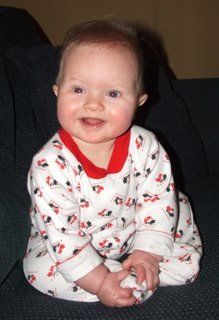
Ain't she sweet? I think my favourite is the serious concentration she displays in trying to chew through her toy (sort of eerily reminscent of my brother trying to gnaw through a chicken wing after seven or eight beers), but I do rather love the Team Canada jammies. If my niece isn't the next Cassie Campbell, it won't be because of a lack of exposure to hockey paraphernalia in her formative years.
OK, I guess I'll look over my paper one more time: "Weapons, the Masses, and Destruction." Good or bad, I think I have a definite talent for titles. And between the film clip I'm showing and the slide show of shiny explosions, I think I can distract from any suckiness that might be present in the paper. Give 'em the old razzle-dazzle, that's my motto.
Wednesday, March 08, 2006
A morning complaint
I'd like to meet the person who's responsible for deciding that radio morning shows should involve a lot of talk, inane contests, manic hosts, and a lot of bad jokes rather than music conducive to waking up. Yes, I'd like to meet that person. And then I'd like to punch him in the face.
The breaking point came this morning as I was waiting on a left hand turn, when the guy talking (I won't grace him with the title of "DJ") made a joke about Billy Ray Cyrus getting on the gay cowboy bandwagon with a new song "Brokey-Backy Heart."
And as if that wasn't bad enough, he sang it.
Why can't morning DJs just play music? And if they must talk, instead of acting as if we lived in a ritalin-free world, why can't they be briefly comiserative of the fact that everyone's tired and in need of coffee, and then continue with the music?
Anyone remember the episode of WKRP in Cincinnati when Johnny Fever had left the station for another job and come back, but his regular slot had been filled so they gave him the 1-5am slot? And he spoke in dull, fatigued tones and went by the air-name "Heavy Early"? That's my ideal morning DJ -- someone who'll just accept that we're all still half asleep and greatly irritated by manic men-children who think crank calls and topical song parodies are the height of human wit, and who'll just play another fucking song.
So ends another brief foray into commercial radio. Back to CBC for me.
The breaking point came this morning as I was waiting on a left hand turn, when the guy talking (I won't grace him with the title of "DJ") made a joke about Billy Ray Cyrus getting on the gay cowboy bandwagon with a new song "Brokey-Backy Heart."
And as if that wasn't bad enough, he sang it.
Why can't morning DJs just play music? And if they must talk, instead of acting as if we lived in a ritalin-free world, why can't they be briefly comiserative of the fact that everyone's tired and in need of coffee, and then continue with the music?
Anyone remember the episode of WKRP in Cincinnati when Johnny Fever had left the station for another job and come back, but his regular slot had been filled so they gave him the 1-5am slot? And he spoke in dull, fatigued tones and went by the air-name "Heavy Early"? That's my ideal morning DJ -- someone who'll just accept that we're all still half asleep and greatly irritated by manic men-children who think crank calls and topical song parodies are the height of human wit, and who'll just play another fucking song.
So ends another brief foray into commercial radio. Back to CBC for me.
Saturday, March 04, 2006
I love living in Nifindlind!
OK, so to begin with: Larry King is a fucking moron. I'm sure we all knew this in some capacity or another, but tonight more or less sealed the deal. I would think that at the very least we should expect of veteran newscasters that they should be able to master basic pronounciation: "ou" is not pronounced as a short "i", nor is "a" -- ever! Now, I have been coached on the vagaries of how you say "Newfoundland," and spent many conversations correcting my mother when she said NewFOUNDland, and was myself chastised by a friend and colleague to pronounce the province's name along the same vowel sounds and cadence as UNDERSTAND. But it takes a particularly idiotic idiom to name the province as Larry King did this evening.
Of course, that only set the stage.
You know, when I was in grade two, seven or eight years of age, I saw images of cruel hunters clubbing cute baby seals and was outraged. I organized a protest and petition -- which did not reach outside my second grade classroom, but then I did not have quite the same professional connections I have today. Still, I was absolutely outraged at the sight of baby seals being killed, and absolutely earnest in my attempts to mobilize my fellow eight-year-olds.
I was eight years old. So what's Sir Paul McCartney's excuse for imbecillity?
Honestly, the man needs to get a job. And to divorce his idiot wife, who makes Yoko Ono look like a Rhodes Scholar by comparison.
I just finished watching, as many of you will have gleaned, Sir Paul's interview on Larry King Live vis a vis the seal hunt. To which our eminent Premier Mr. Danny Williams was the rebuttal witness. Sir Paul and his wife hoped that, in "bringing this amount of attention" to this event, they might bring pressure to bear on the Canadian government to end the seal hunt.
First: Heather, Sir Paul's wife, said of our new prime minister that "We've heard he's a very compassionate man." Um, OK. Seriously? Who told you that? I fear you are the object of a nasty hoax here, Heather ... I'm rather certain that the only reason Stephen Harper isn't out there clubbing baby seals himself is (a) his suddenly busy schedule, and (b) it would be a really bad photo op. He'll have to satisfy himself with strangling puppies at 24 Sussex. Off camera, of course.
Second: Heather is now officially the queen of hyperbole. She compared the seal hunt to, among other things, the killing of her own baby. Which in and of itself itself would be an excusably, if egregious, comparison, if she hadn't then attacked NL Premier Danny Williams for his entirely reasonable question to the McCartneys: i.e., you're attacking one form of subistence hunting, why aren't you making the same crusade against the hunting of white tail deer, of caribou, of the wholesale slaughter of cattle, pigs, and poultry? To which Lady Heather responded (again and again) that Danny what changing the subject.
No, you stupid bint, he really wasn't. He was raising the very real and relevant question of why you think baby seals are worth defending, and baby cows are not.
As ambivalent to my premier as I am, I have to say that he made a good show of it. He was measured and reasonable in the face of what was, for lack of a better word, a pretty damn shrill and strident opposition. Living in Newfoundland for all of seven months has made me aware of a number of issues facing this province, the whole seal hunt thing among them. And I've come to realize, much to the chagrin of my eight-year-old self, that the killing of baby seals constitutes a small fraction of the hunt -- smaller now then it was several decades ago, and ever shrinking. For those who watched the CNN special tonight: there was not a single clip of hunters clubbing baby seals. They were plying their brutal trade among the adults -- the reason being that the key point of the hunt is not the superciliousness of fur but the necessity of food. We're not talking about the selling of pelts to fashionistas in Milan, we're talking abour Flipper Pie -- a Newfie delicacy I have yet to partake of. We're talking about what happens in the fishing inudstry off season.
(As an aside: the premier of our province was interviewed tonight on American TV, and Larry King called him "Danny," as opposed to "Mr. Premier." Now, I can imagine that this was likely a strategy of Danny's media people, or possibly Danny himself, in the interests of maintaining his folksy persona, but I ask you: on CNN, is this how we want to play cricket? Dammit, he should have been "Mr. Premier").
I should point out: I'm hardly a candidate to go out on the floes clubbing seals, but I do recognize that our relatiomship with the natural world is way too complicated to let everything be. One of Danny's (Mr. Premier's) points is that the seal population has tripled in the last decade or so ... leaving them be would mean they would exterminate themselves as they depleted their food sources. Which brings us back to the observation that before Sir Paul and Lady Heather go after the seal hunt, they should perhaps protest hunts of deer designed to cull a population already artifically maintained by a human presence.
In the end, what I find most ironic about this affair is that the original excusion Sir Paul and Lady Heather took to find a photogenic seal cub took longer than expected because there were very few ice floes on which a helicopter could alight. That's right: the ice floes were few and far between this year. Hmm. Perhaps, rather than baby seals, do you not think there is a greater issue to throw your celebrity behind, Sir Paul? Global warming, perhaps?
Of course, that only set the stage.
You know, when I was in grade two, seven or eight years of age, I saw images of cruel hunters clubbing cute baby seals and was outraged. I organized a protest and petition -- which did not reach outside my second grade classroom, but then I did not have quite the same professional connections I have today. Still, I was absolutely outraged at the sight of baby seals being killed, and absolutely earnest in my attempts to mobilize my fellow eight-year-olds.
I was eight years old. So what's Sir Paul McCartney's excuse for imbecillity?
Honestly, the man needs to get a job. And to divorce his idiot wife, who makes Yoko Ono look like a Rhodes Scholar by comparison.
I just finished watching, as many of you will have gleaned, Sir Paul's interview on Larry King Live vis a vis the seal hunt. To which our eminent Premier Mr. Danny Williams was the rebuttal witness. Sir Paul and his wife hoped that, in "bringing this amount of attention" to this event, they might bring pressure to bear on the Canadian government to end the seal hunt.
First: Heather, Sir Paul's wife, said of our new prime minister that "We've heard he's a very compassionate man." Um, OK. Seriously? Who told you that? I fear you are the object of a nasty hoax here, Heather ... I'm rather certain that the only reason Stephen Harper isn't out there clubbing baby seals himself is (a) his suddenly busy schedule, and (b) it would be a really bad photo op. He'll have to satisfy himself with strangling puppies at 24 Sussex. Off camera, of course.
Second: Heather is now officially the queen of hyperbole. She compared the seal hunt to, among other things, the killing of her own baby. Which in and of itself itself would be an excusably, if egregious, comparison, if she hadn't then attacked NL Premier Danny Williams for his entirely reasonable question to the McCartneys: i.e., you're attacking one form of subistence hunting, why aren't you making the same crusade against the hunting of white tail deer, of caribou, of the wholesale slaughter of cattle, pigs, and poultry? To which Lady Heather responded (again and again) that Danny what changing the subject.
No, you stupid bint, he really wasn't. He was raising the very real and relevant question of why you think baby seals are worth defending, and baby cows are not.
As ambivalent to my premier as I am, I have to say that he made a good show of it. He was measured and reasonable in the face of what was, for lack of a better word, a pretty damn shrill and strident opposition. Living in Newfoundland for all of seven months has made me aware of a number of issues facing this province, the whole seal hunt thing among them. And I've come to realize, much to the chagrin of my eight-year-old self, that the killing of baby seals constitutes a small fraction of the hunt -- smaller now then it was several decades ago, and ever shrinking. For those who watched the CNN special tonight: there was not a single clip of hunters clubbing baby seals. They were plying their brutal trade among the adults -- the reason being that the key point of the hunt is not the superciliousness of fur but the necessity of food. We're not talking about the selling of pelts to fashionistas in Milan, we're talking abour Flipper Pie -- a Newfie delicacy I have yet to partake of. We're talking about what happens in the fishing inudstry off season.
(As an aside: the premier of our province was interviewed tonight on American TV, and Larry King called him "Danny," as opposed to "Mr. Premier." Now, I can imagine that this was likely a strategy of Danny's media people, or possibly Danny himself, in the interests of maintaining his folksy persona, but I ask you: on CNN, is this how we want to play cricket? Dammit, he should have been "Mr. Premier").
I should point out: I'm hardly a candidate to go out on the floes clubbing seals, but I do recognize that our relatiomship with the natural world is way too complicated to let everything be. One of Danny's (Mr. Premier's) points is that the seal population has tripled in the last decade or so ... leaving them be would mean they would exterminate themselves as they depleted their food sources. Which brings us back to the observation that before Sir Paul and Lady Heather go after the seal hunt, they should perhaps protest hunts of deer designed to cull a population already artifically maintained by a human presence.
In the end, what I find most ironic about this affair is that the original excusion Sir Paul and Lady Heather took to find a photogenic seal cub took longer than expected because there were very few ice floes on which a helicopter could alight. That's right: the ice floes were few and far between this year. Hmm. Perhaps, rather than baby seals, do you not think there is a greater issue to throw your celebrity behind, Sir Paul? Global warming, perhaps?
Tuesday, February 28, 2006
Back again
Well, long time, no blog ... Kristen was here in St. John's all last week, and ended up staying two days longer courtesy of a "record-breaking" blizzard on Saturday.


This of course is the aftermath ... I wish I'd been able to get some pictures of the actual storm itself -- not that you'd be able to see anything.
Sunday morning was the impressive part. Kristen and I ventured downtown at eleven in the morning, not entirely expecting to find anything open, and discovered a city like an anthill. Everything had been effectively dug out, from sidewalks to storefronts.
I'm becoming inured to these winter storms. This time around, it barely made an impact on me. I suppose that's a good thing.
Anyway ... reading week is over and Kristen is gone, and I'm getting back to the real world and the stack of work I spent last week assiduously avoiding. Sigh.
Thursday, February 16, 2006
The Kristen countdown
Until my beautiful girlfriend arrives for a week-long visit?
At time of posting, 41 hours.
Gonna be a long day tomorrow.
At time of posting, 41 hours.
Gonna be a long day tomorrow.
Tuesday, February 14, 2006
Can't you just feel the love?
Some events that have unfolded on this day in history:
1670 - Roman Catholic emperor Leopold I chases Jews out of Vienna
1779 - Captain James Cook murdered by natives of Hawaii during his third visit to the Pacific island group
1899 - Voting machines are approved by the U.S. Congress for use in federal elections.
1913 – Jimmy Hoffa born.
1924 - IBM corporation founded.
1929 - St. Valentine's Day Massacre: Seven gangster rivals of Al Capone are murdered in Chicago, Illinois.
1943 – General Erwin Rommel defeats American forces at the Battle of the Kasserine Pass in North Africa
1945 - Bombing of Dresden begins
1945 - President Franklin D. Roosevelt meets with King Ibn Saud of Saudi Arabia aboard the USS Quincy, officially starting the US-Saudi diplomatic relationship.
1962 – President John F. Kennedy authorizes American advisors in Vietnam to return fire if fired upon.
1971 - Richard Nixon installs secret taping system in White House.
1989 - Ayatollah Khomeini issues a fatwa encouraging Muslims to kill Salman Rushdie.
1995 - Roseanne weds bodyguard Ben Thomas (the horror—the horror!).
2003 - Dolly the sheep, the first cloned mammal, was euthanized because of incurable lung cancer.
Happy Valentine’s Day, everyone!
1670 - Roman Catholic emperor Leopold I chases Jews out of Vienna
1779 - Captain James Cook murdered by natives of Hawaii during his third visit to the Pacific island group
1899 - Voting machines are approved by the U.S. Congress for use in federal elections.
1913 – Jimmy Hoffa born.
1924 - IBM corporation founded.
1929 - St. Valentine's Day Massacre: Seven gangster rivals of Al Capone are murdered in Chicago, Illinois.
1943 – General Erwin Rommel defeats American forces at the Battle of the Kasserine Pass in North Africa
1945 - Bombing of Dresden begins
1945 - President Franklin D. Roosevelt meets with King Ibn Saud of Saudi Arabia aboard the USS Quincy, officially starting the US-Saudi diplomatic relationship.
1962 – President John F. Kennedy authorizes American advisors in Vietnam to return fire if fired upon.
1971 - Richard Nixon installs secret taping system in White House.
1989 - Ayatollah Khomeini issues a fatwa encouraging Muslims to kill Salman Rushdie.
1995 - Roseanne weds bodyguard Ben Thomas (the horror—the horror!).
2003 - Dolly the sheep, the first cloned mammal, was euthanized because of incurable lung cancer.
Happy Valentine’s Day, everyone!
Saturday, February 11, 2006
Again with the snow ...
Yesterday evening was fun. And by "fun" I mean, well, actually the opposite. Anti-fun. Not as bad a root canal ... well, really nowhere close to root canal, given that I didn't actually suffer any pain, but still kind of annoying. Laced with moments of terror. OK, not so much terror as overweening impatience with the weather.
You get the idea.
It was a repeat of last week's snow day, except that this time it really looked like I might not make it up the hill on the way home. There were a number of tense moments sitting with my foot on the gas while my car, rather than moving forward, sort of meandered vaguely sideways. I had no traction. None. I was reduced to trying to match up my tired with the tracks left by the car ahead of me (which was in similar straits) in the hopes that the spinning of his wheels had excavated some pavement on which my tires might find some purchase. Ack.
The hill on the way home wasn't the most annoying bit however -- that awaited me on arriving home, in trying to enter my building's parking lot. There is a sharp incline at the entrance ... and try as I may, there was nothing happening. It was only a passing stranger who offered to a push that allowed me finally to make it in.
On the plus side, my car seemed to have escaped the snow fence effect this time around -- some cars on the other side of my lot were afflicted. One in particular.
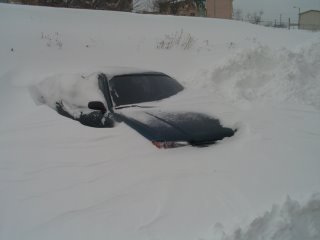
You get the idea.
It was a repeat of last week's snow day, except that this time it really looked like I might not make it up the hill on the way home. There were a number of tense moments sitting with my foot on the gas while my car, rather than moving forward, sort of meandered vaguely sideways. I had no traction. None. I was reduced to trying to match up my tired with the tracks left by the car ahead of me (which was in similar straits) in the hopes that the spinning of his wheels had excavated some pavement on which my tires might find some purchase. Ack.
The hill on the way home wasn't the most annoying bit however -- that awaited me on arriving home, in trying to enter my building's parking lot. There is a sharp incline at the entrance ... and try as I may, there was nothing happening. It was only a passing stranger who offered to a push that allowed me finally to make it in.
On the plus side, my car seemed to have escaped the snow fence effect this time around -- some cars on the other side of my lot were afflicted. One in particular.
Ouch.
Friday, February 10, 2006
Running music redux
Back in September, I posted about my favourite music to run to ... Lately I've been playing with iTunes and downloading some new music and tweaking my playlists. And while the original list still stands, I have some additions.
Actually, this was largely inspired one of of the comments left by former student Brian -- who commented that his favourite running song was "Kickstart My Heart" by Motley Crue ... and what do you know? I downloaded it from iTunes two weeks ago and damn me if it isn't something to put some spring back in the step halfway into the run. Thanks for that, Brian dude.
And the rest of the new additions?
Beastie Boys -- No Sleep Till Brooklyn
Joan Jett -- Let's Do It (from the Tank Girl soundtrack)
Wise Up, Sucker -- Pop Will Eat Itself
Wake Up -- Arcade Fire
Two Tribes -- Frankie Goes to Hollywood
Saturday Night -- Bay City Rollers
OK, was that snickers I heard in the back there at the last entry?? Don't be dissing the Rollers, baby. First, the song has the perfect cadence for running. Second, it gives me fond memories of So I Married an Axe Murderer. Third, it give me fond memories of my brother's wedding reception, when The Laura requested it in honour of my father, who was wearing his dress kilt for the occasion.
You know, I really must post pictures some time of my dad in his kilt.
Actually, this was largely inspired one of of the comments left by former student Brian -- who commented that his favourite running song was "Kickstart My Heart" by Motley Crue ... and what do you know? I downloaded it from iTunes two weeks ago and damn me if it isn't something to put some spring back in the step halfway into the run. Thanks for that, Brian dude.
And the rest of the new additions?
Beastie Boys -- No Sleep Till Brooklyn
Joan Jett -- Let's Do It (from the Tank Girl soundtrack)
Wise Up, Sucker -- Pop Will Eat Itself
Wake Up -- Arcade Fire
Two Tribes -- Frankie Goes to Hollywood
Saturday Night -- Bay City Rollers
OK, was that snickers I heard in the back there at the last entry?? Don't be dissing the Rollers, baby. First, the song has the perfect cadence for running. Second, it gives me fond memories of So I Married an Axe Murderer. Third, it give me fond memories of my brother's wedding reception, when The Laura requested it in honour of my father, who was wearing his dress kilt for the occasion.
You know, I really must post pictures some time of my dad in his kilt.
Thursday, February 09, 2006
Random thoughts and observations
I've started using my Starbucks travel mug to bring my second cup of coffee in the mornings to work with me, and I can say definitively: there is a qualitative difference in the taste of the coffee in my apartment, in my car, and in my office.
I think that if he really worked at it, I mean really put his shoulder into it, Pat Robertson could quite possibly be a bigger jackass. There's unexplored territory there.
"Heuristic" is my new favourite word, simply because when asked to define it I get to talk about Maxwell's Demon.
I am approaching the point where I can carry on a conversation in MSN Messenger entirely in emoticons.
Now that Sawyer on Lost is bad again, the show is in serious jeopardy of becoming like 90210, i.e. characters will alternate between good and evil depending on the ratings and the unimaginativeness of the writers.
Dominic Monaghan on Lost; Sean Astin on 24; we need to have Billy Boyd and Elijah Wood to turn up on their own TV series, and then put all the shows on the same night for an all-hobbit lineup.
I think there's a house at the top of the hill I drive down on the way to work that burns tires in its fireplace. The past three mornings I have smelled burned rubber as I drive through that area and gotten paranoid that my car's engine is about to explode.
I've been eating a lot of soup lately.
In the last seventy-two hours, I have had two songs stuck in my head, and they're taking turns driving me insane: "Hollaback Girl" and the theme song to The Gilmore Girls. I wouldn't have thought anything could be worse than Britney Spears for this sort of thing, but here we are.
Someone at CBC Radio Two is overly fond of organ music in the middle of the day.
I think that if he really worked at it, I mean really put his shoulder into it, Pat Robertson could quite possibly be a bigger jackass. There's unexplored territory there.
"Heuristic" is my new favourite word, simply because when asked to define it I get to talk about Maxwell's Demon.
I am approaching the point where I can carry on a conversation in MSN Messenger entirely in emoticons.
Now that Sawyer on Lost is bad again, the show is in serious jeopardy of becoming like 90210, i.e. characters will alternate between good and evil depending on the ratings and the unimaginativeness of the writers.
Dominic Monaghan on Lost; Sean Astin on 24; we need to have Billy Boyd and Elijah Wood to turn up on their own TV series, and then put all the shows on the same night for an all-hobbit lineup.
I think there's a house at the top of the hill I drive down on the way to work that burns tires in its fireplace. The past three mornings I have smelled burned rubber as I drive through that area and gotten paranoid that my car's engine is about to explode.
I've been eating a lot of soup lately.
In the last seventy-two hours, I have had two songs stuck in my head, and they're taking turns driving me insane: "Hollaback Girl" and the theme song to The Gilmore Girls. I wouldn't have thought anything could be worse than Britney Spears for this sort of thing, but here we are.
Someone at CBC Radio Two is overly fond of organ music in the middle of the day.
Friday, February 03, 2006
After the flood, all of the colours came out
 This picture doesn't quite feel like it does justice to the task of digging my car out yesterday, during which I was quite seriously thinking to myself, "I don't need my car -- I can just wait until spring."
What is perhaps most aggravating however is the fact that I seem to be the only car (besides the poor guy in the spot next to me) with quite this level of snow to deal with -- all the cars on the north side of my lot are far less buried. I'm guessing being in the lee of the building is my problem here. Damn you, snow fence effect! Damn you to hell!
Ahem.
Anyway, as promised, a few pics in the post-blizzard St. John's -- which, given my porous memory (i.e. I forgot to take the camera with me downtown yesterday), are all from my drive up to campus today.
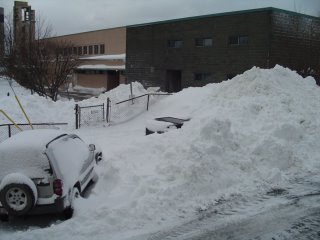
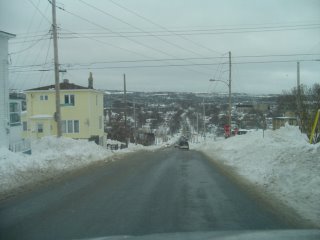
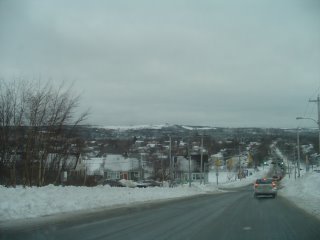
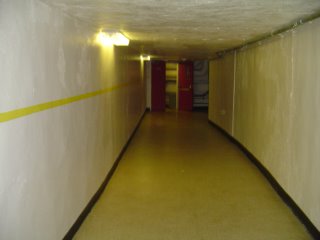
Also, a picture of one of the many tunnels running underneath MUN campus. Now, seriously, tell me: wouldn't this be such a cool setting for a horror film? I'll have to get some pics soon of one of the pedways on a foggy evening for full effect ...
Plus, interesting thing I noticed today: when I use the tunnels to get from the parking lot to my office, I have to go through the music building. Immediately inside the main door to the music building are a series of portraits of former deans of music. And guess what? Jesus Christ was Dean of Music here! Seriously, check it out:
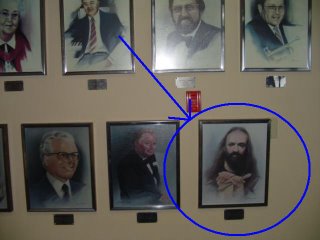
You know, that's what I love about the guy. Most people, in his position, would use that family connection to score themselves some distinguished chair of something or other at Princeton or Cambridge, where they would be paid more money than Dad to teach one half grad course every three years. But not the Man -- no, he works honestly. WWJD? He'd work at MUN, baby.
Thursday, February 02, 2006
Ain't nothing seeing its shadow out there today
 We have officially reached "Holy crap" as far as the weather here goes. When I left home for work yesterday at about quarter after seven, there was the lightest dusting of snow and no wind; by the time I reached campus, the wind was howling and there was significantly more so; about an hour into the day I couldn't see more than a few meters out of my office window.
They closed the university at one o'clock. I toyed with the idea of sticking around to get work done in the absence of classes, but thought better of it -- and a good thing too! The snow was up to my car's wheel wells on the slow, dodgy drive home. And then I got stuck in a small drift getting into my parking lot, and my parking spot was kind of full. Fortunately there's communal shovel just inside one of the side entrances to my building.
It's the one time of the year I see the appeal of SUVs. Though I must say: experts on the subject have frequently commented that the extra safety afforded by SUVs is often offset by the sense of invulnerability drivers feel when behind the wheel of those tanks, something I saw no fewer than three times on the drive home: SUVs taking corners like it was a mild summer day nearly plowed into (1) a fence, (2) a pair of people forced by the blocked sidewalks to walk on the side of the road, and (3) ME.
Not amusing.
As much as I would like to coccoon in here today, there are some unavoidable errands to run. So I was just outside digging out my car for the last forty-five minutes ... which means my jeans are in the dryer for the second time in twenty-four hours.
I considered running in to grab my camera to document the digging-out process, but I was too busy considering varieties of suicide that would be warm and dry.
I do need to go out shortly though ... I shall take some pics around town for the smug amusement of all those enjoying above-zero weather and green grass in Ontario.
Sunday, January 29, 2006
34 years + 1 day
Though I suppose I am now technically in my mid-thirties, I refuse to acknowledge that until I turn thirty-five ... at which point I will be in my mid-thirties until I turn forty.
Thirty-four still counts as early thirties, right?
I unfortunately find myself in a profession in which admitting to only twenty-nine has its drawbacks, seeing as how a certain amount of experience is assumed, and that makes a too-young professor a bit suspect. So I'm thinking if I'm going to freeze my age, thirty-one might be the best bet.
Thirty-four. Get outta here. I can't have been around that long. Of course, when I interact with my students, that's a generation gap that invariably makes me feel old. I get very amused when speaking to former students, now in the last year of their degree or just finished, who speak in exasperated tones about how "young" the first-years they meet seem to them.
Ha. I'm not that far away from being, reasonably speaking, old enough to be my students' father. I think when that realization seeps through you can find me down at a local pub well into my seventh pint.
Not yet though. Still only early thirties.
Thirty-four still counts as early thirties, right?
I unfortunately find myself in a profession in which admitting to only twenty-nine has its drawbacks, seeing as how a certain amount of experience is assumed, and that makes a too-young professor a bit suspect. So I'm thinking if I'm going to freeze my age, thirty-one might be the best bet.
Thirty-four. Get outta here. I can't have been around that long. Of course, when I interact with my students, that's a generation gap that invariably makes me feel old. I get very amused when speaking to former students, now in the last year of their degree or just finished, who speak in exasperated tones about how "young" the first-years they meet seem to them.
Ha. I'm not that far away from being, reasonably speaking, old enough to be my students' father. I think when that realization seeps through you can find me down at a local pub well into my seventh pint.
Not yet though. Still only early thirties.
Friday, January 27, 2006
Good night, and good luck
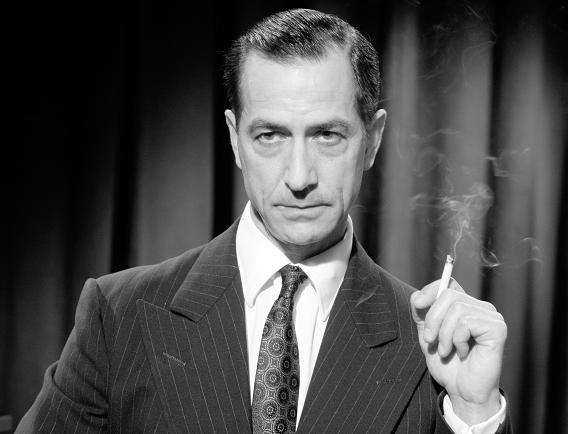
I went last night to see Good Night, And Good Luck, George Clooney's extraordinary film about Edward R. Murrow's fight against Senator Joseph McCarthy. The film begins and ends with an address Murrow made to colleague in the broadcasting industry five years after McCarthy was finally brought down. A few lines from that speech really resonated with me: "This instrument can teach, it can illuminate; yes, it can even inspire. But it can only do so to an extent that humans are determined to use it to those ends. Otherwise it is merely wires and lights in a box."
I love this passage because it expresses a fundamental frustration I have with television's 24/7 crap-a-thon, or rather for the justification programmers give: "Hey, we're only giving the people what they want." I think this is defeatist and condescending. Underselling the intelligence of audiences becomes a self-fulfilling prophecy.
Murrow addresses this sentiment, having suggested that "exposure to ideas and the bringing of reality into the homes of the nation," far from being an exercise in futility, would find far more traction with the viewing public than many believe: "To those who say people wouldn't look; they wouldn't be interested; they're too complacent, indifferent and insulated, I can only replay: There is, in one reporter's opinion, considerable evidence against that contention. But even if they are right, what have they got to lose? Because if they are right, and this instrument is good for nothing but to entertain, amuse and insulate, then the tube is flickering now and we will soon see that the whole struggle is lost."
Sing it, Ed.
Wednesday, January 25, 2006
och, ya wee, sleekit, cow'rin, tim'rous beasties!
ADDRESS TO A HAGGIS
by Robert Burns, Scotsman

Fair fa' your honest, sonsie face,
Great chieftain o' the puddin-race!
Aboon them a' ye tak your place,
Painch, tripe, or thairm:
Weel are ye wordy of a grace
As lang's my arm.
The groaning trencher there ye fill,
Your hurdies like a distant hill,
Your pin wad help to mend a mill
In time o' need,
While thro' your pores the dews distil
Like amber bead.
His knife see rustic Labour dight,
An' cut ye up wi' ready slight,
Trenching your gushing entrails bright
Like onie ditch;
And then, O what a glorious sight,
Warm-reekin, rich!
Then, horn for horn, they strech an' strive:
Deil tak the hindmost! on they drive,
Till a' their weel-swall'd kytes belyve,
Are bent like drums;
Then auld Guidman, maist like to rive,
'Bethankit!' hums.
Is there that owre his French ragout
Or olio that wad staw a sow,
Or fricassee wad mak her spew
Wi' perfect sconner,
Looks down wi' sneering, scornfu' view
On sic a dinner?
Poor devil! see him owre his trash,
As feckless as a wither'd rash,
His spindle shank, a guid whip-lash,
His nieve a nit;
Thro' bluidy flood or field to dash,
O how unfit!
But mark the Rustic, haggis-fed,
The trembling earth resounds his tread.
Clap in his walie nieve a blade,
He'll make it whissle;
An' legs, an' arms, an' heads will sned,
Like taps o' thrissle.
Ye Pow'rs wha mak mankind your care,
And dish them out their bill o 'fare,
Auld Scotland wants nae skinking ware
That jaups in luggies;
But, if ye wish her gratefu' prayer,
Gie her a Haggis!
Happy Robbie Burns Day, everyone.
Slainte!

by Robert Burns, Scotsman
Fair fa' your honest, sonsie face,
Great chieftain o' the puddin-race!
Aboon them a' ye tak your place,
Painch, tripe, or thairm:
Weel are ye wordy of a grace
As lang's my arm.
The groaning trencher there ye fill,
Your hurdies like a distant hill,
Your pin wad help to mend a mill
In time o' need,
While thro' your pores the dews distil
Like amber bead.
His knife see rustic Labour dight,
An' cut ye up wi' ready slight,
Trenching your gushing entrails bright
Like onie ditch;
And then, O what a glorious sight,
Warm-reekin, rich!
Then, horn for horn, they strech an' strive:
Deil tak the hindmost! on they drive,
Till a' their weel-swall'd kytes belyve,
Are bent like drums;
Then auld Guidman, maist like to rive,
'Bethankit!' hums.
Is there that owre his French ragout
Or olio that wad staw a sow,
Or fricassee wad mak her spew
Wi' perfect sconner,
Looks down wi' sneering, scornfu' view
On sic a dinner?
Poor devil! see him owre his trash,
As feckless as a wither'd rash,
His spindle shank, a guid whip-lash,
His nieve a nit;
Thro' bluidy flood or field to dash,
O how unfit!
But mark the Rustic, haggis-fed,
The trembling earth resounds his tread.
Clap in his walie nieve a blade,
He'll make it whissle;
An' legs, an' arms, an' heads will sned,
Like taps o' thrissle.
Ye Pow'rs wha mak mankind your care,
And dish them out their bill o 'fare,
Auld Scotland wants nae skinking ware
That jaups in luggies;
But, if ye wish her gratefu' prayer,
Gie her a Haggis!
Happy Robbie Burns Day, everyone.
Slainte!
Tuesday, January 24, 2006
O brave new world, that has such weenies in't!
So I woke up this morning feeling arrogantly self-righteous, disdainful of the unemployed, and vaguely hostile toward my gay friends.
Plus, I had really bad hair.
Can't put my finger on it. Something in the air? Something in the water?
Plus, I had really bad hair.
Can't put my finger on it. Something in the air? Something in the water?
Friday, January 20, 2006
Life in the tunnels
Finally, after a semester and change here at MUN, I'm starting to avail myself on a regular basis of the rather intricate series of above- and below-ground tunnels that interlace the campus. They're actually rather impressive: you can pretty much get anywhere on campus without ever having to venture outside. Western could learn a thing or two, and finally develop the tunnel I always wanted there -- the one that would have gone directly from my office to the Grad Club. Alas that that was never to be, but maybe others may benefit from it in the future. Get on that, would you Davenport?
The above-ground tunnels, or "pedways," are particularly cool; made mostly of glass, they offer a great view of the campus as you make your transit, and they often cross roads and streets, so you get to look down on traffic in various crappy weather. Last week I was crossing from the track to the gym on a particularly foggy evening, which had cloaked everything in an eerie haze. It put me in the mind of atmospheric horror films; it occurred to me that you could make a pretty creepy movie about a group of people trapped on a campus by some sort of monstrous incursion (to make it a film to really freak me out, it would ideally be zombies on the outside), in which the main characters would have successfully barricaded themselves in one building, but of course have no food or supplies ... and so have to make forays out into the tunnels to see if they can make their way to the kitchens &c out at the student center.
You'd have to set it on an American campus if you wanted access to guns. Or I suppose you could have one of the forays be to the police center where they'd break into the gun locker. But I think it would be entirely more scary if the characters would only have clubs and hockey sticks.
Of course, this sort of thing has been done (Aliens or Dawn of the Dead, anyone?). Still, every time it gets dark and foggy here I imagine this will make its creepy way into my mind.
The above-ground tunnels, or "pedways," are particularly cool; made mostly of glass, they offer a great view of the campus as you make your transit, and they often cross roads and streets, so you get to look down on traffic in various crappy weather. Last week I was crossing from the track to the gym on a particularly foggy evening, which had cloaked everything in an eerie haze. It put me in the mind of atmospheric horror films; it occurred to me that you could make a pretty creepy movie about a group of people trapped on a campus by some sort of monstrous incursion (to make it a film to really freak me out, it would ideally be zombies on the outside), in which the main characters would have successfully barricaded themselves in one building, but of course have no food or supplies ... and so have to make forays out into the tunnels to see if they can make their way to the kitchens &c out at the student center.
You'd have to set it on an American campus if you wanted access to guns. Or I suppose you could have one of the forays be to the police center where they'd break into the gun locker. But I think it would be entirely more scary if the characters would only have clubs and hockey sticks.
Of course, this sort of thing has been done (Aliens or Dawn of the Dead, anyone?). Still, every time it gets dark and foggy here I imagine this will make its creepy way into my mind.
Friday, January 13, 2006
First sentences
There's a running joke among English professors, of the (hypothetical!) class you have not only not prepared for, you haven't even read the text in question. The solution? "We can learn a lot from a close reading of this novel's opening paragraph ..."
All joking aside though, I do rather love looking at opening sentences. In my first-year course this week, that's what we're doing -- looking at a selection of opening passages from a variety of novels and considering how the tone and voice set the stage for the story to come.
Gabriel Garcia Marquez is a master of the opening sentence:
"Many years later, as he faced the firing squad, Colonel Aureliano Buendía was to remember that distant afternoon when his father took him to discover ice."
"On the day they were going to kill him, Santiago Nasar got up at five-thirty in the morning to wait for the boat the bishop was coming on."
"Over the weekend the vultures got into the presidential palace by pecking through screens on the balcony and the flapping of their wings stirred up the stagnant time inside, and at dawn on Monday the city awoke out of its lethargy of centuries with the warm, soft breeze of a great man dead and rotting grandeur."
A great opening sentence is one you can roll over in your mouth like a slowly melting candy. They are even better upon returning to them after having read the book in question: seeing the groundwork they lay, appreciating what the author is doing right out of the gate. Some of my favourites:
"He speaks in your voice, American, and there's a shine in his eye that's halfway hopeful."
"With a single drop of ink for a mirror, the Egyptian sorcerer undertakes to reveal to any chance comer far–reaching visions of the past."
"You are about to begin reading Italo Calvino's new novel, If on a winter's night a traveler."
"One summer afternoon Mrs. Oedipa Maas came home from a Tupperware party whose hostess had put perhaps too much kirsch in the fondue to find that she, Oedipa, had been named executor, or she supposed executrix, of the estate of one Pierce Inverarity, a California real estate mogul who had once lost two million dollars in his spare time but still had assets numerous and tangled enough to make the job sorting it out more than honorary."
Then of course, there are the classics:
"It is a truth universally acknowledged, that a single man in possession of a good fortune, must be in want of a wife."
"Once upon a time and a very good time it was there was a moocow coming down along the road and this moocow that was coming down along the road met a nicens little boy named baby tuckoo."
"Call me Ishmael."
Or the simple and chilling:
"They shoot the white girl first."
Or the comical:
All joking aside though, I do rather love looking at opening sentences. In my first-year course this week, that's what we're doing -- looking at a selection of opening passages from a variety of novels and considering how the tone and voice set the stage for the story to come.
Gabriel Garcia Marquez is a master of the opening sentence:
"Many years later, as he faced the firing squad, Colonel Aureliano Buendía was to remember that distant afternoon when his father took him to discover ice."
--One Hundred Years of Solitude
"On the day they were going to kill him, Santiago Nasar got up at five-thirty in the morning to wait for the boat the bishop was coming on."
--Chronicle of a Death Foretold
"Over the weekend the vultures got into the presidential palace by pecking through screens on the balcony and the flapping of their wings stirred up the stagnant time inside, and at dawn on Monday the city awoke out of its lethargy of centuries with the warm, soft breeze of a great man dead and rotting grandeur."
--The Autumn of the Patriarch
A great opening sentence is one you can roll over in your mouth like a slowly melting candy. They are even better upon returning to them after having read the book in question: seeing the groundwork they lay, appreciating what the author is doing right out of the gate. Some of my favourites:
"He speaks in your voice, American, and there's a shine in his eye that's halfway hopeful."
--Don DeLillo, Underworld
"With a single drop of ink for a mirror, the Egyptian sorcerer undertakes to reveal to any chance comer far–reaching visions of the past."
--George Eliot, Adam Bede
"You are about to begin reading Italo Calvino's new novel, If on a winter's night a traveler."
--Italo Calvino, If on a winter's night a traveler
"One summer afternoon Mrs. Oedipa Maas came home from a Tupperware party whose hostess had put perhaps too much kirsch in the fondue to find that she, Oedipa, had been named executor, or she supposed executrix, of the estate of one Pierce Inverarity, a California real estate mogul who had once lost two million dollars in his spare time but still had assets numerous and tangled enough to make the job sorting it out more than honorary."
--Thomas Pynchon, The Crying of Lot 49
Then of course, there are the classics:
"It is a truth universally acknowledged, that a single man in possession of a good fortune, must be in want of a wife."
--Jane Austen, Pride and Prejudice
"Once upon a time and a very good time it was there was a moocow coming down along the road and this moocow that was coming down along the road met a nicens little boy named baby tuckoo."
--James Joyce, A Portrait of the Artist as a Young Man
"Call me Ishmael."
--Herman Melville, Moby Dick
Or the simple and chilling:
"They shoot the white girl first."
--Toni Morrison, Paradise
Or the comical:
"Having placed in my mouth sufficient bread for three minutes' chewing, I withdrew my powers of sensual perception and retired into a privacy of my mind, my eyes and face assuming a vacant an preoccupied expression."
--Flann O'Brien, At Swim-Two-Birds
"I was never so amazed in my life as when the Sniffer drew his concealed weapon from its case and struck me to the ground, stone dead."
--Robertson Davies, Murther and Walking Spirits
OK, enough. I could do this all day -- how geeky is that?
Wednesday, January 11, 2006
Brain is love

Welcome to semester two of the freshman faculty experience. I realized yesterday that the sign on my office door needed updating, as my office hours have changed. I decided that while I was at it, the image I have over my name should switch too ... last term it was Dr. Strangelove; this term I think I want to be The Brain.
What are we doing in class today, Dr. Lockett? The same thing we do every class -- trying to take over the world. Mwuhaha.
Sunday, January 08, 2006
Back on the Rock
Well, it is good to be home ... nice to feel like I'm getting back in a rhythm of things, and nice to know tomorrow I'll be in front of the classroom again. I've been working today on class prep ... getting the lectures together, and giving myself a schedule of work for the next few weeks. I love this deep breath moment, and the sense of having things mapped out. Of course, that maybe lasts a week before my carefully parcelled packages of time are all jumbled together in something resembling fractal geometry, but it still feels good to have a plan.
That, plus New Year's resolutions. I actually have some this year, not the least of which is to get back into shape and fit back into a disturbing number of pairs of pants that are too snug now to be comfortable (which is a euphemism meaning I can barely get them buttoned. Oh, beer, look what thou hast wrought).
And after three weeks away, it's also good to be back with the cat, who is currently making me suffer for my absence. He doesn't leave me along. It's been like a feline love-fest since I returned, punctuated by the occasional burst of petulance (i.e. tiger-like attack from behind a chair) to remind me of my perfidy. That, plus reproachful endless miaows whenever I'm otherwise occupied (such as now).
So, happy 2006 ...
That, plus New Year's resolutions. I actually have some this year, not the least of which is to get back into shape and fit back into a disturbing number of pairs of pants that are too snug now to be comfortable (which is a euphemism meaning I can barely get them buttoned. Oh, beer, look what thou hast wrought).
And after three weeks away, it's also good to be back with the cat, who is currently making me suffer for my absence. He doesn't leave me along. It's been like a feline love-fest since I returned, punctuated by the occasional burst of petulance (i.e. tiger-like attack from behind a chair) to remind me of my perfidy. That, plus reproachful endless miaows whenever I'm otherwise occupied (such as now).
So, happy 2006 ...
Thursday, January 05, 2006
A mile high blog
I’m not a nervous flyer, but there’s a moment right after takeoff that always gets me a little—as the plane ascends, angling steeply upward, the feeling of forward momentum ebbs, leaving me looking down at ground that is still a little disturbingly close and the sense that we are hanging precariously in the air without moving. It’s a moment that always makes me think of Douglas Adams’ description of the alien ships at the beginning of The Hitchhikers’ Guide to the Galaxy: “They hung in the air the way bricks didn’t.”
So I’m writing this entry mid-way back to the Rock, sitting in the second-to-last row of an Air Canada Jazz CRJ-705, a small two-engine regional jet that looks a little like a Gulf Stream’s poor cousin. There’s a sticker on the back of the seat in front of me that helpfully says “Coming soon to this space in front of you: a digital audio/video system YOU can control.” I’m thinking seriously of removing it and placing it on the back of one of my car’s headrests.
Meanwhile, I’m wondering why I neglected to put a DVD in my carry-on, given that taking my laptop home for the holidays did little more than make my bag annoyingly heavy on the way out and back. Always I have such utopian plans for the work I’ll get done over the holidays, and always I do next to none of it. At least I could have watched a movie for however long my battery would hold out (not long, I think). One year I will learn.
Ah well. At least I can bash out a few words to cut and paste into the blog when I get home. It passes the time, at any rate.
Very strange it is to be returning home after three weeks vacation—it will be an adjustment, and not just for the weather (though I’ll be sure to include a “Holy Crap!!” at the snow to keep Lesley happy). It was a lovely Christmas and New Years’ (though my unwise packing for the trip means that the balance of my Christmas gifts will have to come by mail in the next little while), made even better by the fact that I was able to spend nearly a week in London with Kristen, and to see a lot of friends in the old burg. London, in its odd way, still felt like home—I guess living somewhere for eight years(!) makes its streets and landscapes second nature, in a way St. John’s has yet to do for me (weirdest thing about walking around London? It felt impossibly flat after five months of my new home’s steep inclines). Hitting old haunts and relaxing at Kristen’s in the mornings doing crosswords and reading the paper over coffee made me feel painfully nostalgic and more than a little sad.
Which is not to embark here on a maudlin sentimentalization of London; far from it. The best things there for me are the people, and I certainly cannot complain about the circumstances that took me away to Newfoundland. Even as I mope a bit in the inevitable post-holidays depression (and gird myself for another long stretch of missing Kristen), I’m pretty excited about the new semester. One thing you can say about a curriculum entirely composed of half-courses: while aggravating on some fronts, it allows for a renewal every semester. I do rather like starting from scratch, and I’m looking forward this weekend to getting myself set to go. Replete with new clothes for Christmas!
I love airplanes and airports for that reason—they signify transition and change and possibility. Even if they do sometimes feel like they’re hanging in the air like bricks.
Like how I came full circle on that one?
So I’m writing this entry mid-way back to the Rock, sitting in the second-to-last row of an Air Canada Jazz CRJ-705, a small two-engine regional jet that looks a little like a Gulf Stream’s poor cousin. There’s a sticker on the back of the seat in front of me that helpfully says “Coming soon to this space in front of you: a digital audio/video system YOU can control.” I’m thinking seriously of removing it and placing it on the back of one of my car’s headrests.
Meanwhile, I’m wondering why I neglected to put a DVD in my carry-on, given that taking my laptop home for the holidays did little more than make my bag annoyingly heavy on the way out and back. Always I have such utopian plans for the work I’ll get done over the holidays, and always I do next to none of it. At least I could have watched a movie for however long my battery would hold out (not long, I think). One year I will learn.
Ah well. At least I can bash out a few words to cut and paste into the blog when I get home. It passes the time, at any rate.
Very strange it is to be returning home after three weeks vacation—it will be an adjustment, and not just for the weather (though I’ll be sure to include a “Holy Crap!!” at the snow to keep Lesley happy). It was a lovely Christmas and New Years’ (though my unwise packing for the trip means that the balance of my Christmas gifts will have to come by mail in the next little while), made even better by the fact that I was able to spend nearly a week in London with Kristen, and to see a lot of friends in the old burg. London, in its odd way, still felt like home—I guess living somewhere for eight years(!) makes its streets and landscapes second nature, in a way St. John’s has yet to do for me (weirdest thing about walking around London? It felt impossibly flat after five months of my new home’s steep inclines). Hitting old haunts and relaxing at Kristen’s in the mornings doing crosswords and reading the paper over coffee made me feel painfully nostalgic and more than a little sad.
Which is not to embark here on a maudlin sentimentalization of London; far from it. The best things there for me are the people, and I certainly cannot complain about the circumstances that took me away to Newfoundland. Even as I mope a bit in the inevitable post-holidays depression (and gird myself for another long stretch of missing Kristen), I’m pretty excited about the new semester. One thing you can say about a curriculum entirely composed of half-courses: while aggravating on some fronts, it allows for a renewal every semester. I do rather like starting from scratch, and I’m looking forward this weekend to getting myself set to go. Replete with new clothes for Christmas!
I love airplanes and airports for that reason—they signify transition and change and possibility. Even if they do sometimes feel like they’re hanging in the air like bricks.
Like how I came full circle on that one?
Monday, January 02, 2006
The year in review
As anyone who reads this blog knows, I love lists—both making them and reading them. So some of my favourite reading comes this time of year as the incessant best- and worst-of lists emerge in the newspapers starting in the week or so before Christmas. Not that New Year’s tends to mean much to me—as I’ve stated here before, for me the new year starts the day after Labour Day. Also, I dislike New Year’s Eve as a holiday, and generally do my best to stay away from the greatest excesses of its revelry.
Still—lists!
What’s funny this year is how little I am familiar with most of what’s being listed, especially in terms of best and worst films. If 2005 has resonance for me with regards to movies, it is probably the year in which I saw the fewest theatrical releases ever. Much of that has to do with the general lack of decent films that made it to London and St. John’s (often what I did go see was quite dreadful), but in the last few years I have found myself less and less inclined to go to the cinema anyway.
Also, a quick review of the G&M’s best books of the year drove home the cruel paradox of being an English professor—namely, that for someone whose job is largely to do with reading, I am utterly unfamiliar (for the most part) with this year’s publications. Ask me about anything between 1947-1963 and I can help you … but not so much anything that is still sitting on the shelves in hardcover.
So here is my highly subjective review of the year … a banner one for me, for obvious reasons, but which was so rife with disasters and tragedies that it makes me feel mildly guilty to feel good about it. Still, here were some of the highlights and lowlights from my limited perspective:
Best Book: Collapse, by Jared Diamond. Having picked up Guns, Germs and Steel and been entranced, I didn’t hesitate to buy Collapse while it was still in hardcover. Diamond is a brilliant thinker and writer, and presents his arguments in an admirably lucid fashion: asking the question of why some societies fail and others do not, he examines such examples as Easter Island, the Viking settlements in Greenland, and the Anasazi in the American southwest, and holds them up in comparison to our own current global political and environmental messes. He’s not pedantic, and he’s also not a doom and gloomer, offering possible fixes that are both pragmatic and doable. A highly recommended read.
Greatest Guilty Pleasure: Finally, after two years of deferring its publication, fantasy writer George R. R. Martin released A Feast for Crows, the fourth book of his Ice and Fire series … a series I have been following since 1996. For those who have also been reading it, you know what I’m talking about. For those curious to read it, I’d consider waiting until the series is done. The books are like crack, and the wait between installments is excruciating.
Most Addictive Television Show: Hands down, Lost. With my old stand-by The West Wing long past its best-before date and many shows I used to follow now on too late (you’d think they could do something about that hour-and-a-half time-shift out in NL, but no … with all the 10pm shows on at 11:30 out there, I just no longer have the stamina to follow the likes of Law & Order any more—thank god The Daily Show gets replayed every day at 5:00), Wednesday nights became the TV staple. Loving that Sayid. And how can you go wrong with a former hobbit as an erstwhile rock star and heroin addict?
Music Highlight(s): Again, not really a contest—unsurprisingly, the boys from Dublin are in the forefront. Seeing the Vertigo tour twice, first in Toronto and then in Montreal, and both times from the floors. Montreal was doubly good because of the opening act: The Arcade Fire, that endearing bunch of geeks who make some pretty great music and who got extensive kudos from Bono. Plus, Daniel Lanois playing along to “Bad” in the encore didn’t suck.
Most Aggravating Conservative Pundit: Wow, what a field to choose from this year. Pat Robertson’s double whammy of advocating Chavez’s assassination and then condemning Dover PA for turfing intelligent design (OK, he’s not exactly a pundit, but has earned a place on the list) was bad enough; Tucker Carlson’s characterization of Canada as the “retarded cousin” made his bow tie seem intelligent by comparison; but the winner this year has to go to Bill O’Reilly for his sustained campaign against the supposed “war on Christmas” in which he managed single-handedly to supplant “liberals” as the conservative boogeymen with “secular progressives.” He constructed an elaborate conspiracy theory in which the combined forces of secular progressives, the ACLU and corporate America were working in concert to destroy Christian America by replacing “Merry Christmas” with “Happy Holidays.” Now … I’m no expert on conspiracy theories—hardly having given the topic any thought at all, really—but that’s even weak compared to the idea that Martin Luther King and Elvis faked their deaths and are using U2 as a front to perpetrate their pernicious ideas of racial equality and political progressiveness (seriously, that exists).
Best Response to Stupid Conservative Punditry: Jon Stewart, who ridiculed O’Reilly’s paranoia by declaring that he hated Christmas and would not rest until families celebrated December 25 at “Osama’s homo-abortion pot-commie jizzporium.” Oh, Jon.
Best Film: Of the few I saw in the theatre, I think Jarhead is in the forefront—really not what the trailers would lead you to think, it is a very intense, well-written and –shot film that challenges our conceptions of war generally and Gulf War the First in particular. Coming a close second? March of the Penguins—how can animals manage to be that dignified and that absurd at the same time?
So much for the lists—happy 2006, everyone.
Still—lists!
What’s funny this year is how little I am familiar with most of what’s being listed, especially in terms of best and worst films. If 2005 has resonance for me with regards to movies, it is probably the year in which I saw the fewest theatrical releases ever. Much of that has to do with the general lack of decent films that made it to London and St. John’s (often what I did go see was quite dreadful), but in the last few years I have found myself less and less inclined to go to the cinema anyway.
Also, a quick review of the G&M’s best books of the year drove home the cruel paradox of being an English professor—namely, that for someone whose job is largely to do with reading, I am utterly unfamiliar (for the most part) with this year’s publications. Ask me about anything between 1947-1963 and I can help you … but not so much anything that is still sitting on the shelves in hardcover.
So here is my highly subjective review of the year … a banner one for me, for obvious reasons, but which was so rife with disasters and tragedies that it makes me feel mildly guilty to feel good about it. Still, here were some of the highlights and lowlights from my limited perspective:
Best Book: Collapse, by Jared Diamond. Having picked up Guns, Germs and Steel and been entranced, I didn’t hesitate to buy Collapse while it was still in hardcover. Diamond is a brilliant thinker and writer, and presents his arguments in an admirably lucid fashion: asking the question of why some societies fail and others do not, he examines such examples as Easter Island, the Viking settlements in Greenland, and the Anasazi in the American southwest, and holds them up in comparison to our own current global political and environmental messes. He’s not pedantic, and he’s also not a doom and gloomer, offering possible fixes that are both pragmatic and doable. A highly recommended read.
Greatest Guilty Pleasure: Finally, after two years of deferring its publication, fantasy writer George R. R. Martin released A Feast for Crows, the fourth book of his Ice and Fire series … a series I have been following since 1996. For those who have also been reading it, you know what I’m talking about. For those curious to read it, I’d consider waiting until the series is done. The books are like crack, and the wait between installments is excruciating.
Most Addictive Television Show: Hands down, Lost. With my old stand-by The West Wing long past its best-before date and many shows I used to follow now on too late (you’d think they could do something about that hour-and-a-half time-shift out in NL, but no … with all the 10pm shows on at 11:30 out there, I just no longer have the stamina to follow the likes of Law & Order any more—thank god The Daily Show gets replayed every day at 5:00), Wednesday nights became the TV staple. Loving that Sayid. And how can you go wrong with a former hobbit as an erstwhile rock star and heroin addict?
Music Highlight(s): Again, not really a contest—unsurprisingly, the boys from Dublin are in the forefront. Seeing the Vertigo tour twice, first in Toronto and then in Montreal, and both times from the floors. Montreal was doubly good because of the opening act: The Arcade Fire, that endearing bunch of geeks who make some pretty great music and who got extensive kudos from Bono. Plus, Daniel Lanois playing along to “Bad” in the encore didn’t suck.
Most Aggravating Conservative Pundit: Wow, what a field to choose from this year. Pat Robertson’s double whammy of advocating Chavez’s assassination and then condemning Dover PA for turfing intelligent design (OK, he’s not exactly a pundit, but has earned a place on the list) was bad enough; Tucker Carlson’s characterization of Canada as the “retarded cousin” made his bow tie seem intelligent by comparison; but the winner this year has to go to Bill O’Reilly for his sustained campaign against the supposed “war on Christmas” in which he managed single-handedly to supplant “liberals” as the conservative boogeymen with “secular progressives.” He constructed an elaborate conspiracy theory in which the combined forces of secular progressives, the ACLU and corporate America were working in concert to destroy Christian America by replacing “Merry Christmas” with “Happy Holidays.” Now … I’m no expert on conspiracy theories—hardly having given the topic any thought at all, really—but that’s even weak compared to the idea that Martin Luther King and Elvis faked their deaths and are using U2 as a front to perpetrate their pernicious ideas of racial equality and political progressiveness (seriously, that exists).
Best Response to Stupid Conservative Punditry: Jon Stewart, who ridiculed O’Reilly’s paranoia by declaring that he hated Christmas and would not rest until families celebrated December 25 at “Osama’s homo-abortion pot-commie jizzporium.” Oh, Jon.
Best Film: Of the few I saw in the theatre, I think Jarhead is in the forefront—really not what the trailers would lead you to think, it is a very intense, well-written and –shot film that challenges our conceptions of war generally and Gulf War the First in particular. Coming a close second? March of the Penguins—how can animals manage to be that dignified and that absurd at the same time?
So much for the lists—happy 2006, everyone.
Sunday, December 25, 2005
The shock and awe of Christmas morning
Morgan experienced her first ever Lockett Christmas this morning ... and I think the look on her face and her dad's perhaps says it all ...

The blitz of holiday cheer my parents are capable of delivering can be measured in megatons. Best left to the seasoned pros ...
Merry Christmas, everyone.
Saturday, December 24, 2005
And the stockings were hung, etc etc
 Happy Christmas Eve, everyone ... I just finished helping lug up all the gifts from the basement to put under the tree, and think I may have herniated a disc. I tried to beg off, claiming that my fragile belief in Santa would be in jeopardy, but no dice.
Looks nice though, don't it?
Tonight I will engage in what is perhaps my favourite of Christmas pastimes -- sitting in front of the dying fire with the room lights off and the tree lights on, something strong to sip on and some appropriate music playing (trying to decide between Bing Crosby or something solemn and orchestral -- or perhaps I'll give "A Child's Christmas in Wales" another listen).
This past week has been lovely. I have done nothing, save read and shop and wrap gifts. I indulged my reading sweet tooth a bit and read Bernard Cornwell's The Last Kingdom, an historical novel about the Viking raids on England in the ninth century. I've also seemed to have started something of a Christmas reading tradition: last year I went a bit nuts reading Philip Roth, making it through five of his novels; this year I've managed two. I'm not entirely sure why the novels of America's favourite acerbic Jew seem to be a good fit with me for Christmastime, but I'm just going with it.
Well, I think I'm going to go in search of that drink of something strong and enjoy the tree. I'd wish everyone visions of sugarplums tonight, but I don't think I'd know a sugarplum if it bit me on the ass. At which point, the visions of sugarplums would probably be nightmares.
So skip the sugarplums. Seriously.
But raise a glass.
Wednesday, December 21, 2005
Dickens and the city
Something over a decade ago, my parents started collecting, as part of their general Christmas-decor mania, the "Dickens Village" collectables -- figures and houses designed to evoke A Christmas Carol specifically and Dickensian England more generally. When it began, it really was like a little parochial hamlet in the English countryside.
We're well past that now.
Seriously, we've moved into a sort of Dickens Urban Sprawl. We're very soon going to need a Dickens Mass Transit to maintain economic infrastructure and quite possibly a Dickens Nuclear Reactor to provide energy for this bustling metropolis on display in my parents' living room.
It's really my brother who is the one to blame for this unchecked growth, providing every Christmas, like clockwork, a few new buildings, to the point where my father had to add an extra four feet to the trestle-table on which the city is built. My parents, this year, said no more ... please! We have no more space. To which my brother, predictably, laughed at them and refused.
I think at this rate next Christmas I'll be sleeping on the couch because the Dickens Megalopolis will have taken over the extra bedroom.
You think I exaggerate? Please to see, starting at the city's west end and moving east:

We're well past that now.
Seriously, we've moved into a sort of Dickens Urban Sprawl. We're very soon going to need a Dickens Mass Transit to maintain economic infrastructure and quite possibly a Dickens Nuclear Reactor to provide energy for this bustling metropolis on display in my parents' living room.
It's really my brother who is the one to blame for this unchecked growth, providing every Christmas, like clockwork, a few new buildings, to the point where my father had to add an extra four feet to the trestle-table on which the city is built. My parents, this year, said no more ... please! We have no more space. To which my brother, predictably, laughed at them and refused.
I think at this rate next Christmas I'll be sleeping on the couch because the Dickens Megalopolis will have taken over the extra bedroom.
You think I exaggerate? Please to see, starting at the city's west end and moving east:


We are arriving at a point in this city's development that we might soon expect to see some urban decay. To that end, I am on the lookout for the Dickens Whitechapel and Dickens Red Light District; perhaps some Dickens Tenement Housing, and some little figurines of Fagin and the Artful Dodger, and perhaps Jack the Ripper just for good measure.
But then, my parents don't seem to amenable to my suggestions for such social realism ...
Tuesday, December 20, 2005
RIP Leo McGarry
 I was very saddened the other day to learn that John Spencer, the actor who played White House chief of staff Leo McGarry on The West Wing died of a heart attack. It's a testament to his talents as an actor that I would feel the loss so keenly -- he was a perfect fit as the exacting, rough-edged but compassionate McGarry, and brought a great depth to the character.
It was also a tragic example of life imitating art, as his character suffered a near-fatal heart attack at the beginning of last season.
This season, Leo McGarry had stepped into the role of the democratic vice-presidential candidate. From what I've gathered, the show was three episodes ahead of itself, which means that four episodes from now they're going to have to take a rather severe narrative turn.
But then, speculating on how a television series will adapt to the tragic death of a cast member is perhaps a bit macabre. Enough to say, we're made poorer in the loss of such an actor.
Ah John Spencer, we hardly knew ye.
Monday, December 19, 2005
Greetings from ChristmasLand
Ahhh. Back home. I am that anomaly of the academic world (and probably the wide world too): the person who not only has a civil relationship with his parents but actively gets along with them and looks forward to spending time at home, something I have blogged about before. Every year I end up being part of a conversation in early december with colleagues in which everyone but me shares their dread of the necessity of spending time with family, and relates their version of what I think of as the Christmas Calculus: threshold of time able to spend with parents multiplied number of divorces and remarriages divided by reasonable excuses for absence (children, other commitments, etc) plus distance necessary to travel minus savings on food and drink while being at home, all to the power of traumas, grudges and annoyances suffered during adolescence.
Seeing how bad I am at math, I'm doubly glad I've never had to do that calculation.
 Mere hours after being home I was sitting by a fire with a single malt scotch and catching up with my parents. And then after dinner I wandered over to see my brother and sister-in-law, and, more importantly, my niece -- now almost five months old but grown well past that. A solid, and disturbingly strong (my finger, ouch) baby.
And then the next morning, the traditional cutting down of the Christmas tree at the tree farm we've been going to since before I was born.
There is a picture somewhere of me at the age of three, holding the very tip of the tree in an attempt to help my father drag it along. I'd say this was progress, except I was much cuter back then.
But speaking of cuteness, this year was the first year little Morgan joined us -- her first tree felling, which she experienced from the vantage of a Morgan-sized sled. She seemed a bit ambivalent about the experience, perhaps because she was bundled up so tightly that any movement was kind of impossible. She did like the movement of the sled over the snow, which we know because whenever the sled paused for more than a few seconds, wails would emerge from the depths of that baby-scented fleece. So when we stopped to actually cut down the tree, my sister-in-law Michelle was obliged to walk her in a slow, tight circle on the path to keep her happy.
Photos of the trimmed tree, and the shrine to the season that is my family home, to come.
But one more gratuitous niece picture before I go: the lion cub in winter, as it were.
Seeing how bad I am at math, I'm doubly glad I've never had to do that calculation.
 Mere hours after being home I was sitting by a fire with a single malt scotch and catching up with my parents. And then after dinner I wandered over to see my brother and sister-in-law, and, more importantly, my niece -- now almost five months old but grown well past that. A solid, and disturbingly strong (my finger, ouch) baby.
And then the next morning, the traditional cutting down of the Christmas tree at the tree farm we've been going to since before I was born.
There is a picture somewhere of me at the age of three, holding the very tip of the tree in an attempt to help my father drag it along. I'd say this was progress, except I was much cuter back then.

But speaking of cuteness, this year was the first year little Morgan joined us -- her first tree felling, which she experienced from the vantage of a Morgan-sized sled. She seemed a bit ambivalent about the experience, perhaps because she was bundled up so tightly that any movement was kind of impossible. She did like the movement of the sled over the snow, which we know because whenever the sled paused for more than a few seconds, wails would emerge from the depths of that baby-scented fleece. So when we stopped to actually cut down the tree, my sister-in-law Michelle was obliged to walk her in a slow, tight circle on the path to keep her happy.
Photos of the trimmed tree, and the shrine to the season that is my family home, to come.
But one more gratuitous niece picture before I go: the lion cub in winter, as it were.
Wednesday, December 14, 2005
The divine Dylan
 No, not Bob Dylan, but the guy from whom Bob stole his last name: poet Dylan Thomas, whose "A Child's Christmas in Wales" is currently playing on my iPod.
I'm feeling quite festive at the moment, in spite of the oppressive gray rain outside; though I think this feeling has more to do with the fact that I have a mere five essays left to grade, and those I will strategically leave to grade during my American Drama students' final exam tomorrow. If grading essays is worse than writing them, proctoring exams is comparable -- not quite as bad as writing exams, but so crushingly boring that one does well to have a distraction on hand. And while I suppose I could watch a DVD on my laptop with the earphones on, that might not appear quite as professional as grading papers.
But back to the divine Dylan, whose glorious language is a pleasure in and of itself. Indeed, my three favourite Christmas stories -- How the Grinch Stole Christmas, A Christmas Carol, and "A Child's Christmas in Wales" -- are all so poetic and lyrical that they practically read as Christmas carols in and of themselves. Listen to the rhythms of Dickens as he describes Scrooge, in what is one of my favourite passages of prose: "Oh! But he was a tight-fisted hand at the grindstone, Scrooge! a squeezing, wrenching, grasping, scraping, clutching, covetous old sinner! Hard and sharp as flint, from which no steel had ever struck out generous fire; secret, and self-contained, and solitary as an oyster."
But Dylan Thomas trumps even Dickens ... "A Child's Christmas" is a simple, short story that merely details a typical Christmas day for the young Dylan, and the first sentence beautifully expresses how memories merge together in the mind's eye: "One Christmas was so much like another, in those years around the sea-town corner now and out of all sound except the distant speaking of the voices I sometimes hear a moment before sleep, that I can never remember whether it snowed for six days and six nights when I was twelve or whether it snowed for twelve days and twelve nights when I was six."
Read that out loud to yourself! Words given the quality of music ... One of Thomas' principal pastimes was to sit in his local pub with a pint and make lists of his favourite words. When you read his poetry, often the meanings of his combinations of words makes little or no sense: you have to read them for the sounds they make.
John Updike once said of Vladimir Nabokov that he wrote prose "the way it should be written -- exuberantly." The same is doubly so for Dylan Thomas. Listen to this description of the snow of his youth: "it came shawling out of the ground and swam and drifted out of the arms and hands and bodies of the trees; snow grew overnight on the roofs of the houses like a pure and grandfather moss, minutely -ivied the walls and settled on the postman, opening the gate, like a dumb, numb thunder-storm of white, torn Christmas cards."
Or of the postmen: "With sprinkling eyes and wind-cherried noses, on spread, frozen feet they crunched up to the doors and mittened on them manfully."
"Mittened on them manfully." I love alliteration.
Or of some "useful" gifts received on Christmas day: "pictureless books in which small boys, though warned with quotations not to, would skate on Farmer Giles' pond and did and drowned; and books that told me everything about the wasp, except why."
Or of a "useless" gift (much preferred, or course, to the useful ones): "a celluloid duck that made, when you pressed it, a most unducklike sound, a mewing moo that an ambitious cat might make who wished to be a cow."
Or of his roaming around the snowbound town: "I would scour the swathed town for the news of the little world, and find always a dead bird by the Post Office or by the white deserted swings; perhaps a robin, all but one of his fires out."
I love that ... so vivid an image of the red bird lying starkly on the snow, melancholy yet still beautiful.
I love writers who can, with the sheer elegance or force of their language, take the mundane and make it sublime. Dylan Thomas, Alice Munro, Kazuo Ishiguro, John Banville, Don DeLillo, George Eliot, James Joyce ... just to name a few (seeing as how I'm still in listing mode).
Listening to "A Child's Christmas in Wales" makes me forget the gaudy tinsel that permeates the mall the day after Halloween, the incessant advertising, the bludgeoning pressure to buy buy buy, and the adult anxieties that accompany much of this season. It even makes me forget the likes of Bill O'Reilly and his *%#%@# "war on Christmas" rhetoric.
Yes, feeling very festive this afternoon.
Tuesday, December 13, 2005
Holiday reading
In the comments on my last post, Lesley made the following suggestion: "I think at some point, you should do a post about books you recommend for people like me. Namely, people who don't read much, are only looking to be entertained but still need that little bit of 'enlightenment' by reading something that is actually 'worthy'."
Hmm. Tough call, because reading is such a personal endeavour, and what I love might be boring or annoying to someone else ... as is, in fact, often the case.
Also, "enlightenment," or "worthy" literature for that matter, are tricky notions. In the pre-WWII years there was a group of literary critics in Britain (including TS Eliot) who advanced the idea that a cultivated appreciation of art, literature and all forms of "high" culture would improve people morally. Of course, as literary theorist Terry Eagleton wryly observed, that idea kind of got blown out of the water when people realized that Nazi death camp commandants whiled away their leirsure hours reading Goethe and listening to Mozart. So I tend to reject the idea of "worthy" literature or reading.
But at the same time, I do know what you mean Lesley ... because some things are quite definitively brain candy and others not, and there is an intangible but deeply felt satisfaction in finding a novel that is at once challenging, disturbing and enjoyable that one does not find in, say, formulaic and predictable fiction.
So I have some reservations about making such a list, not least because it's entirely likely that people might pick up one of the books on my recommendation and end up throwing it into a wall half-way through with the curse "&%$#% Lockett! Last time I listen to him. English professor, my ass ..."
Or something like that.
Still, I cannot resist making lists or recommending books. So as long as we all understand that these are books I found enjoyable and engaging, and that I don't necessarily expect others to like them, we're all good.
Isabelle Allende, The House of the Spirits
Paul Auster, The New York Trilogy
Pat Barker, Regeneration
Julian Barnes, Flaubert's Parrot
Sebastian Faulks, Birdsong
Timothy Findley, Famous Last Words
Ursula Hegi, Stones From the River
Milan Kundera, Immortality
Gabriel Garcia Marquez, Love In the Time of Cholera
Haruki Murakame, The Wind-Up Bird Chronicle
Gloria Naylor, Mama Day
Jeannette Winterson, Written on the Body
Hmm. Tough call, because reading is such a personal endeavour, and what I love might be boring or annoying to someone else ... as is, in fact, often the case.
Also, "enlightenment," or "worthy" literature for that matter, are tricky notions. In the pre-WWII years there was a group of literary critics in Britain (including TS Eliot) who advanced the idea that a cultivated appreciation of art, literature and all forms of "high" culture would improve people morally. Of course, as literary theorist Terry Eagleton wryly observed, that idea kind of got blown out of the water when people realized that Nazi death camp commandants whiled away their leirsure hours reading Goethe and listening to Mozart. So I tend to reject the idea of "worthy" literature or reading.
But at the same time, I do know what you mean Lesley ... because some things are quite definitively brain candy and others not, and there is an intangible but deeply felt satisfaction in finding a novel that is at once challenging, disturbing and enjoyable that one does not find in, say, formulaic and predictable fiction.
So I have some reservations about making such a list, not least because it's entirely likely that people might pick up one of the books on my recommendation and end up throwing it into a wall half-way through with the curse "&%$#% Lockett! Last time I listen to him. English professor, my ass ..."
Or something like that.
Still, I cannot resist making lists or recommending books. So as long as we all understand that these are books I found enjoyable and engaging, and that I don't necessarily expect others to like them, we're all good.
Isabelle Allende, The House of the Spirits
Paul Auster, The New York Trilogy
Pat Barker, Regeneration
Julian Barnes, Flaubert's Parrot
Sebastian Faulks, Birdsong
Timothy Findley, Famous Last Words
Ursula Hegi, Stones From the River
Milan Kundera, Immortality
Gabriel Garcia Marquez, Love In the Time of Cholera
Haruki Murakame, The Wind-Up Bird Chronicle
Gloria Naylor, Mama Day
Jeannette Winterson, Written on the Body
Monday, December 12, 2005
End of term (almost)
Five days.
I'm almost there -- I just cleaned off my desk after finishing up the final bits of work on English 2000, my Medieval-18th Cent course. Essays handed back, exams graded, final grades submitted. And now time for round two: final essays to grade for American Drama, then the exam on thursday ... which leaves me exactly 24hrs to grade the exams and submit the marks.
Piece of cake.
Of course, given that there is a stack of essays to grade, I'm inevitably finding other tasks that are just relevant enough to take the edge off the guilt of not turning my attention to the more immediate concern.
Part of this isn't strictly avoidance, but the little annoying quirk of my mind to tend to leap ahead to the next major project while the one at hand still needs to have some loose ends tied up. So I've been doing some course prep for next semester; I'll be teaching a first-year and a fourth-year class (I hit for the cycle this year, teaching-wise: first, second, third and fourth-year courses), the former an introduction to the study of prose fiction, and the latter a senior seminar on Depression-era American literature.
Can I tell you how excited I am about these classes? I'm such a geek. No surprise perhaps on the fourth-year, but I've populated the intro course with some of my favourite reads: In Our Time by Ernest Hemingway; Pride and Prejudice, the only drawback of which is I'm now kind of obliged to see the Keira Knightly film -- rest assured, anyone in my class who watches the film without reading the novel is in for a nasty shock; Elizabeth Smart's divine By Grand Central Station I Sat Down and Wept; Chronicle of a Death Foretold by Gabriel Garcia Marquez; and Time's Arrow, that exquisite mindfuck by Martin Amis.
Sigh. God, I love books ...
I've also been sketching out ideas for a graduate course for next year. I have to say, this is my favourite part of this job: thinking up ideas for courses and organizing them. A year ago this past summer, the FIMS associate dean at Western called me and said they needed some new courses for the fall, and would I be willing to teach one? I said sure, what do you want me to teach? "Anything you want," she said. "Just have it on my desk in two days."
Now that was fun. What emerged was the Alternative Realities course ... which, coincidentally, is one of my ideas for something to pitch to the department here.
There's also some standard Lockett fare I could peddle -- a course in conspiracy culture (which would also be recycled from MIT at Western), or something on the literature of the Cold War Consensus.
What's been tickling my mind lately however is a course on "endings" -- teleological and eschatological readings, especially in terms of the frequent claim, seemingly made once a decade that we've arrived at the end of history (it must really piss off those writers that people ignore their books and go one making history anyway). This could be fun, because it could be, in essence, all about the American fascination with apocalypse ... so in addition to literary works, there could be a whole sub-section on disaster movies. Also, I could inflict those vapid Left Behind novels that I ranted about way back when on the students ...
Ah well. Back to work.
I'm almost there -- I just cleaned off my desk after finishing up the final bits of work on English 2000, my Medieval-18th Cent course. Essays handed back, exams graded, final grades submitted. And now time for round two: final essays to grade for American Drama, then the exam on thursday ... which leaves me exactly 24hrs to grade the exams and submit the marks.
Piece of cake.
Of course, given that there is a stack of essays to grade, I'm inevitably finding other tasks that are just relevant enough to take the edge off the guilt of not turning my attention to the more immediate concern.
Part of this isn't strictly avoidance, but the little annoying quirk of my mind to tend to leap ahead to the next major project while the one at hand still needs to have some loose ends tied up. So I've been doing some course prep for next semester; I'll be teaching a first-year and a fourth-year class (I hit for the cycle this year, teaching-wise: first, second, third and fourth-year courses), the former an introduction to the study of prose fiction, and the latter a senior seminar on Depression-era American literature.
Can I tell you how excited I am about these classes? I'm such a geek. No surprise perhaps on the fourth-year, but I've populated the intro course with some of my favourite reads: In Our Time by Ernest Hemingway; Pride and Prejudice, the only drawback of which is I'm now kind of obliged to see the Keira Knightly film -- rest assured, anyone in my class who watches the film without reading the novel is in for a nasty shock; Elizabeth Smart's divine By Grand Central Station I Sat Down and Wept; Chronicle of a Death Foretold by Gabriel Garcia Marquez; and Time's Arrow, that exquisite mindfuck by Martin Amis.
Sigh. God, I love books ...
I've also been sketching out ideas for a graduate course for next year. I have to say, this is my favourite part of this job: thinking up ideas for courses and organizing them. A year ago this past summer, the FIMS associate dean at Western called me and said they needed some new courses for the fall, and would I be willing to teach one? I said sure, what do you want me to teach? "Anything you want," she said. "Just have it on my desk in two days."
Now that was fun. What emerged was the Alternative Realities course ... which, coincidentally, is one of my ideas for something to pitch to the department here.
There's also some standard Lockett fare I could peddle -- a course in conspiracy culture (which would also be recycled from MIT at Western), or something on the literature of the Cold War Consensus.
What's been tickling my mind lately however is a course on "endings" -- teleological and eschatological readings, especially in terms of the frequent claim, seemingly made once a decade that we've arrived at the end of history (it must really piss off those writers that people ignore their books and go one making history anyway). This could be fun, because it could be, in essence, all about the American fascination with apocalypse ... so in addition to literary works, there could be a whole sub-section on disaster movies. Also, I could inflict those vapid Left Behind novels that I ranted about way back when on the students ...
Ah well. Back to work.
Wednesday, December 07, 2005
Global warming my ass
The lovely weather I've been able to gloat about lately in comparison to southern Ontario's cold and snow came to an abrupt halt yesterday. I woke up and saw a blinding expanse of white outside -- so of course stayed home and did work rather than expose myself to the elements. I even stayed away from the windows for the most part, on the assumption that if I couldn't see the snow, it wouldn't see me. Or something.
This morning however I could practice no such avoidance, as I'd agreed to proctor an exam for a colleague. Walking out into the parking lot, I was treated to the following image:
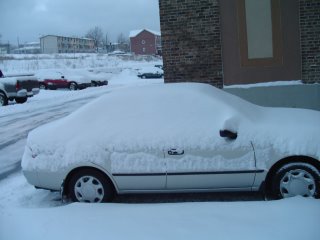
Those archives are great. I could easily use up a half hour a day doing research there. If only there were other ways to spend my time in Barbados ... oh well, I'm happy to suffer for my scholarship.
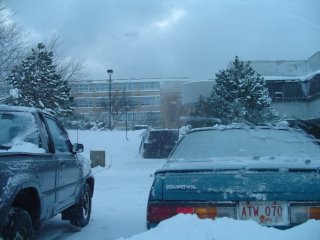
This morning however I could practice no such avoidance, as I'd agreed to proctor an exam for a colleague. Walking out into the parking lot, I was treated to the following image:
My poor car ...
Several things were clarified for me, or at least certain purchases were. I now know I should probably buy:
- Snow tires, or possibly an M1A1 Abrams, for traversing this city's hills.
- Cross-country skis, or possibly a sled with a dozen huskies.
- A garage.
- A massive gravitational manipulator that will shift the earth's orbit enough to make Newfoundland's climate more like Barbados (what do you think -- Sharper Image? LL Bean? EBay? There's got to be one available somewhere ...)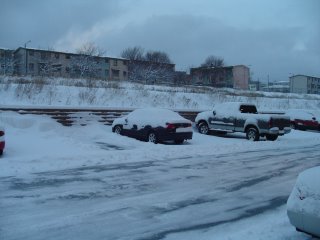
Those archives are great. I could easily use up a half hour a day doing research there. If only there were other ways to spend my time in Barbados ... oh well, I'm happy to suffer for my scholarship.
Tuesday, December 06, 2005
Impostor syndrome
It doesn't go away -- the sense of being somehow substandard, the anxiety that someone somewhere has made a mistake and soon they're going to figure it out, and arrive at the office door saying "I'm sorry sir, but we just realized that you're not, in fact, smart enough to be here."
We call this impostor syndrome, which starts on day one of grad school and then proceeds to dog you for -- apparently -- the duration of your time in academia. I've blogged about this before (I think), and I will undoubtedly blog about it again. You would think that the various validations along the way -- acceptance to grad school, passing comps, successfully defending the thesis, getting hired -- would be mitigating factors. I suppose they are, and sometimes can contribute to feelings of supreme confidence; but just as frequently there is the sense of somehow having pulled the wool over everyone's eyes. I think this has much to do with the evaluative nature of this profession: there's always something to prove.
All of this is by way of my first time in the role of a thesis examiner. Given that it was only slightly more than a year ago that I sat across the table defending my own thesis, it seems absurd to me that I get to play the opposite part now. And of course, that all leads to the sense of myself being tested as much as the dissertation's author ... which is so absurdly self-centered that I'm kind of embarassed for having introduced this topic at all now ...
I'm happy to say this has a happy ending -- apparently I know what I'm doing after all. A bit of a relief, that.
We call this impostor syndrome, which starts on day one of grad school and then proceeds to dog you for -- apparently -- the duration of your time in academia. I've blogged about this before (I think), and I will undoubtedly blog about it again. You would think that the various validations along the way -- acceptance to grad school, passing comps, successfully defending the thesis, getting hired -- would be mitigating factors. I suppose they are, and sometimes can contribute to feelings of supreme confidence; but just as frequently there is the sense of somehow having pulled the wool over everyone's eyes. I think this has much to do with the evaluative nature of this profession: there's always something to prove.
All of this is by way of my first time in the role of a thesis examiner. Given that it was only slightly more than a year ago that I sat across the table defending my own thesis, it seems absurd to me that I get to play the opposite part now. And of course, that all leads to the sense of myself being tested as much as the dissertation's author ... which is so absurdly self-centered that I'm kind of embarassed for having introduced this topic at all now ...
I'm happy to say this has a happy ending -- apparently I know what I'm doing after all. A bit of a relief, that.
Friday, December 02, 2005
Awash in confusion in TVLand
So with Seth and Summer in Providence next season, and Ryan and Marissa apparently at Berkeley, what will The O.C. do? Will we get parallel storylines? Or will they reveal a la Buffy that there's been a university in their immediate vicinity all along, and everyone will go there? And will all these rich, beautiful people who live in a perfect climate suddenly realize that they're rich, beautiful people who live in a perfect climate and finally stop moaning over their trivial neuroses?
Maddening, maddening questions ...
I think all the TV shows I watch should exist in the same universe, and every episode should be a crossover episode. So Jed Bartlet would be everyone's president; Gil Grissom would have been on hand to examine the crime scene when Trey was shot; when Trey comes out of his coma he gets sent to prison at Oz and becomes Schillinger's bitch; Josh Lyman visits relatives in Star's Hollow and hooks up with Lorelei; Rory ends up getting a job at the White House, as she meets their two principal job requirements, which are having a photographic memory and the ability to talk really fast; anytime anyone dies, the funeral arrangements are handled by Fischer & Diaz; and at some point or another everyone gets saved from vampires by Buffy.
That's all I ask. If I were king of TV, that's how it would work ... that, and I'd make reality TV lethal -- anybody "voted off" would be tossed in a pit with lions. Now that's reality television I'd watch ...
Maddening, maddening questions ...
I think all the TV shows I watch should exist in the same universe, and every episode should be a crossover episode. So Jed Bartlet would be everyone's president; Gil Grissom would have been on hand to examine the crime scene when Trey was shot; when Trey comes out of his coma he gets sent to prison at Oz and becomes Schillinger's bitch; Josh Lyman visits relatives in Star's Hollow and hooks up with Lorelei; Rory ends up getting a job at the White House, as she meets their two principal job requirements, which are having a photographic memory and the ability to talk really fast; anytime anyone dies, the funeral arrangements are handled by Fischer & Diaz; and at some point or another everyone gets saved from vampires by Buffy.
That's all I ask. If I were king of TV, that's how it would work ... that, and I'd make reality TV lethal -- anybody "voted off" would be tossed in a pit with lions. Now that's reality television I'd watch ...
Subscribe to:
Posts (Atom)