Well, as I said, the time has come to retire this blog--though it's not something I do lightly. I'm actually quite emotional about this. Going back and perusing old posts makes me grateful that I started it to begin with: it offers an interesting series of snapshots of the last eight years, and brings a lot of great memories to the surface.
But considering how sporadic my posting has become, it's time to move on. I will not delete this blog, of course ... there is too much here I want to keep. But it's time to recharge and refocus, and change to a more appropriate forum.
On that note, I now have my own domain name! The new blog can be found here, at cjlockett.com.
It's been amazing. See you in the new space.
Tuesday, June 18, 2013

Friday, June 14, 2013
How HBO has ruined me
As I mentioned before starting on my co-posts on this season of Game of Thrones, I came to the conclusion a while ago that it is time to retire this blog. I started it when I moved to St. John’s; it was then a way of letting friends and family know about how I was faring, and a place to record my impressions of both Newfoundland and life as a newly-minted full time professor.
Eight years later, St. John’s is home, I am more than settled in my life here, and, having received tenure two years ago, I am in the midst of the inevitable transformation from arrogant young turk to querulous old fart (hopefully the full transformation is still years off, but I do find myself gravitating more toward tweed than I ever have).
All of which tells me I’m now quite overdue to retire An Ontarian in Newfoundland—its original mission has long been obsolete, and it has lost its focus. When I do update it, it is usually in the service of talking about topics in the general orbit of my readings and viewings … not in itself a bad thing, but it’s high time I started putting those posts in a more appropriate setting.
So the next time I post, it will be to announce the launch of blog 2.0 … as yet unnamed. Stay tuned.
In the meantime, my penultimate post is on a topic near and dear to my heart, and will hopefully put a nice little bow on what has become Lockett’s Television and Literature Emporium (a title I considered and rejected for the new blog).
 |
| "I've snapped and plotted all my life. There's no other way to be alive, king, and fifty all at once." |
I’ve always loved the film The Lion in Winter. I have seen it numerous times (often late at night when I’ve happened across it on TV), and a few years ago I picked up the DVD in a bargain bin. Until recently, however, I had never read the play itself.
More or less on a whim, I picked it up when I found it at Chapters about a week ago. Reading it was like visiting old friends, except that I found the experience vaguely … dissatisfying. One of my quibbles with the film, as good as it is, has always been just how contrived the action feels: the scheming and plotting and counter-scheming by King Henry, by Queen Eleanor, and their three sons is exhilaratingly naked and frank, but it always stretched credulity that they would wear their resentments and ambitions so openly. That being said, it was always easy to ignore the little voice in the back of my head, so brilliant are the performances by Peter O’Toole and Katherine Hepburn.

But reading the play laid its theatrical contrivances—its setpiece conflicts, improbable revelations, declarations, and avowals, to say nothing of the constant convenient (and inconvenient) entrances and exits—all bare and painfully obvious. To be certain, the genre of the parlor drama, of which Lion is a noble example, cannot escape such contrivances. It must, by necessity, force a critical mass of conflict, painful revelations, and psychological angst into a limited time and space (see also: Night, Long Day’s Journey Into, and Virginia Woolf, Who’s Afraid Of). However scrupulously the stage, costumes, and characters are rendered, the action itself necessarily begs a little bit more suspension of disbelief.
Such is the case with The Lion in Winter. Still, had I read it five or ten years ago, I would probably not be having these quibbles to the same degree. So what has changed? In a word: television. HBO and the cable stations that have learned from its example—AMC, Showtime, FX, and every now and again the networks—have burst the riverbanks of episodic TV. Rather than tuning in once a week to see the latest self-contained, procedural narrative, we increasingly get caught up in intricate seasons-long, multiple-character stories.
HBO, not to put too fine a point on it, has ruined me. It has ruined me not just for episodic procedurals and un-nuanced, big-brush dramas, but also for otherwise bravura setpiece dramas where I find myself wanting to know how we got there, or getting irritated by the lack of subtlety the two-hours’ traffic of the stage (or screen) often necessitates. It has ruined me for expansive historical narratives that privilege overstated romance over the vagaries of political power; it has ruined me, really, for anything that feels the need for heavy-handed exposition or for its characters to state the obvious. I gravitate now to the long build and the slow burn, stories that take between eight and twelve hours to develop, characters whose evolution—their progress, regress, irruptions, collapses and triumphs—seems to unfold on a geological time scale.
None of this should really surprise me, as I’ve always been a narrative junky (another name I considered and rejected for the new blog)—preferring substantial, chunky novels to novellas or short stories, and drawn more to good stories told well than to visual or written narratives that rely more on expressionism or metaphor. There is something deeply satisfying about television series like The Wire, Breaking Bad, or Deadwood (among others) in the way they tend not to pander, to resist easy closure and pat resolutions, the way they show their characters no quarter (I’m looking at you, Game of Thrones), and above all the way in which they are unapologetically intelligent. While I can read something like The Lion in Winter and appreciate its artistry, it now unfortunately feels like the penultimate episode in a series based on Henry II and his family—except that, in the series, all of the play’s histrionics would be unnecessary, because at the point when they met for that fateful Christmas we’d be intimately familiar with the characters, their loves and hates, jealousies and resentments, desires and fears.
I’m aware, of course, that this is an entirely unfair criticism to level against a classic piece of theatre, at least in the way I’ve done it. But as I say, HBO has ruined me: these are not unusual thought processes for me anymore. For good or for ill, a certain amount of my reading and viewing has become inflected with the question “What would HBO do?” I recently read The Wars of the Roses by Trevor Royle, and could not help but imagine what a series or mini-series about the dysfunctional York family would look like (actually, that’s an easy one—it would look an awful lot like Game of Thrones, minus the dragons); or when I read Tim Cook’s excellent two-volume history of Canadian troops in WWI (At the Sharp End and Shock Troops), I longed for our irreverent, foul-mouthed, colonial soldiers to be given the Band of Brothers treatment; watching Elizabeth: The Golden Age at my parents’ house while visiting a few weeks ago, I couldn’t help but think how brilliantly HBO or AMC could do a series depicting the career of Elizabeth’s spymaster Walsingham; and knowing HBO has an adaptation of Neil Gaiman’s American Gods in the hopper threatens to make my head explode with fanboyish glee.
None of which, I should hasten to add, is to suggest that HBO is infallible. It’s put its foot in it a few times (John of Cincinnati, anyone?), and it has a good number of series that you won’t find me defending. Sex and the City started really well, but after two or three seasons fundamentally betrayed what made it great, as it shifted from depictions of unapologetically single, sexually adventurous women to an ongoing hunt for husbands; True Blood has long since become what Game of Thrones is often accused of, namely a weekly excuse for blood and boobs; aside from the brilliant performance of Steve Buscemi, Boardwalk Empire always felt a little like warmed-over Sopranos; and I’ll never quite understand why Entourage was ever green-lit in the first place.
But these are quibbles. At their best, HBO and its acolytes have redefined television—or have, at any rate, shattered the conceptions of television’s limitations. Once upon a time, it was inconceivable that the medium of television could ever produce art. Now there are those who hail a show like The Wire as the contemporary incarnation of the Great American Novel.
Is that hyperbole? Yes and no. Mostly, it’s a misapplication of the term “novel,” but it unsurprisingly invites backlash. Just the other day, Andrew Sullivan’s blog The Daily Dish linked to an article whose author, Liel Leibovitz, takes umbrage with what he characterizes as the vastly exaggerated esteem in which some television is now held. Television, in his words, “has ascended to a perch previously reserved exclusively for the furrow-browed and the ink-stained, the Tolstoys and the Henry Jameses and the Prousts.” While he avers that he is delighted to see such a previously degraded medium achieve excellence (even though he himself has no intention of watching the shows in question), it irks him that there are those who would presume to rank today’s television auteurs alongside our greatest novelists. To quote him at length:
The more discerning bother making specific cases—suggesting, for example, that David Simon is our modern-day Dickens or that Vince Gilligan, creator of Breaking Bad, would’ve felt completely at home had he stumbled into a party at Turgenev’s and was seated right next to his apparent equal, Dostoyevsky … It’s time to stop this madness. Let the unfashionable truth ring clear: No matter how good it is, it will never be more than just TV—an unparalleled distraction, crisply shallow, full of wondrous sounds and gorgeous furies that ultimately, in the ways that are truly vital and important to human life, signify nothing. It does not now, nor will it ever, meet the same sublime depths explored by the great novels. It is, quite simply, essentially inferior.
I’m not unsympathetic. I’m not, really … because I am, myself, at best ambivalent about claims that television can accomplish what a novel can. But my ambivalence is fundamentally different from Mr. Leibovitz’s. Indeed, where he gives away the game with his declaration that it “will never be more than just TV,” I reject the idea that one medium is or can be categorically inferior to another. Television may pursue similar ends as the novel—as it pursues similar ends as cinema or theatre—but also possesses its own unique constraints and possibilities. Its possibilities and potential, I’d argue, have only recently been explored on a larger scale. Once upon a time I probably would have agreed implicitly with Mr. Leibovitz’s argument; once upon a time, I opined that no matter how banal, poorly written, or formulaic a book was, it was a better intellectual pursuit than watching television, because it engaged the brain in a way television could never manage.
In hindsight, I was wrong: there has always been television that is intelligent and challenging (even if much of it tended to air on the BBC). But now more than ever, I would say that there is television that is vastly superior—intellectually, artistically, and otherwise—to the balance of novels populating the fiction section of your local bookstore. Not all of it, mind you—not even most. I’m not about to pit Top Chef against a decent read. But The Wire? Deadwood? Breaking Bad? To categorize such shows as “just TV” is meaningless, for the simple reason that these shows have fundamentally challenged the very idea of what television can be and do.
To be fair, however, Mr. Leibovitz’s ire appears to proceed from his argument with the idea that these shows are “like novels,” and he attempts to demonstrate how television inherently lacks the depth and complexity of Henry James. But in so doing, he engages in a classic straw man argument. It’s like saying to a possible draft pick “You’ll never be good enough to play in the NBA” and proving your premise by making him play some one-on-one with Kobe Bryant. Indeed, besides James the only other novelists Leibovitz mentions are Tolstoy, Proust, Dostoyevsky, and Turgenev. Well, if those are your benchmarks, it’s hard not to be skeptical of the claim that “TV is so good now that it’s just as great as our great novels!”
And, really, if he honestly is hearing that on a regular basis, I understand his irritation. But again, if James, Tolstoy, et al are your starting lineup, then the statement “Novels are so good right now they’re just as great as our great novels!” would be just as valid a target for your skepticism. That the most current novelist cited is Proust makes Mr. Leibovitz’s argument suspect, though even if he’d mentioned the likes of Don DeLillo or Ian McEwan or Toni Morrison, the premise falls apart for the simple reason that we’re talking two very different kinds of fruit here. The novel is now around three hundred years old; television is not quite sixty, and it has only found its stride, artistically, in the last fifteen. Let’s not forget that the novel was, in its infancy, roundly condemned by the intelligentsia as a degraded and corrupt form that catered to the lowest common denominator—too sentimental and lascivious, too full of cliché and “low” characters to ever aspire to the level of art.
Sound familiar?
On that note, here’s more:
In television narrative, any television narrative, the commandments are few and simple: Something must always be happening, for otherwise there would be little reason to tune in next week; and whatever’s happening must happen on screen, for this is a visual medium, and a shot of Walter White brooding in his kitchen isn’t quite as gratifying as a shot of Walter White shooting some guy in the head. Our new technologies, and the gluttonous viewing habits they’ve created, have given the medium some more room to play, to build, as it were, character. But the primary principles still apply: To keep us amused, a show, any show, has to parade a quick succession of spectacles, far exceeding the scope of thrills and woes that befall any ordinary or extraordinary person in real life. That’s the nature of entertainment.
I honestly don’t even know where to start with this, so I’ll quote Andrew Sullivan’s response:
He’s so wrong. And he’s crazy to pick an example like Breaking Bad. Watching the evolution of the central character of Walter White—and those around him—as he sinks deeper and deeper into the easy evil, has been a character study equal to any novel, or even Shakespearean drama. And what makes this show so great is precisely its ability to slow down, to show character in grainy detail, to watch human faces and bodies change, to observe the subtly changing dynamics between, say, Walter and his son. There is silence in that series, just as there is immense psychological complexity.
The fact that Mr. Leibovitz did choose Breaking Bad as his example suggests two things to me: (1) he hasn’t actually watched the show for more than an episode or two, and (2) it’s probably the show most often being called novelistic in his presence. But I think where he really goes off the rails is in his implication that somehow the imperative to entertain and keep an audience riveted isn’t also crucial to the novel. Why else do we read? All of the novelists he mentions produced great art—but they also knew how to tell a good story.
He’s technically correct to say that a shot of Walter White brooding in his kitchen is less thrilling than a shot of Walter White shooting a man in the head … but in saying so, he’s entirely missing the point of what makes Breaking Bad such a compelling show, and what keeps viewers coming back. If all Walter White did was shoot people in the head—just as if all Tony Soprano did was whack informants, if all we ever saw on The Wire was shootouts between drug gangs, if variations on the Red Wedding happened in every episode of Game of Thrones—well, frankly, I wouldn’t be wasting my time writing this rebuttal. The fact of the matter is that scenes of Walter White brooding in his kitchen, to say nothing of his many strained and awkward dinners with his wife, his tortured paternal relationship with his sidekick Jesse Pinkman, his cancer treatments, his meticulous and fussy (and often stridently pedantic) cooking sessions, all of that makes his irruptions of rage and violence and his cumulative sociopathy that much more significant.

And here is where the inclination to compare such shows to novels becomes tempting. The long-form storytelling, the multi-linear narrative, the complexity and nuance of the stories as they evolve over multiple seasons, the preoccupation with character psychology … these elements invite such a comparison. But of course, however much certain series might emulate and replicate these novelistic tendencies, it is a fallacy to make a simple one-to-one analogy.
But it is understandable—for the simple reason that HBO and company’s departure from televisual norms begs for language to describe it, and in the absence of a new critical vocabulary we reach for the closest analogues we can find. I sympathize with Mr. Leibovitz’s irritation—to a point. Beyond that point however is the part of me that reads a classic piece of theatre and wonders what would David Simon do with this? or Ian McShane = awesome Henry II.
It’s a sickness.
Wednesday, June 12, 2013
Game of Thrones 3.10: Mhysa
Phaernswirte morghulis, fellow Westeros nerds. For those who don’t read High Valyrian, that means “all television must die.” That, however, is just the literal translation—colloquially, it means “all great seasons of television must end.” (The Valyrian word for television comes from their tendency to ascribe the existence of a thing with its originating moment, and so the word is a bastardization of Philo Farnsworth, inventor of television. Interesting history, really. The literal understanding of the phrase led to the Great Recapitulation a millennium before Valyria’s Doom, in which all television sets were fed into the maw of a volcano).
Ahem. Well, this is the last co-blog I’ll be doing with the beautiful and talented Nikki Stafford for ten months … or will it? Let’s find out!
 |
| Daenerys tries out the mosh pit for the first time. |
Nikki: Well, I, for one, am never eating pork sausage again.
This week was the season finale of Game of Thrones, and while for most TV shows, the season finale is where it all happens, GoT loves to lay that stuff out in the penultimate episode, leaving the finale as the one where we try to breathe again, grieve a little bit, and then start crying all over again that we have to wait a whole year for the next season. And that was pretty much what this episode did. A letdown from last week’s, yet, but it was pretty hard to top the Great Stark Massacre of 2013.
Let’s start with the character reactions to the Red Wedding:
Joffrey: Laughing like a maniacal hyenaCersei: Calm acceptanceTywin: TriumphTyrion: This is a really, really bad idea. The shizz is gonna hit the fan.Arya: Angry, empty, murderousBran: Doesn’t knowTheon: A little bit busy right now!!
The Lannisters were missing from last week’s episode (other than Tywin being the hand that was dealing the blow from afar) and so they return, with Joffrey being an even bigger shit than he’s ever been, and Tyrion at this season’s best.
First we see Tyrion and Sansa walking through the garden (with Shae sadly following behind) and you can see that Sansa is actually warming up to him as a friend and not an enemy. She’s no longer sulking in her bedroom about having to marry him, but instead is treating him like a BFF, explaining a really good prank that her sister used to pull on her. But when she believes that “sheep shit” is actually pronounced “sheep shift,” probably because that’s what her parents told her to prevent her from cursing, there’s a look of sad bemusement on Tyrion’s face, as if he’s once again reminded that he’s married a little girl.
 |
| "People died horribly! Isn't that awesome?" |
The highlight of the episode, for me, is the small council, where Joffrey is so insanely happy he can’t even stand still, bouncing around behind Tywin’s chair like a goofy little monkey, squeaking, “Show him! Show him!” and practically throwing the scroll in Tyrion’s face. Joffrey lives in the moment, hopping about in a “Yippee, we won!!!” kind of way. Tywin is stoic and pragmatic, with a smugly victorious look on his face, convincing himself that by offing the King of the North, he has saved thousands of lives. (That’s his story and he’s stickin’ to it.) Tyrion is instantly hesitant, and tells his father, “The Northerners will never forget.” Tywin doesn’t care. “Good. Let them remember what happens when they march on the South.”
The best part of this scene is that despite Tyrion and Tywin being on opposite sides of the moral coin on this one, they both take out their feelings on Joffrey. Giddy King D-Bag excitedly instructs Pycelle to have Robb’s head sent to them, because he wants to serve it to Sansa on a platter for her wedding. Tyrion reminds him that “she is no longer yours to torment,” but the little shit will have none of it, reminding them all that HE IS THE KING and that Tyrion is just a little monster. Tyrion’s response — “Then you’d better be careful. Monsters are dangerous and just not kings are dying like flies” — is priceless, but immediately topped by Tywin telling his stupid little grandson that “Any man who has to say ‘I am the king’ is no king.” But he catches himself quickly, and tells Joffrey — who is now as livid as he was excited earlier — that he needs to lie down, that it’s all been too taxing. “You just sent the most powerful man in Westeros to bed without his supper,” sneers Tyrion.
And Tywin reminds him that no, Joffrey is not the most powerful man in Westeros. Before, of course, explaining to Tyrion that the only reason he didn’t kill the imp at birth is because he’s a Lannister.
Let's all look back on this particular moment with fondness, shall we? And yes, you are WELCOME:
The game has gotten more complicated, and the ties that bind this family have weakened. Tyrion isn’t just a Lannister anymore, he’s married to a Stark. This massacre hits home in a way the death of Ned Stark simply didn’t, and when he returns to his chamber to find Sansa with a look on her face that tells him the little girl has just been forced to grow up, he can do nothing but turn and slowly walk away. Trapped between two families, Tyrion doesn’t know where his loyalties lie. And to me, that makes him even more interesting than he’s been before.
Brilliantly acted all around, this scene is definitely a highlight of the series.
What were your thoughts on the season 3 finale, Chris?
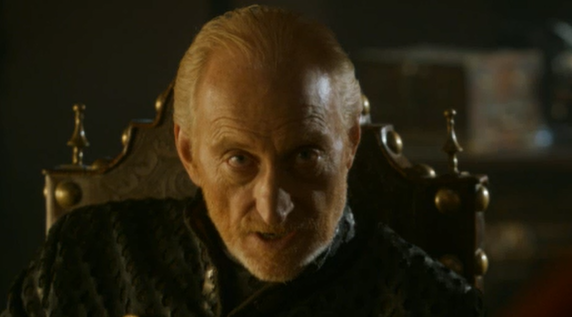 |
| The Go To Bed Without Supper look: You're doing it right. |
Christopher: My initial response—which seems to be echoed on the interwebz thus far—was: Really? That’s it? But on reflection, and watching the final episode again, I revise my opinion to: Nicely done. As you say, GoT has made a practice of putting the big action into the penultimate episodes. Daenerys having her messianic moment wasn’t quite as awesome as seeing her emerge sooty and naked with dragons, or seeing the frozen army of the dead, but it will do. And in a number of ways, it makes season four that much more alluring—ending with the Red Wedding, or the Battle of the Blackwater, or Ned Stark’s death would have been shocking … but they also would have offered finalities. After this episode, we look forward to: (1) the continuing escapades of Arya and the Hound (now including extra homicidal Arya!) edition; (2) the Bran: North of the Wall edition; (3) the Jon Snow: Wildlings! Wildlings! edition; (4) the Balon Greyjoy “Oh crap, one of those leeches bore my name” edition; (5) the Stannis: Who Am I Allowed to Kill Now? edition; and of course (6) the Tyrion: I Hate My Family edition.
So … you know, a lot to get to next season.
You might never eat pork sausage again, but holy crap, I will never again date a redhead. I mean, really … a little, slight, misunderstanding, and she puts not one, not two, but three arrows into you? Jeebus. What’s up with that?
 |
| "What part of 'nothing' don't you know, Jon Snow? Oh, right ... all of it." |
Once again, the Jon-Ygritte moments are so good. So we’re clear: this scene was not in the novel. Jon takes an arrow in the leg as he flees the wildlings (which was, admittedly, shot from Ygritte’s bow), but the confrontation they have here is an invention of the show. I love so much that she shoots him repeatedly as he leaves her … to have had her sob and lower her bow would have been somehow a betrayal of her character. Of course she shoots him. Perhaps she misses his vital bits on purpose … or perhaps not.
But to return to the question of pork sausage … finally, we now know the identity of Theon’s torturer, and all of us who have the read the novels can stop bouncing up and down in our seats with theatrically sealed lips. Ramsay Bolton: and I cannot remember if Roose specifies that he is a bastard or not. In the novels, Ramsay is Ramsay Snow, a bastard boy Roose got on a peasant woman in his lands. He looks different from how he’s described in the novels—GRRM describes him as thick-necked and broad-shouldered, with a plain dull face. But they got two elements spot on, namely his crazy eyes and his thick, wet lips.
The one hint we had as to his identity, I should mention, is the sigil we’ve seen Bolton’s men carrying: the image of the flayed man, upside down against an x-shaped cross—the same kind of cross on which Theon is (admittedly upright) pinioned.

The scene with Theon and Ramsay was at once incidental and crucial. Nothing really happened … having gelded Theon, Ramsay doesn’t seem interested (for the moment) in continuing, the torture aside from taunting him with a length of sausage. But he does want to assert his dominance: having robbed Theon of his manhood and his dignity and his pride, he now wants to rob him of his name. Reek. His name is now Reek, as everyone who has read the novels knew it would become.
Again, we see torture here at work not in the name of interrogation but as a process of destroying a person. Roose’s resigned words about his son give us all we really need to know—that Ramsay is a man given to his own whims and enthusiasms, which apparently mostly involve pain and torment. That Roose doesn’t seem overly chagrined at his son’s distractions is a dire reflection on how the new Warden of the North will rule his subjects—and reminds us that his family’s sigil is a flayed man.
What did you think of the Theon sequence, Nikki?
 |
| Sometimes a sausage is just a sausage. And sometimes it's a really gross way to taunt the man you've just castrated. |
Nikki: As soon as Ramsay was identified as Bolton’s, I said, “I knew it!!!” to my perplexed husband. Last week’s episode made me sit up and notice Bolton in a way I hadn’t before. He’s willing to carry out the task at the Red Wedding, pitting him against the Starks but on side with the Lannisters and the Freys. He’s the one who captured Jaime and is responsible for Jaime losing a hand (while pretending he’s sorry about that) so that makes him a complicated and interesting character, and I thought if he’s somehow behind the Theon abduction, it would put him up against the Greyjoys. I thought the kid was working from him, not that he’d come from him. Near the end of the episode they referred to him as Ramsay Snow, which was the tip-off that he was Roose’s bastard. And what a bastard he is. I wasn’t sure what I thought of Theon’s sister last season, but this season, in her only appearance, I believe, she really steps up and becomes completely badass. Once again, it’s the women who come off as strong on this show: when the father’s being a prick, it’s Yara who says fine, I’m going to war.
As for Theon, each week I try to like him, but I can’t find it in me. I just found out he’s Lily Allen’s brother Alfie (she wrote that song about him) and he’s engaged to Ray Winstone’s daughter, so that should make him seriously cool. But nope. Just can’t find it in myself to like the character AT ALL. I have no doubt he reeks. The name works for me.
And yes, the Ygritte/Jon Snow thing was shocking, but like you I loved that she shot him; if she’d just stood there and let him ride away I would have been really disappointed. He tells her that he loves her, and he knows that she loves him, but we know that they just can’t be together. She’s devoted to the wildlings and he’s devoted to the Night’s Watch and his world south of the Wall. He looks at her and tells her that he knows she won’t shoot him. And then BAM, shoots him. Oh Jon Snow, you really know nothing.
After so many near misses in the last episode — Bran doesn’t quite run into Jon Snow; Arya doesn’t make it to the Twins in time to be reunited with her family — we finally get three big reunions. The first of these is Bran meeting with Sam. Now, while this isn’t technically a reunion, it’s two groups that we’ve been following coming together and finding a common ground. I loved that Sam knew exactly who Bran was, and recognized Hodor (and the bashful look that Hodor gives when he says that; part of me wanted Hodor to look down at the ground, clasp his hands, drag the toe of his shoe in the dirt and say, “Hodor” sweetly). Of course, it was just a brief meeting where Bran expresses his desire and reason to go north of the Wall, and where Sam gets to play hero by giving the daggers to the group. Sam continues on to Castle Black, and where he left a schlubby loser, he returns a hero, telling the Maester what’s coming, sending out the ravens to tell the rest of Westeros, and then ordering the others to take Jon Snow inside and help him. (That’s the second reunion of the episode.)
Did the Bran and Samwell bits play out similarly in the book, Chris?
 |
| "Hodoooooooooooooooooooooor ..." |
Christopher: You can’t even bring yourself to like Theon after his cameo on Gay of Thrones? Harsh.
Yes, the Samwell bits are pretty spot on—the only difference (which was a bit disappointing for me and, I assume, other readers) is that in the novel, the way underneath the Wall is guarded by a magical weirwood gate that will only open for a brother of the Night’s Watch. I was hoping that they’d show that, but I guess since it doesn’t really play a crucial role, the opted to save some money.
There is also another missing element that I won’t mention for fear of spoilers. Suffice to say we might be meeting another north-of-the-Wall character at the start of season four.
I really enjoyed the Sam bits in this episode, especially considering his stammering explanations to Maester Aemon provide some of the only levity (“It’s not what it looks like,” says he to the blind man. Ha!). And we see how he returns a hero in more ways than one: Gilly by this point is obviously taken with him, seeing him not as a fat craven but a courageous and caring man—and someone, moreover, who does not possess a speck of cruelty. After her life with Craster, it’s unsurprising she looks at Sam with such a wondering expression all the time.
And she feels safe enough with him to name her son after him, in spite of the usual injunction not to name babies until they’re a year old. In spite of his protestations to Maester Aemon, it obviously is what it looks like, at least a little … Sam has of course behaved with complete respect and propriety, but that doesn’t change that fact that he has, for all intents and purposes, taken on the role of the baby’s father. His oath forbids him from formalizing that relationship in any way, of course, but it’s obvious that Gilly sees him as her and her child’s protector.
Which, to segue to one of this episode’s key themes, makes Samwell Tarly the sole instance of noble or virtuous fatherhood we encounter. The episode’s title, “Mhysa,” is Ghiscari for “mother” … and while it is used to describe Daenerys at the end, it also reflects back on one of the sympathetic moments the show gives Cersei, when she urges Tyrion to impregnate Sansa—not for Tywin’s reasons, but to give her happiness. Her speech was, I found, quite affecting, for it reminded us that most of her adult life has been spent as the unwilling bride of a drunken, brutal lout who not only never loved her but came to despise her as much as she did him. And even in the aftermath of his death, she is still a pawn in her father’s machinations. What joy her life has had, she tells Tyrion, she got from her children, without whom she would have thrown herself from “the highest window in the Red Keep.” That Joffrey has grown up to be a sociopathic tyrant distresses her but cannot obviate the memory of the happiness she experienced when he was an infant. Her words resonate, I suspect, with anyone who has been a parent:
He was all I had once, before Myrcella was born. I used to spend hours looking at him … his wisps of hair, his tiny little hands and feet. He was such a jolly little fellow. You always hear the terrible ones were terrible babies. We should have known, then, we should have known … it’s nonsense. Whenever he was with me he was happy. And no one can take that away from me, not even Joffrey. How it feels to have someone … someone of your own.
Cersei’s words are in profound contrast to the sentiments expressed by the fathers in the episode, who are more numerous: Tywin, Balon Greyjoy, Roose Bolton, and the lingering specter of Craster. Balon’s scene is perhaps the starkest. Having received proof of Theon’s captivity and ongoing torment, he echoes Tywin’s preoccupations in the harshest terms possible: without the capacity to further the Greyjoy line, his son is no longer a son or a man, and is therefore useless. Tywin’s revelation that he desired nothing more than to give the newborn Tyrion up to the waves but did not is offered in the spirit of pure pragmatism: here was a son, dwarf though he may be, and therefore with a role to play.
 |
| Somewhere, Bradley Whitford is lamenting, "She had the conch in her hand ..." |
Roose seems to come at it from a slightly different angle, though in his case he is willing to tolerate his bastard son’s terrifying enthusiasms for the sake of having a son, bastard though he may be. And it seems as though much of his cruelty is learned: “My mother taught me never thrown stones at cripples,” he tells Theon. “But my father taught me aim for the head!” Ramsay is obviously psychotic, but it is just as obvious that his father has been an enabler.
Even the most sympathetic father has failed: Davos bonds with Gendry over their shared humble beginnings, and tells him his ambivalence about becoming a knight and lord—but that he did it so his son would have a better life that he did. “And does he?” Gendry asks. “He’s dead,” replies Davos. “Following me.”
Your thoughts, Nikki?

Nikki: Agreed on the Cersei scene: for once she’s a completely sympathetic character, and of course as a mother I agreed with every word she said. In a world where she has to keep her true love secret, her son doesn’t respect her, her father treats her like useless garbage, and her husband is a boor, everyone sees her as a bitch, they know about her incestuous relationship and they know that Joffrey is the product of that. And she knows they know, and has to endure the snickers. Her marriages are arranged, her love is gone, her life is controlled by the men around her. But no one can tell her how to be a mother, or have the babies for her: in that sense, as a mother, she is the one who is in control, and she tells Tyrion that it’s the one thing in her life that truly belongs to her. I still remember staring at my own daughter when she was just a few hours old, thinking, “Wow. She’s mine.” I didn’t buy her; I created her, and she was mine. It’s a shocking feeling.
And then her son grows up to be Joffrey, and she’s as disgusted by him as the next person, but deep down, he’s still hers, and he once smiled at cuddles, not massacres. A wonderful scene.
It’s interesting that you brought up Davos and his mention of his son, which was a poignant moment, because when you first said this was an episode where we really got to look at fatherhood, it was Davos who jumped into my head. Not for his relationship with his son, but the way he is with Stannis’s daughter. Another failed father, Stannis has tossed his “imperfect” child into a dungeon and has nothing to do with her, but Davos engages her, talks to her, learns with her, and tells her things others wouldn’t. She’s taught him how to read, and he’s a companion to her. I love seeing those two together.
And of course, so much of the action has been spawned by fathers: Ned Stark’s death has precipitated so much of what’s happened in seasons 2 and 3; Daenerys is out to avenge the murder of her own father; Gendry is a threat to Stannis because of who his real father is; Tyrion is alive because of his father’s decision; Theon may soon be dead because of both his father and Ramsay’s father; Sam is on the Night’s Watch because his father abandoned him there; Jon Snow’s father wasn’t married to his mother, and now he’s ended up there; Joffrey’s a king because of who he pretends his father to be; his real father has returned, but can never openly admit he’s his father.
And that final scene is the last of the three reunions I mentioned earlier, where Jaime appears before Cersei, and she is utterly speechless. When he left, he was a carbon copy of Prince Charming from Shrek. Now he returns, dirty, with mud-filled hair, probably stinking to high heaven, and missing the very arm that earned him the title of Kingslayer. And she just stares at him, as if she cannot believe he’s returned… and likely that she cannot believe he looks like this.
Of course, we should also mention Arya in all of this. Having lost her father, and now her mother, the Hound has stepped in as somewhat of a protector, though he’s a reluctant one (she despises him) and realizes she’s as much a danger to herself as anyone else is. At the end of last season, Jaqen gave Arya a coin and told her that if she ever needs him, to hold out the coin and say, “Valar Morghulis” and he’d return. I thought it would take a few seasons before we’d see her pull it out, but I guess having most of your family slaughtered in front of you would do the trick. Remember: Arya probably feels like she’s alone. She assumes Sansa was killed after Ned because she was in King’s Landing, and if she’s heard the news about Bran and Rickon that Theon spread, then she assumes they’re dead, too. The Hound is her protector, and she hates him (he’s on her dreaded list), so she’s desperate and turning to the only way out she knows. I’m looking forward to Jaqen showing up; he was one of my favourite characters in season 2.
 |
| "Beetlejuice, Beetlejuice, Beetlejuice! Oh, wait. That's wrong. Bloody Mary? Nope. Candyman? Crap. I should have written it down." |
Christopher: The relationship that has developed between Arya and the Hound is intriguing—less adversarial than in the novel, which I would have thought would have been thus less interesting, but in fact the opposite is true. Arya, we assume, still hates the Hound; the knife she took from him was almost certainly meant to be sunk into his neck, something the Hound just as certainly knows. But if he is concerned, he does not show it—in fact, his irritation, as he says, proceeds just from wanting to be kept apprised. That Arya chose to interrupt their journey to kill a man who had a hand in the murder of her mother and brother—effectively risking both their lives—is something he takes entirely in stride.
Arya has become hardened to her world, forced to mature faster than she should have by circumstances. As you say, she must feel alone in the world, but she does not curl up in a fetal position and weep, but takes her revenge when she can. Her murder of the Frey man is cold and clear-eyed until she sinks the knife into his neck, at which point anger takes over. Her answer to the Hound’s question about whether that was the first man she’d killed—“The first man”—reminds us that she has killed before, but it was in the heat of the moment and in self-defense when the stableboy came at her and she stabbed him with Needle. This time, she approached it very deliberately. And as much as we like to go on about Arya’s awesomeness, there is something deeply saddening about her transformation from precocious tomboy to killer.
The bit was the coin was similarly bittersweet. Will Jaqen return next season to help her? As usual, I say nothing.
Your comments about Davos’s friendship with Stannis’ daughter are spot on, as are your observations about how fathers’ actions and inactions set so much of the action in motion. It is, after all, not just a patriarchal but a patrilineal culture being depicted in which the Cerseis and Daeneryses and Yaras and Aryas are not just the exceptions but the potential spoilers to the main action. Sometimes not always to the benefit of things, as Varys seems to think: his proposal to Shae (which is yet another deviation from the novel, and yet again beautifully done) reads like an ironic reflection of Tywin’s iron law. “The house that puts family first,” he lectures Tyrion, “will always defeat the house that puts the whims and wishes of its sons and daughters first.” Tywin demands that Tyrion do his duty; Varys has a similar wish, but he must accomplish it by other means. He cares nothing for family—his concern is for the realm, and he sees Tyrion’s love for Shae and her love for him as a threat to Tyrion’s efficacy.
I am still uncertain of how to take Varys’ offer: on one hand it smacks of paternalism, however kindly meant, and that is certainly how Shae interprets it. But I also cannot help but think he means to atone for Ros. Is he genuinely just trying to get Shae out of the way, or is Ros’ death tugging at his conscience? Varys has no qualms about using others as his informants, as a means of getting leverage. But I have to wonder whether Littlefinger’s cruelty—and Joffrey’s—wrong-footed him, and have him a little gun shy.
What do you think, Nikki?

Nikki: I have to agree. Maybe I’m getting caught in the spider’s web, but I truly believed that Varys was offering Shae a way out. He wants to save the realm, and he’s completely honest about that, telling Shae that Tyrion can’t be distracted by her, or “endangered,” as he puts it. He comes right out with it and says Tyrion is the only hope they have, and if Shae puts him at risk, it’ll put the entire realm at risk. Shae knows deep down that the future she laid out a few episodes ago — that she’ll be Tyrion’s little piece on the side, that he’ll care for her and take care of their bastard children, but that eventually he’ll either tire of her or she’ll be killed by Joffrey when he finds out — is absolutely true. She’s not safe in King’s Landing, and neither is Tyrion.
So Varys offers her the way out: take these diamonds and you can go and live in a palace, have any man you want, have servants, and Tyrion can save the realm and your life won’t be in danger and your children won’t have to hide. But clearly she loves Tyrion too much, and she hurls the diamonds back at him. I couldn’t help but think Varys was right. There is no real life for her in King’s Landing, and this is the best offer she’ll ever get. But the heart wants what the heart wants.
And next we come to Stannis and Melisandre (yes, we’re actually going to make it to every character in this episode write-up!) Melisandre, whom Gendry described as having big words and no clothes (ha!) is taking credit for Robb Stark’s death, thinking the leech in the fire procured his murder, and not a bunch of letters written by Tywin or agreements between houses. Davos begs the two of them to listen to reason, telling them about Sam’s raven, that something horrible is coming from the north, and that you simply cannot unite the seven kingdoms with blood and magic. But just as last season ended with Davos appearing to have betrayed Stannis and allowing him to lose the war, he’s betrayed him again by letting Gendry go free. The blunt discussion between the two of them was one of the highlights of the episode:
Ever been in a boat before?No.Know how to swim?No.
Don’t fall out.
 |
| "I'm on a boat!" |
And finally, Daenerys. Season 1 ended with her emerging from the fire with freakin’ dragons on her shoulders. In season 2, she defeated the creepy bald guy and her dragons destroyed him. And now she has become not just the mother of dragons, but the mother of all those who are in chains. While Robb Stark waged war, and the Lannisters have united houses to gang up on others, and the Night’s Watch fears what’s coming, Daenerys is almost like a politician, roaming through the countryside and finding loyalty and followers wherever she goes. Her dragons are growing up, her people love her, and her army is fiercely loyal to her. She is an incredible character (certainly better used this season than last) and next season? Bigger dragons.
And that ends the finale. So much has happened in season 3, Chris! And yet, if I understand it correctly, we’re only halfway through the third book, is that correct? Are you already imagining what season 4 will look like?
Christopher: The Red Wedding occurred on pages 582 and 583 of my edition of A Storm of Swords, which runs to 924 pages. So we’re about two-thirds of the way through, but soon the storyline starts getting a bit wonky. I have to imagine that season four will get into material from books four and five—at least, I really hope it does. There isn’t much I can say about what season four might look like without getting spoilery, but suffice it to say that while the Red Wedding was the most shocking part of ASoS, it was by no means the only shock. GRRM still has lots in store for us, so stock up on your heart pills.
I loved the exchange between Davos and Gendry as he sends him out in a tiny little boat. There’s a very slight hesitation after Gendry tells Davos he can’t swim as you see Davos think to himself “Oh, crap. I hadn’t considered that.” But there’s nothing else for it, and he shoves him out onto the waves. Between the red priestess and the deep blue sea, as it were.
Have you noticed that every season ends with a high angle panorama shot? Actually, that isn’t entirely accurate—this episode ended with a vertical crane shot, pulling directly up so we see Daenerys at the center of a concentric circles of arms all straining inward toward her so that she is the focus of a seething mass of humanity. It is actually reminiscent of the crane shot of Drogo’s pyre in season one:

But season one ended with the camera pulling back at ground level as Daenerys’ few followers (those happy few) knelt before her and her newborn dragons, then with two cuts taking the camera’s eye higher and more distant. The final effect was both to emphasize the desolation of their location, and metaphorically show the blank slate of possibility Daenerys had won.

But season one ended with the camera pulling back at ground level as Daenerys’ few followers (those happy few) knelt before her and her newborn dragons, then with two cuts taking the camera’s eye higher and more distant. The final effect was both to emphasize the desolation of their location, and metaphorically show the blank slate of possibility Daenerys had won.

Season two ended just a memorably, with the image of the army of frozen undead. Like season one, it started out at ground level, the camera pulling back through the legion of wights, rising until it finally settled on the chilling (heh) image of a mass of remorseless, implacable zombies herded forward by the mounted White Walkers.

This season ends on a note that resonates with season one, in that the crane shot recalls the image of Drogo’s pyre, but also because it is an image of Daenerys’ worshipful followers—except now they number in the thousands, and the landscape is no longer empty but full of people. The final seconds before fading to black juxtaposes the mass of newly liberated people with the serried ranks of Daenerys’ army—cleverly reminiscent of the final shot in episode four, with her dragons soaring above her newly won army of Unsullied.

We’re well set for season four … though the prospect of waiting ten months is torturous (which, on reflection, is a poor choice of adjective—sorry, Theon). Once again, I want to thank you, Nikki, for proposing this project. It is such a pleasure to do these posts with you. Whatever will we do to salve our Game of Thrones cravings in the coming year?
Nikki: Why… I think it’s time to read the books!! And who better to guide me along as I discover what GRRM’s original world read like than you, my trusted compadre. I’ll mention something on my site to let everyone know when I’m going to start book 1, and Chris and I will talk our way through it just like we have the shows, so if anyone else wants to join in and read the books (or jump into the discussion, having already read the books), we look forward to more discussions as we wait for season 4! Thanks to everyone who has been reading along and joining in all season long and remember: Season 4 Is Coming.
Well that and Breaking Bad, which is my next obsession on the calendar.
See you all soon!
Tuesday, June 04, 2013
Game of Thrones 3.09: The Rains of Castamere, or, It's A Nice Day For A Red Wedding
Greetings again fantasy nerds, for the penultimate installment of the Nikki & Chris co-blog of Game of Thrones’ third season.
Tonight was one of those nights the GRRM readers have been waiting for: even more than Ned Stark’s death or Daenerys’ immolation of Astapor, the Red Wedding marks a point in the Ice and Fire novel when we really, truly understood the fact that Martin will in fact do anything to his characters. No one is safe. It’s my turn on this post to lead off the discussion, and when that’s the case I normally like to write my first blurb as soon as the show’s over, while it’s fresh in my head. But this week … it was just way too much fun to watch the internet explode.
So even though it is my turn to lead off, I think I’ll look in on Nikki to get her initial reaction. How you doing over there, Nik?
 |
| The tension started as soon as I saw the Twins were back in the credits. |
Nikki: AAAAAAAAHHHHHHHHHH!!!!!! OH MY GOD I… AAAAHHHHH!!!! They just stabbed her in the… AAAHHHHHH!!!! And the knife and the OH MY GOD NOT THE DIREWOLF AAAAAAHHHHHHH!!!! :::sob!!:::

Christopher: Shhhh. Shhhhh. There, there … everything’s going to be all right.
Or … perhaps not. Once again, GRRM totally fucks with everyone’s head. The Red Wedding, as the massacre at the Twins comes to be known, makes the execution of Ned Stark look like a fratboy prank by comparison … and the body count of people we assumed to be important, pivotal characters is appallingly high. Robb! Catelyn! Grey Wind!
Obviously, this is our biggest point of discussion today—but we’ll save it for last so as to get through a handful of other rather important developments. So while Nikki struggles to regain her composure, let’s consider the rest of the episode, in which Jon Snow betrays the wildlings—and Ygritte—killing Orell in the process; Arya almost makes it home to her mother; Daenerys conquers another city; the Bran storyline finally has some substance to it; and Rickon gets to talk! I don’t know what’s more surprising, the mass murder of Starks or the fact that their youngest scion actually had some lines for a change. And guess what? The kid’s a pretty good actor. Too bad we won’t see him again for the foreseeable future.
So let’s start with Bran … or rather, let’s start with Samwell and Gilly’s five minutes of screen time, in which we get a nifty little bit of exposition disguised as yet another moment of cognitive dissonance between the civilized south and the backward north. Sam goes on at great length—professorially, one might say—about the arrangements of castles at the Wall, and their history. What I like about this moment is the guileless pleasure Sam obviously takes in relating what he knows, which is consistent with his character in the books … he is very much a reader, much preferring the company of musty old tomes to most of his brothers in black, and is possessed of a limitless curiosity. To him, it’s all old hat, but the very idea of learning things in the abstract from “marks on a page” is utterly alien to Gilly. To her, the ability to read is literally magical, and in an awed voice she calls Sam a wizard.
But of course in this charming little interchange is buried some key information—as when Sam shows Gilly the obsidian knife, we’re being set up for something later on. We begin to glean what it is when Bran &co. start talking along similar lines—about how there are a host of deserted castles along the wall, and pondering how they mean to get to the other side. Bran discounts Osha’s seaborne method, as it would take too long; similarly, his useless legs make it effectively impossible for them to scale the Wall. Perchance this secret passage under the Nightfort described by Sam will come in handy?
 |
| "I'm not actually a wizard ... though I am a level 90 mage in World of Warcraft." |
After an entire season of Bran inching north, punctuated only by Osha’s petulance and Jojen’s cryptic wisdom (and the occasional “Hodor” thrown in for good measure), it was a relief to finally have something happen with that group. We see a more impressive display of Bran’s talents, for one thing—slipping his skin to briefly possess Hodor, first, in order to silence him. It was a nice little moment, and not just a little creepy to see Bran’s eyes go milky. Jojen stresses that possessing a human is practically unheard-of; and with his encouragement, Bran slips into his direwolf to save Jon in what turns into one of the better fight scenes I’ve seen on the show.
So, Nikki—what did you think of the Bran sequences in this episode?
Um … Nikki? You OK there?
 |
| "All in the game, yo." |
Nikki: [puts down paper bag she’s been breathing into] Gasp… gasp… okay, yes. I think I can speak now. And I have a LOT to say about that final scene, but yes, let’s begin elsewhere while I attempt to compose my thoughts on the Apologetic Second-Tier Wedding massacre.
Let’s just say I wish I was limited to Hodor’s vocabulary right now. Seems so much… simpler.
I agree that it was exciting for something to finally happen with that other group, and while I’m sure the GRRM fans were all yelling, “NO! Get back to the Twins and leave this stuff til later!” I had no idea what was coming (well, some idea as I’ll explain in a minute) so I was happy just to see some side characters finally get screen time.
Oh, and to add to what you said above, I have in my notes, “Rickon says more in his first scene than in the entirety of his presence on the show!” Wow. I’m sure there’s a casting agent out there who put the kid in the show when he was a babe who sat back in relief and went, “Whew,” after that episode.
The direwolf scene was AMAZING. The readers of the books adore the direwolves, and as a viewer I think they are truly majestic to watch, but we almost never see them. I suspect they have a bigger role in the books, since there is a spiritual connection to their guardian that just can’t be conveyed on screen. But near the beginning we see the cavalry go by and the direwolf is almost the same size as the horse. Incredible. My husband and I were both yelling and cheering when the direwolves attacked, and he said he didn’t think we’d ever seen one attack before, but I know we’ve seen a couple of smaller ones where arms and legs get bitten. But this was amazing.
I couldn’t help during this scene but watch Ygritte with some amusement after her repeated comments previously when she and Jon were travelling over the Wall, and kept doing her voice through the episode. “You know NOTHING of decapitation, JON SNOW.” But at the very end, when he leapt on the horse, I thought he was going to pause and pull her up and then… he just took off. The look on her face mirrored mine in that moment. “You know NOTHING about commitment, JON SNOW.” Perhaps this is a deliberate mislead, and he’s actually tricking the others to think he’s leaving her when in fact he’s coming back. But that was a shock.
This episode easily had the best fight scenes in it since the Battle of the Blackwater, from the direwolves to the end scene (sob). But there’s also a pretty fantastic fight scene with the Three Danyketeers: Jorah, Grey Worm, and Daario. Of course there was the constant threat that Daario was leading them into a trap the entire time, but he stayed true to the Khaleesi. What did you think of that scene, Chris?
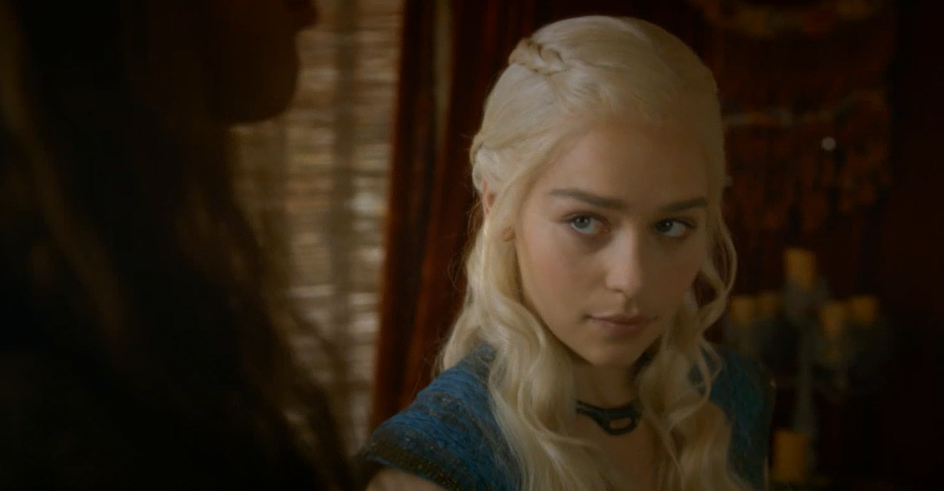 |
| "Yes, Daario. Sure, you're handsome, with that chin and that hair and that smile that could take the paint off a wall, but ... um ... what was I saying?" |
Christopher: I thought the fight scene was pretty amazing, though there was something about it that was weirdly familiar. I didn’t put my finger on it until I read a review of the episode that said it was “very 1960s Batman.” And it was! Something about the way the bad guys encircled them and got fought off was very reminiscent of the way in which Batman and Robin always found themselves surrounded by wave after wave of assailants. All it needed was “PAFF!” and “CLANG!” being thrown up on the screen to be perfect.

Strange overtones of Adam West aside, I thought it was really well done, and it was quite satisfying to see Grey Worm fight—after all the hype about how awesome the Unsullied are in combat, it was good to see that the eunuch has some game. But the scene was also entirely different from the novel: in the book, Yunkai submits to Daenerys’ demands and allows their slaves to join her growing army. I suspect they made the change as a means of letting Daario prove his bona fides … and also because it’s more exciting than simply watching a stream of former slaves issue from Yunkai’s gates.
That being said, I found that all the Daenerys bits in the episode were somewhat flat. Perhaps I was just clenching up in anticipation of the wedding, but it seemed somewhat hurried and rote: Daario establishing himself in Dany’s inner circle; Jorah getting his alpha male hackles up; those hackles going up further when Dany gets flirty; Barristan being honourable. About the only real point of interest is the point Daenerys makes of asking Grey Worm’s opinion—emphasizing that he is no longer a slave, but a leader of his people. And the ending, when Jorah returns to tell Daenerys that all those soldiers streaming out into the courtyard in fact proceeded to surrender, it feels somewhat anticlimactic. I think it would have made for a far more affecting and dramatic scene to have seen the Yunkish soldiers throw down their weapons after a threatening moment where they just stood silently around the Danyketeers.
(Now you have me wondering: which one is Athos? Porthos? Aramis? I would have to assume Jorah is Athos, and Barristan Aramis … which would mean Daario would have to be Porthos, with Grey Worm taking on the heroic role of D’Artagnan. He certainly fights well enough).
But to return to the north: if we ignore the Red Wedding, easily the most affecting moments of the episode belonged to Jon Snow and Ygritte. The closer they get to Castle Black, the greater the tension, as we know the moment of truth is coming for Jon. I loved everything about the ramp-up to the fight, from Jon’s subtle smack on the rock with his sword to warn the horse-breeder, to the way he distracts Ygritte so her arrow misses. Rose Leslie, it needs to be said, was stellar in this episode—she did more with her face than everyone else’s words combined, wearing her fear and suspicion and love for Jon Snow all the way through. When she misses the man on the horse, the look she throws at him is so conflicted it’s heartbreaking—though not as heartbreaking as her utter shock at his betrayal when he rides off.
 |
| The painful moment of realizing He's Just Not That Into You. |
If Ygritte’s shock is the most affecting moment, I’d say the most satisfying one is when Jon Snow kills Orell, murmuring “You were right about me all along.” Cold comfort for the wildling, I suppose (poor Gareth. Always getting the short end of the stick). It’s dueling wargs, though, and Jon has no time to take satisfaction in his victory as Orell’s eagle proceeds to dive-bomb him. These pets … so, so protective of their humans.
The other storyline in this episode, of course, was the continuing buddy comedy starring Arya and the Hound … not nearly as entertaining as Jaime and Brienne, but with some funny moments. My favourite bit was Arya preventing him from killing the cart man. Their exchange is worth quoting in its entirety:
“You’re so dangerous, aren’t you? Saying scary things to little girls. Killing little boys and old people. A real hard man, aren’t you.”“More than anyone you know.”“You’re wrong. I know a killer. A real killer.”“Is that so?”“You’d be like a kitten to him. He’d kill you with his little finger.”[indicates unconscious man] “Is that him?”“No.”“Good.”“Don’t kill him! Please! Please don’t.”“You’re very kind. Some day it will get you killed.”
And then as the cart man struggles back to consciousness, Arya matter-of-factly thwacks him across the skull again. And for all of the Hound’s show of being unimpressed, the look he gives her as she walks past him is appraising.
What I loved about this is it shows two sides of Arya—on one hand, practical and fearless, unfazed by neither the Hound’s looks nor his brutality; but she is still a lost little girl, and in a moment of weakness reaches for the memory of the last person who impressed her—Jaquen. Her description of him is funny but also vaguely pathetic, like some phantom big brother she wishes could rescue her.
What did you think of the Arya moments, Nikki?

Nikki: I realize GRRM clearly has a penchant for killing Starks, but seriously, if he touches one hair on Arya’s head…
I thought Arya’s scene definitely had some of the comic highlights, as did the scene where Robb stood before Walder and apologized for not marrying one of his female descendants. VERY funny, actually, which is something that tipped me off that things were about to go VERY BADLY.
Tip #1: When Robb Stark said to his mom (I might be paraphrasing here), “So, I’d like to ask for your advice out of the blue and make amends with absolutely no lead-up to it whatsoever after locking you up and treating you like a prisoner forever, BECAUSE you counseled me on something else that I’d completely ignored, and of course by saying this I’m reminding viewers of that OTHER thing you counseled me on — marrying Walder’s kid — and therefore hinting that something very bad is about to happen. Oh, and just to drive that point home, let’s put this little chiseled model of the Twins here on the board…”
Me: “Oh shit… Robb’s going to die.”
Tip #2: When Charlie Chaplin’s granddaughter says to Robb, “And we shall name him EDDARD!!”
Me: “Oh crap. That kid is doomed. So… she’s going to die. And Robb. And baby makes three.”
Tip #3: Arya looking out at the Twins while the Hound is totally wasting time eating pig’s feet and not moving for god’s sakes!!! and he says, “You’re worried you won’t make it in time.”
Me: OH MY GOD they’re going to kill all of them.
Tip #4: The merry little wedding band begins playing “The Bear and the Maiden Fair” during the celebration.
Me: WTF they’re going to lock them in with a bear?! Or… they’re going to slice off a hand. Last time I heard that song Bolton’s men had just sliced off Jaime’s hand.
Tip #5: Bolton’s sitting there.
Me: I’m going to be sick.
So… was it worse than what happened to Ned in season 1? Yes. Three Starks and an unborn child is pretty darn awful. (And methinks Edmure isn’t going to fare well down the hall there…) But was it as shocking as Ned’s? No. For weeks fans had been talking about a Very Big Thing that was going to happen. I had no idea it was going to be this. But I figured someone was going to die. And by the time the wedding was in full swing I knew it was going to be a Stark or three. My stomach was in terrible knots. Seeing the end was like knowing I was about to step into a boxing ring, and then having to deal with pain that’s much worse than what I could have possibly imagined. But with Ned? There was no way they were going to kill him. Major character… most famous person in the cast… the guy on the freakin’ season 1 poster and all promo materials… yeah, they won’t kill him. They’re going to go up there, and bend him over on the thing and Joffrey will be a prick and Arya will run up there just in time and OH MY GOD THEY KILLED HIM WTF?! To go back to the boxing metaphor, it was like I was walking down the street enjoying the beautiful day when I suddenly got walloped in the gut so hard it knocked me unconscious.
The Red Wedding was horrific and awful and the scope of it was inconceivable, but it wasn’t quite the shock that Ned’s death was. Was I still shocked? Holy hell, yes. DAMN I thought Filch was awful when he was at Hogwarts, but that was nothing compared to what he’s like now.
 |
| Harry Potter 8: The Re-Filchening. |
But the one thing I absolutely didn’t see coming… was the direwolf. Catelyn was shot and Robb was shot and Talisa was stabbed repeatedly in her gut and my hand was over my mouth to stifle my screams (even if you see it coming, you just can’t imagine how horrific it’ll be). But when they cut to outside, and Arya senses something is terribly wrong and runs to the direwolf, I was begging her to get there. And she didn’t. When the dog rolled onto the ground and she saw its face as it died, I lost it. Tears. Everywhere. We had just seen how powerful those animals were (and perhaps the warg scene was there just for that foreshadowing), and to watch the light go out of its eyes was devastating. And then we cut back to the Red Wedding, and I began to think that Catelyn had a chance. That she was going to watch her son die, that she was going to slit the throat of Walder’s wife (which elicited no more than a “meh” from him) and then her punishment would be to go on living, having witnessed all of it. The camera slowly pans in as Catelyn looks like she’s had a lobotomy: she just stands there, eyelids heavy, mouth agape, like her mind just can’t take all of this pain and horror. And then, silently, Walder’s guard steps up and with one movement, slits her throat, and she falls. Fade to black, silent credits.
One of the most powerful moments I’ve ever seen on television.
And, just as she did two seasons ago, Arya arrived just in time to find out that one of her parents has been killed, and before she can do anything, a large man has grabbed her and stopped her, probably saving her life.
They have totally turned her into Batman.
So, tell me how the scene on screen compared to the books. Were you disappointed? Pleased?

Christopher: I was very pleased—if that’s a word I can use to describe my reaction to such a horrific scene. I think they did an excellent job in dramatizing it. They made a handful of changes, all of them minor and none of which affected the scene adversely. If anything, some of the changes were to greater effect: for one thing, in the novel it’s not Walder Frey’s wife that Catelyn threatens and kills, but his grandson—a simpleton who has been given the role of court jester and renamed Jinglebell. It is utterly unsurprising that Walder Frey is indifferent to his idiot grandson; it’s a whole lot colder when he says of his young wife, “I can get another.”
The other significant change is that in the novel Robb is more circumspect and does not bring his wife with him to the Twins. Thus, the fact that they went for Talisa first should not have surprised me as much as it did … but I was shocked, horrified really, for when the Frey henchman stabbed her repeatedly in the belly, it was one of the most brutal moments I have seen on this show—and that’s saying a lot, I think you’ll agree.
I’ve spoken to a handful of people today who have read the books, and the consensus seems to be that knowing what was coming created its own unique tension leading into the last ten minutes. Speaking for myself, as soon as we were past the actual ceremony and into the feast, I could feel my stomach start to clench up in anticipation. I rewatched the episode this afternoon, and tried to see the massacre scene as if I hadn’t read the novels. I found myself deeply impressed with the pacing; the first go around I didn’t notice it as much, as I was just bracing for the midden to hit the windmill, but on returning to the scene I was struck by how well they built the tension. At that point, you didn’t need all of us GRRM fans gleefully saying “just wait!” And you didn’t need the copious foreshadowing that you pointed out … just a few hints, and Catelyn’s wary expression as she senses that something is amiss. And when the song starts playing … I’d forgotten that in the novel the signal to start the killing was “The Rains of Castamere.” It’s even more haunting to hear it on the show, that mournful threatening melody, and Michelle Fairley does a lovely job of registering the slow realization of their danger.
 |
| "Waaaaaiiiiit a minute ..." |
I’m with you on the direwolf. The cut from Catelyn’s face as the song starts playing to where they’ve penned up Grey Wind—with the strains of the melody still audible—reminds us of how vulnerable Robb and the others are. We’ve already seen direwolves come to the rescue of one Stark son, but the camera tells us now that that won’t be repeated. Grey Wind’s agitation mirrors Catelyn’s.
In an odd way, the killing of the direwolf gave the scene its finality before Robb and Catelyn died. At this point there isn’t really any hope that they’ll live—the shocking death of Ned Stark in season one taught us there are no miraculous rescues on this show—and the cruel and efficient slaying of the animal who is Robb’s protector and the symbol of the Stark family reminds us of that fact.
It was a hugely powerful ending. Catelyn’s final despairing cry and her vacant expression as she allows her throat to be cut was heartrending. Even knowing how it ended, even having girded myself beforehand, it was devastating. I sat in the silence of the credits digesting it all.

One last thought: in the novel, the death blow is dealt to Robb Stark by a nameless Frey who says “Jaime Lannister sends his regards” as he slides the knife in. On the show, it was Roose Bolton who finishes Robb off, saying, “The Lannisters send their regards.” In the novel, the Boltons aren’t in the thick of the betrayal, but Roose is happy to let it play out and claim the North for himself. Here, he’s the co-architect of the scheme with Walder Frey, and seems to take a perverse pleasure in it—letting Catelyn realize that he is wearing armour under his clothes, and thus revealing his complicity.
Did I say he and Walder were co-architects? Perhaps I should be more specific—they were sub-plotters. The true architect, of course is back in King’s Landing. Remember when I said those letters Tywin was writing would play a major role later?
Any last thoughts, Nikki?
Nikki: Just this afternoon I was sealing an envelope (everyone I know has a birthday this week, it seems) and suddenly stopped and thought, “Oh my god, Tywin’s letters. He was orchestrating all of this.”
I joked on Twitter that last night’s episode had two camps: the one going, “OMG! OMG! SOB!” and the other saying, “BWOOHAHAHA! WE HAVE WAITED FOR THIS MOMENT.” But like I said above, I certainly believe you when you say that as a reader, the suspense and adrenaline were probably almost unbearable, while we non-readers were watching all the other stories, “Oh look, Hodor’s talking! And oh hey, Rickon’s talking, too!! Ooh, they killed Orell, and did you see—” and the readers are going, “OH BLOODY HELL ENOUGH WITH THIS JUST GET TO THE BLOODY RED WEDDING THIS IS KILLING ME.” So perhaps there’s a bliss to our ignorance.
But no longer. As soon as next week’s episode is over, I’m reading these books. Chris and I have already discussed doing blogs where I read and discuss with him, our own book club of two. I just can’t take it anymore. GRRM is a mastermind, a genius, a sadist, a very evil man, and I want to read his words before I see them transformed for the screen.
I just can’t imagine what the fallout for this will be, but DAMMIT I can’t believe after next week I have to wait a whole year. Argh. Bring on the books, baby.


Subscribe to:
Posts (Atom)