Sunday, December 25, 2005

The shock and awe of Christmas morning

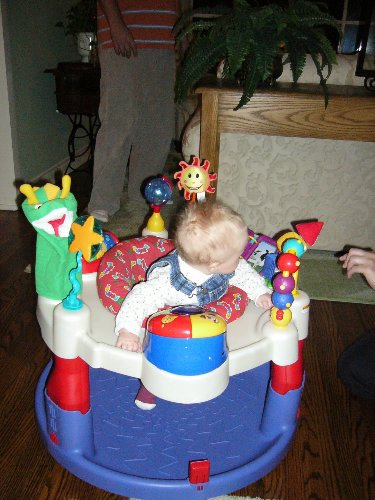
Morgan experienced her first ever Lockett Christmas this morning ... and I think the look on her face and her dad's perhaps says it all ...


The blitz of holiday cheer my parents are capable of delivering can be measured in megatons. Best left to the seasoned pros ...

Merry Christmas, everyone.

Saturday, December 24, 2005

And the stockings were hung, etc etc

Happy Christmas Eve, everyone ... I just finished helping lug up all the gifts from the basement to put under the tree, and think I may have herniated a disc. I tried to beg off, claiming that my fragile belief in Santa would be in jeopardy, but no dice.

Looks nice though, don't it?

Tonight I will engage in what is perhaps my favourite of Christmas pastimes -- sitting in front of the dying fire with the room lights off and the tree lights on, something strong to sip on and some appropriate music playing (trying to decide between Bing Crosby or something solemn and orchestral -- or perhaps I'll give "A Child's Christmas in Wales" another listen).

This past week has been lovely. I have done nothing, save read and shop and wrap gifts. I indulged my reading sweet tooth a bit and read Bernard Cornwell's The Last Kingdom, an historical novel about the Viking raids on England in the ninth century. I've also seemed to have started something of a Christmas reading tradition: last year I went a bit nuts reading Philip Roth, making it through five of his novels; this year I've managed two. I'm not entirely sure why the novels of America's favourite acerbic Jew seem to be a good fit with me for Christmastime, but I'm just going with it.

Well, I think I'm going to go in search of that drink of something strong and enjoy the tree. I'd wish everyone visions of sugarplums tonight, but I don't think I'd know a sugarplum if it bit me on the ass. At which point, the visions of sugarplums would probably be nightmares.

So skip the sugarplums. Seriously.

But raise a glass.

Wednesday, December 21, 2005

Dickens and the city

Something over a decade ago, my parents started collecting, as part of their general Christmas-decor mania, the "Dickens Village" collectables -- figures and houses designed to evoke A Christmas Carol specifically and Dickensian England more generally. When it began, it really was like a little parochial hamlet in the English countryside.

We're well past that now.

Seriously, we've moved into a sort of Dickens Urban Sprawl. We're very soon going to need a Dickens Mass Transit to maintain economic infrastructure and quite possibly a Dickens Nuclear Reactor to provide energy for this bustling metropolis on display in my parents' living room.

It's really my brother who is the one to blame for this unchecked growth, providing every Christmas, like clockwork, a few new buildings, to the point where my father had to add an extra four feet to the trestle-table on which the city is built. My parents, this year, said no more ... please! We have no more space. To which my brother, predictably, laughed at them and refused.
I think at this rate next Christmas I'll be sleeping on the couch because the Dickens Megalopolis will have taken over the extra bedroom.

You think I exaggerate? Please to see, starting at the city's west end and moving east:


We are arriving at a point in this city's development that we might soon expect to see some urban decay. To that end, I am on the lookout for the Dickens Whitechapel and Dickens Red Light District; perhaps some Dickens Tenement Housing, and some little figurines of Fagin and the Artful Dodger, and perhaps Jack the Ripper just for good measure.

But then, my parents don't seem to amenable to my suggestions for such social realism ...

Tuesday, December 20, 2005

RIP Leo McGarry

I was very saddened the other day to learn that John Spencer, the actor who played White House chief of staff Leo McGarry on The West Wing died of a heart attack. It's a testament to his talents as an actor that I would feel the loss so keenly -- he was a perfect fit as the exacting, rough-edged but compassionate McGarry, and brought a great depth to the character.

It was also a tragic example of life imitating art, as his character suffered a near-fatal heart attack at the beginning of last season.

This season, Leo McGarry had stepped into the role of the democratic vice-presidential candidate. From what I've gathered, the show was three episodes ahead of itself, which means that four episodes from now they're going to have to take a rather severe narrative turn.

But then, speculating on how a television series will adapt to the tragic death of a cast member is perhaps a bit macabre. Enough to say, we're made poorer in the loss of such an actor.

Ah John Spencer, we hardly knew ye.

Monday, December 19, 2005

Greetings from ChristmasLand

Ahhh. Back home. I am that anomaly of the academic world (and probably the wide world too): the person who not only has a civil relationship with his parents but actively gets along with them and looks forward to spending time at home, something I have blogged about before. Every year I end up being part of a conversation in early december with colleagues in which everyone but me shares their dread of the necessity of spending time with family, and relates their version of what I think of as the Christmas Calculus: threshold of time able to spend with parents multiplied number of divorces and remarriages divided by reasonable excuses for absence (children, other commitments, etc) plus distance necessary to travel minus savings on food and drink while being at home, all to the power of traumas, grudges and annoyances suffered during adolescence.

Seeing how bad I am at math, I'm doubly glad I've never had to do that calculation.

Mere hours after being home I was sitting by a fire with a single malt scotch and catching up with my parents. And then after dinner I wandered over to see my brother and sister-in-law, and, more importantly, my niece -- now almost five months old but grown well past that. A solid, and disturbingly strong (my finger, ouch) baby.
And then the next morning, the traditional cutting down of the Christmas tree at the tree farm we've been going to since before I was born.

There is a picture somewhere of me at the age of three, holding the very tip of the tree in an attempt to help my father drag it along. I'd say this was progress, except I was much cuter back then.

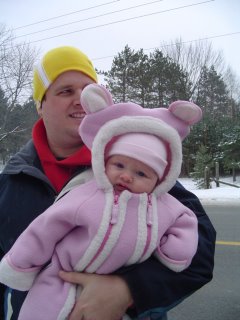
But speaking of cuteness, this year was the first year little Morgan joined us -- her first tree felling, which she experienced from the vantage of a Morgan-sized sled. She seemed a bit ambivalent about the experience, perhaps because she was bundled up so tightly that any movement was kind of impossible. She did like the movement of the sled over the snow, which we know because whenever the sled paused for more than a few seconds, wails would emerge from the depths of that baby-scented fleece. So when we stopped to actually cut down the tree, my sister-in-law Michelle was obliged to walk her in a slow, tight circle on the path to keep her happy.

Photos of the trimmed tree, and the shrine to the season that is my family home, to come.

But one more gratuitous niece picture before I go: the lion cub in winter, as it were.

Wednesday, December 14, 2005

The divine Dylan

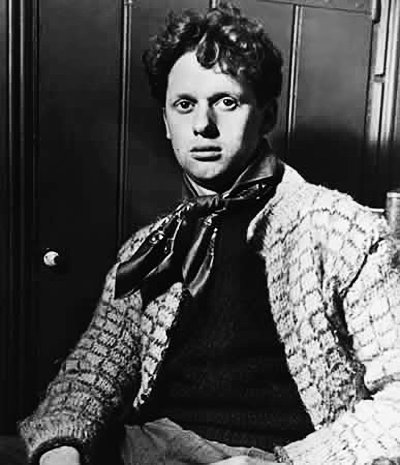
No, not Bob Dylan, but the guy from whom Bob stole his last name: poet Dylan Thomas, whose "A Child's Christmas in Wales" is currently playing on my iPod.
I'm feeling quite festive at the moment, in spite of the oppressive gray rain outside; though I think this feeling has more to do with the fact that I have a mere five essays left to grade, and those I will strategically leave to grade during my American Drama students' final exam tomorrow. If grading essays is worse than writing them, proctoring exams is comparable -- not quite as bad as writing exams, but so crushingly boring that one does well to have a distraction on hand. And while I suppose I could watch a DVD on my laptop with the earphones on, that might not appear quite as professional as grading papers.

But back to the divine Dylan, whose glorious language is a pleasure in and of itself. Indeed, my three favourite Christmas stories -- How the Grinch Stole Christmas, A Christmas Carol, and "A Child's Christmas in Wales" -- are all so poetic and lyrical that they practically read as Christmas carols in and of themselves. Listen to the rhythms of Dickens as he describes Scrooge, in what is one of my favourite passages of prose: "Oh! But he was a tight-fisted hand at the grindstone, Scrooge! a squeezing, wrenching, grasping, scraping, clutching, covetous old sinner! Hard and sharp as flint, from which no steel had ever struck out generous fire; secret, and self-contained, and solitary as an oyster."

But Dylan Thomas trumps even Dickens ... "A Child's Christmas" is a simple, short story that merely details a typical Christmas day for the young Dylan, and the first sentence beautifully expresses how memories merge together in the mind's eye: "One Christmas was so much like another, in those years around the sea-town corner now and out of all sound except the distant speaking of the voices I sometimes hear a moment before sleep, that I can never remember whether it snowed for six days and six nights when I was twelve or whether it snowed for twelve days and twelve nights when I was six."

Read that out loud to yourself! Words given the quality of music ... One of Thomas' principal pastimes was to sit in his local pub with a pint and make lists of his favourite words. When you read his poetry, often the meanings of his combinations of words makes little or no sense: you have to read them for the sounds they make.

John Updike once said of Vladimir Nabokov that he wrote prose "the way it should be written -- exuberantly." The same is doubly so for Dylan Thomas. Listen to this description of the snow of his youth: "it came shawling out of the ground and swam and drifted out of the arms and hands and bodies of the trees; snow grew overnight on the roofs of the houses like a pure and grandfather moss, minutely -ivied the walls and settled on the postman, opening the gate, like a dumb, numb thunder-storm of white, torn Christmas cards."

Or of the postmen: "With sprinkling eyes and wind-cherried noses, on spread, frozen feet they crunched up to the doors and mittened on them manfully."

"Mittened on them manfully." I love alliteration.

Or of some "useful" gifts received on Christmas day: "pictureless books in which small boys, though warned with quotations not to, would skate on Farmer Giles' pond and did and drowned; and books that told me everything about the wasp, except why."

Or of a "useless" gift (much preferred, or course, to the useful ones): "a celluloid duck that made, when you pressed it, a most unducklike sound, a mewing moo that an ambitious cat might make who wished to be a cow."

Or of his roaming around the snowbound town: "I would scour the swathed town for the news of the little world, and find always a dead bird by the Post Office or by the white deserted swings; perhaps a robin, all but one of his fires out."

I love that ... so vivid an image of the red bird lying starkly on the snow, melancholy yet still beautiful.

I love writers who can, with the sheer elegance or force of their language, take the mundane and make it sublime. Dylan Thomas, Alice Munro, Kazuo Ishiguro, John Banville, Don DeLillo, George Eliot, James Joyce ... just to name a few (seeing as how I'm still in listing mode).

Listening to "A Child's Christmas in Wales" makes me forget the gaudy tinsel that permeates the mall the day after Halloween, the incessant advertising, the bludgeoning pressure to buy buy buy, and the adult anxieties that accompany much of this season. It even makes me forget the likes of Bill O'Reilly and his *%#%@# "war on Christmas" rhetoric.

Yes, feeling very festive this afternoon.

Tuesday, December 13, 2005

Holiday reading

In the comments on my last post, Lesley made the following suggestion: "I think at some point, you should do a post about books you recommend for people like me. Namely, people who don't read much, are only looking to be entertained but still need that little bit of 'enlightenment' by reading something that is actually 'worthy'."

Hmm. Tough call, because reading is such a personal endeavour, and what I love might be boring or annoying to someone else ... as is, in fact, often the case.

Also, "enlightenment," or "worthy" literature for that matter, are tricky notions. In the pre-WWII years there was a group of literary critics in Britain (including TS Eliot) who advanced the idea that a cultivated appreciation of art, literature and all forms of "high" culture would improve people morally. Of course, as literary theorist Terry Eagleton wryly observed, that idea kind of got blown out of the water when people realized that Nazi death camp commandants whiled away their leirsure hours reading Goethe and listening to Mozart. So I tend to reject the idea of "worthy" literature or reading.

But at the same time, I do know what you mean Lesley ... because some things are quite definitively brain candy and others not, and there is an intangible but deeply felt satisfaction in finding a novel that is at once challenging, disturbing and enjoyable that one does not find in, say, formulaic and predictable fiction.

So I have some reservations about making such a list, not least because it's entirely likely that people might pick up one of the books on my recommendation and end up throwing it into a wall half-way through with the curse "&%$#% Lockett! Last time I listen to him. English professor, my ass ..."

Or something like that.

Still, I cannot resist making lists or recommending books. So as long as we all understand that these are books I found enjoyable and engaging, and that I don't necessarily expect others to like them, we're all good.

Isabelle Allende, The House of the Spirits
Paul Auster, The New York Trilogy
Pat Barker, Regeneration
Julian Barnes, Flaubert's Parrot
Sebastian Faulks, Birdsong
Timothy Findley, Famous Last Words
Ursula Hegi, Stones From the River
Milan Kundera, Immortality
Gabriel Garcia Marquez, Love In the Time of Cholera
Haruki Murakame, The Wind-Up Bird Chronicle
Gloria Naylor, Mama Day
Jeannette Winterson, Written on the Body

Monday, December 12, 2005

End of term (almost)

Five days.

I'm almost there -- I just cleaned off my desk after finishing up the final bits of work on English 2000, my Medieval-18th Cent course. Essays handed back, exams graded, final grades submitted. And now time for round two: final essays to grade for American Drama, then the exam on thursday ... which leaves me exactly 24hrs to grade the exams and submit the marks.

Piece of cake.

Of course, given that there is a stack of essays to grade, I'm inevitably finding other tasks that are just relevant enough to take the edge off the guilt of not turning my attention to the more immediate concern.

Part of this isn't strictly avoidance, but the little annoying quirk of my mind to tend to leap ahead to the next major project while the one at hand still needs to have some loose ends tied up. So I've been doing some course prep for next semester; I'll be teaching a first-year and a fourth-year class (I hit for the cycle this year, teaching-wise: first, second, third and fourth-year courses), the former an introduction to the study of prose fiction, and the latter a senior seminar on Depression-era American literature.

Can I tell you how excited I am about these classes? I'm such a geek. No surprise perhaps on the fourth-year, but I've populated the intro course with some of my favourite reads: In Our Time by Ernest Hemingway; Pride and Prejudice, the only drawback of which is I'm now kind of obliged to see the Keira Knightly film -- rest assured, anyone in my class who watches the film without reading the novel is in for a nasty shock; Elizabeth Smart's divine By Grand Central Station I Sat Down and Wept; Chronicle of a Death Foretold by Gabriel Garcia Marquez; and Time's Arrow, that exquisite mindfuck by Martin Amis.

Sigh. God, I love books ...

I've also been sketching out ideas for a graduate course for next year. I have to say, this is my favourite part of this job: thinking up ideas for courses and organizing them. A year ago this past summer, the FIMS associate dean at Western called me and said they needed some new courses for the fall, and would I be willing to teach one? I said sure, what do you want me to teach? "Anything you want," she said. "Just have it on my desk in two days."

Now that was fun. What emerged was the Alternative Realities course ... which, coincidentally, is one of my ideas for something to pitch to the department here.

There's also some standard Lockett fare I could peddle -- a course in conspiracy culture (which would also be recycled from MIT at Western), or something on the literature of the Cold War Consensus.

What's been tickling my mind lately however is a course on "endings" -- teleological and eschatological readings, especially in terms of the frequent claim, seemingly made once a decade that we've arrived at the end of history (it must really piss off those writers that people ignore their books and go one making history anyway). This could be fun, because it could be, in essence, all about the American fascination with apocalypse ... so in addition to literary works, there could be a whole sub-section on disaster movies. Also, I could inflict those vapid Left Behind novels that I ranted about way back when on the students ...

Ah well. Back to work.

Wednesday, December 07, 2005

Global warming my ass

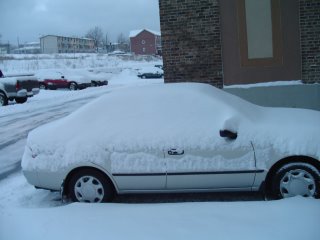
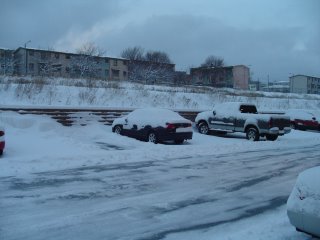
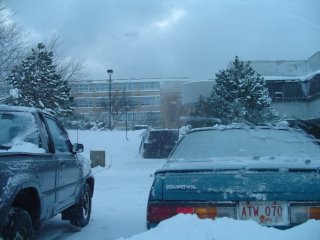
The lovely weather I've been able to gloat about lately in comparison to southern Ontario's cold and snow came to an abrupt halt yesterday. I woke up and saw a blinding expanse of white outside -- so of course stayed home and did work rather than expose myself to the elements. I even stayed away from the windows for the most part, on the assumption that if I couldn't see the snow, it wouldn't see me. Or something.

This morning however I could practice no such avoidance, as I'd agreed to proctor an exam for a colleague. Walking out into the parking lot, I was treated to the following image:

My poor car ...

Several things were clarified for me, or at least certain purchases were. I now know I should probably buy:

- Snow tires, or possibly an M1A1 Abrams, for traversing this city's hills.
- Cross-country skis, or possibly a sled with a dozen huskies.
- A garage.
- A massive gravitational manipulator that will shift the earth's orbit enough to make Newfoundland's climate more like Barbados (what do you think -- Sharper Image? LL Bean? EBay? There's got to be one available somewhere ...)
Speaking of Barbados, I'm beginning to think it's time to shift my research area so as to exploit my family history on that island and get a grant that would let me spend the winter months in the Bridgetown archives.

Those archives are great. I could easily use up a half hour a day doing research there. If only there were other ways to spend my time in Barbados ... oh well, I'm happy to suffer for my scholarship.

Tuesday, December 06, 2005

Impostor syndrome

It doesn't go away -- the sense of being somehow substandard, the anxiety that someone somewhere has made a mistake and soon they're going to figure it out, and arrive at the office door saying "I'm sorry sir, but we just realized that you're not, in fact, smart enough to be here."

We call this impostor syndrome, which starts on day one of grad school and then proceeds to dog you for -- apparently -- the duration of your time in academia. I've blogged about this before (I think), and I will undoubtedly blog about it again. You would think that the various validations along the way -- acceptance to grad school, passing comps, successfully defending the thesis, getting hired -- would be mitigating factors. I suppose they are, and sometimes can contribute to feelings of supreme confidence; but just as frequently there is the sense of somehow having pulled the wool over everyone's eyes. I think this has much to do with the evaluative nature of this profession: there's always something to prove.

All of this is by way of my first time in the role of a thesis examiner. Given that it was only slightly more than a year ago that I sat across the table defending my own thesis, it seems absurd to me that I get to play the opposite part now. And of course, that all leads to the sense of myself being tested as much as the dissertation's author ... which is so absurdly self-centered that I'm kind of embarassed for having introduced this topic at all now ...

I'm happy to say this has a happy ending -- apparently I know what I'm doing after all. A bit of a relief, that.

Friday, December 02, 2005

Awash in confusion in TVLand

So with Seth and Summer in Providence next season, and Ryan and Marissa apparently at Berkeley, what will The O.C. do? Will we get parallel storylines? Or will they reveal a la Buffy that there's been a university in their immediate vicinity all along, and everyone will go there? And will all these rich, beautiful people who live in a perfect climate suddenly realize that they're rich, beautiful people who live in a perfect climate and finally stop moaning over their trivial neuroses?

Maddening, maddening questions ...

I think all the TV shows I watch should exist in the same universe, and every episode should be a crossover episode. So Jed Bartlet would be everyone's president; Gil Grissom would have been on hand to examine the crime scene when Trey was shot; when Trey comes out of his coma he gets sent to prison at Oz and becomes Schillinger's bitch; Josh Lyman visits relatives in Star's Hollow and hooks up with Lorelei; Rory ends up getting a job at the White House, as she meets their two principal job requirements, which are having a photographic memory and the ability to talk really fast; anytime anyone dies, the funeral arrangements are handled by Fischer & Diaz; and at some point or another everyone gets saved from vampires by Buffy.

That's all I ask. If I were king of TV, that's how it would work ... that, and I'd make reality TV lethal -- anybody "voted off" would be tossed in a pit with lions. Now that's reality television I'd watch ...

Wednesday, November 30, 2005

Metablog

I was "interviewed" the other day by my friend and former student Alex on the whole phenom of blogging ... I suspect my response came a bit late for use in her essay, but I quite enjoyed the process, largely because it got me thinking of this whole odd revolution in self-expression--this assortment of autobiographical, editorializing, ranting, exhibitionist online writing more diverse than a handful of snowflakes.

Anyway, I thought I'd post my answers to (some of) Alex's questions, given that that were in fact thought-provoking for me. Hopefully I'm not breaking any copyright laws should my answers actuall make it into Alex's article ...


1. Why do you blog?

My blog started as a way of keeping in touch with friends and family. I moved from London, ON this past summer to St. John's, and wanted a way of keeping people posted on the major events in my life without resorting to lengthy mass emails that tend to annoy more than engage. This way, I can give people a web site and they can tune in (or not) at their own leisure.

That was the initial reason for starting, but now I quite enjoy the forum. I certainly don't limit myself to "significant" occurrences -- my entries range from musings to political rants and editorializing to personal narrative to more considered philosophical meditations to observations of the odd or quirky. And certainly one of the best parts of blogging, for me, is inspiring comments from readers -- I often measure the success of a post by the number of comments I get. I enjoy the dialogue that can happen.


2. Are blogs and blogging culture interesting to you? do you actively read/comment on the blogs of others?

I went from being more or less indifferent to blogs to being an avid reader the day I started my own. It was at that point that I began to appreciate the scope of the blogosphere -- people I didn't know would comment on my blog, and I would follow their links back to their pages, and sometimes would comment there. My own contact list has expanded in this way, as I have developed online acquaintances with people.


3. If I were to say that blogging is changing the media world and how journalism functions in our culture, would you agree/disagree? Why/why not?

Yes and no. On one hand, blogs are coming to fulfill that promise that techno-gurus and electronic new-agers sermonized about in the mid-nineties when then internet was first really getting its legs; that is, the promise of an infinitely interconnected forum that provides for genuinely free speech and expression, and a resource for those wishing an alternative to the mainstream press. And this phenomenon has certainly had its impact on that very same mainstream media, if for no other reason than both CNN and FOXNews have "blog updates" in which an anchorperson of some description provides a very brief rundown on how major news stories are playing out in the major blogs.

On the other hand, this presence of the blogs in mainstream media is nothing if not superficial -- a mere tip of the hat to the phenomenon itself rather than any sort of genuine engagement with the medium. As for a change in "journalism" itself, we have to remember that this is a profession with a set of standards in terms of how information is gathered, researched, confirmed, and presented ... the freedom of the internet is a double-edged sword insofar as it does not provide for any sort of vetting process or set of standards for how information is to be presented. And while this may provide a niche for those working outside the mainstream, at the same time there is nothing to prevent people from posting blatant lies and claiming them as truth. I suppose one could say that this makes for skeptical readers, a media audience less inclined to accept reportage at face value and more inclined to confirm "facts" for themselves ... I certainly hope this might be the case.

I think that, overall, blogs make us redfine our standard understanding of "media," for at their best they are less sources for news than for debate and dialogue. At their best, they offer us that which is entirely absent from the mainstream media, which is to say a vigorous debate that steps outside of political talking points. They are not "media" in the traditional sense, but a reinvention of it; nor are they "journalism" in the traditional sense, but they offer a skeptical and discerning reader a great resource for stories and news that work against the grain.


In other news, check out The DeWaard's raccoon. Let's hear it for urban critters who know they're always safe co-habitating with sensitive students.

Sunday, November 27, 2005

Oh where the time goes

First off, to answer Eano's query: the weather in St. John's has been consistently kicking the ass of the weather in London. We've been averaging about 10+ degrees, more or less alternating between gray & wet and bright-autumn-crisp. Gotta love that Gulf Stream.

So no, the weather hasn't gotten me down. The main reason my blog has gone un-updated till now is sheer busy-ness, mostly to do with my needing to clear my desk before this past weekend, which I spent in Montreal.

Ah, Montreal ... how I do love that city. Especially when I can sit with Kristen at a cafe window overlooking a snowy street with a ridiculously expensive latte. Good times.

This is not to say that I didn't have anything to blog about. Many possible topics surfaced in my mind, but I was generally too exhausted in the evenings for the past two weeks to do much more than meld with my couch. So, in no particular order, the blogs that weren't:


The homoeroticism of the movie Jarhead (apparently marines in the desert really like to take off their clothes).

My new love for John Irving, having just finished reading The World According to Garp--not as good as Owen Meany, but still a very entertaining novel.

Exactly why I loathe the thought of seeing the new Pride and Prejudice based on its trailers (hint: Mr. Darcy does not brood, he glowers). This may still be a post one day, though.

Reasons to look forward to a trip to Montreal (this would probably have made it to print, but Kristen forbade me to post a picture of her).

The disturbing new trend on some blogs I've encountered to post countdowns to Emma Watson's (aka Hermione Granger's) eighteenth birthday.


These among others. You get the idea.
Wednesday, November 16, 2005

For the want of a camera

I really have to learn to always have my camera at hand ... perhaps the most startling thing about St. John's is the number of times I'm suddenly treated to a spectacular landscape -- one I'm intimately familiar with, yet which is radically transformed by the light, the clouds, the weather. This morning and yesterday morning I crested the hill that looks down over the MUN campus: a pretty cool view anyway, framed as the campus is by a high ridge covered in coniferous trees behind it. Yesterday there was a brilliant sunrise at my back and black clouds in front of me that looked like they were hovering just mere feet over the ridge, and thrown into stark, inky relief by the blazing sunlight ... or as my late Grandmother Jean once famously said, "it's darker because of the light."

This morning I noticed that the sunrise was coming marginally later, not boding well for the time soon when my days will be going from darkness to darkness between going to work and coming home. The sun had not yet crested Signal Hill as I left, but by the time I was again looking down at campus it was perfectly horizontal, just above the horizon, and setting all the windows on campus ablaze with light.

Two pretty spectacular pics I now wish I'd been able to take.

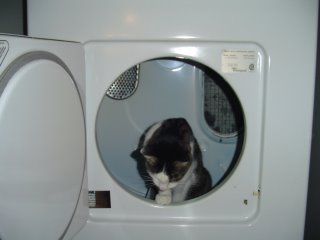
On the other hand, there are some notable photo ops that occur on a regular basis simply around my apartment. My dryer had recently gone on the fritz; I was without it for about a week. Upon its repair, I was apparently not the only one excited by this:

"Ah yes. I remember this place."

"Yes, this will do nicely. Can we perhaps get some warm linens in here?"
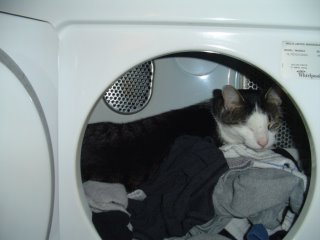
"Lovely. Now, begone and be sure to fill my food bowl, boy."

Sunday, November 13, 2005

Here we go again ... sigh ...

So, as we've all heard, the town of Dover, Pennsylvania voted out eight school board members who favoured the teaching of intelligent design and voted in eight new people who promptly turfed that idiocy.

Nice it is when sanity occasionally prevails.

But of course the good most Reverend Pat Roberston had this to say to the heathens: "If there is a disaster in your area, don't turn to God, you just rejected him from your city. And don't wonder why he hasn't helped you when problems begin, if they begin. I'm not saying they will, but if they do, just remember, you just voted God out of your city. And if that's the case, don't ask for his help because he might not be there."

Can this man not open his mouth without saying something stupid?

Well, let's see .... here's Robertson's appraisal of 9/11: "We have insulted God at the highest levels of our government. And then we say, 'Why does this happen?' Well, why it's happening is that God Almighty is lifting his protection from us."

Or his opinion of George W. Bush: "The Lord has just blessed him ... It doesn't make any difference what he does, good or bad. God picks him up because he's a man of prayer and God's blessing him."

Or his wisdom on the U.S. constitution: "The Constitution of the United States ... is a marvelous document for self-government by the Christian people. But the minute you turn the document into the hands of non-Christian people and atheistic people they can use it to destroy the very foundation of our society. And that's what's been happening."

Hmmm ... are you suggesting, Pat, that non-Christians are unfit to lead, or otherwise generally incompetent? "Christians are the only ones really ... that are qualified to have the reign, because hopefully, they will be governed by God and submit to Him."

Oh, come on now ... surely Hindus, say, might have a good idea now and then: "If anybody understood what Hindus really believe, there would be no doubt that they have no business administering government policies .... Can you imagine having Mahatma Gandhi as minister of health, education, and welfare?"
I see. Well, at least we have both men and women to do the necessary -- no? "God's pattern is for men to be the leaders, both in the church and in the family... Women should listen and learn quietly and submissively. I do not let women teach men or have authority over them."

Uh-huh ... so I'm guessing you have issues with feminism, do ya? "The feminist agenda is not about equal rights for women. It is about a socialist, anti-family political movement that encourages women to leave their husbands, kill their children, practice witchcraft, destroy capitalism, and become lesbians."

Lesbians. Gotcha. Anything else? "[Planned Parenthood] is teaching kids to fornicate, teaching people to have adultery, every kind of bestiality, homosexuality, lesbianism ..."

I see. Are you suggesting that there might be reprecussions for such behaviour? "Such people are sinning against God and will lead to the ultimate destruction of the family and our nation. I am unalterably opposed to such things, and will do everything I can to restrict the freedom of these people to spread their contagious infection to the youth of our nation."

Oh, but tell us what you really think, Pat. "How can there be peace when drunkards, drug dealers, communists, atheists, New Age worshipers of Satan, secular humanists, oppressive dictators, greedy money changers, revolutionary assassins, adulterers, and homosexuals are on top?"

Pat, I'm not entirely sure what you're saying. Can you perhaps make a much more extreme and paranoid claim? "Just like what Nazi Germany did to the Jews, so liberal America is now doing to the evangelical Christians. "

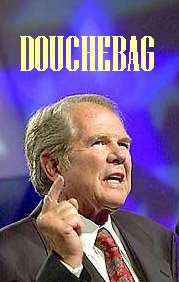
Hmm, so I guess it isn't possible for him to open his mouth without saying anything stupid. Which means I get to recycle a picture used by Brian F. of the MIT posse, back when Robertson advocated assassinating Hugo Chavez:


My heartfelt apologies to douchebags everywhere for the unfair comparison.

Friday, November 11, 2005

Remembering

James Joyce once famously said that the best way to write an anti-war novel is to not write a novel about war. In the years since I first read that little piece of wisdom, I've gone round and round a few times in terms of whether I agree or not. In the end, I think it's an insoluble question -- when we engage artistically and aesthetically with the issue of warfare, there is always an extent to which the material must embrace its subject matter, must lose a certain amount of critical distance and hazard becoming in some small part a glorification. I think this was Joyce's principal insight, something echoed by the great film auteur Francois Truffaut, who maintained that there can never be any such thing as an anti-war film because the medium inevitably turns it into a thrilling spectacle.
At the same time, art offers the most powerful and poingant critiques of war, critiques whose rhetorical force vastly eclipses the academic or journalistic, which can so easily stray into pedantry. Who recovers quickly from the gut-shots of such novels as Mailer's The Naked and the Dead, Hemingway's A Farewell to Arms or Heller's Catch-22? or films like Apocalypse Now, Full Metal Jacket or A Bridge Too Far? paintings like Picasso's Guernica? poetry like that of Wilfred Owen? And yet each in its own way aetheticizes warfare, or else (as in Catch-22) renders it as an experience so absurd as to pull the teeth of its own critique.

I'm pondering this today for a variety of reasons:

  1. It's Remembrance Day
  2. I've been watching the HBO series Band of Brothers
  3. An article in the most recent Harper's Magazine has put me into this head space
  4. Mulling over these heavy questions is vastly preferable to grading essays
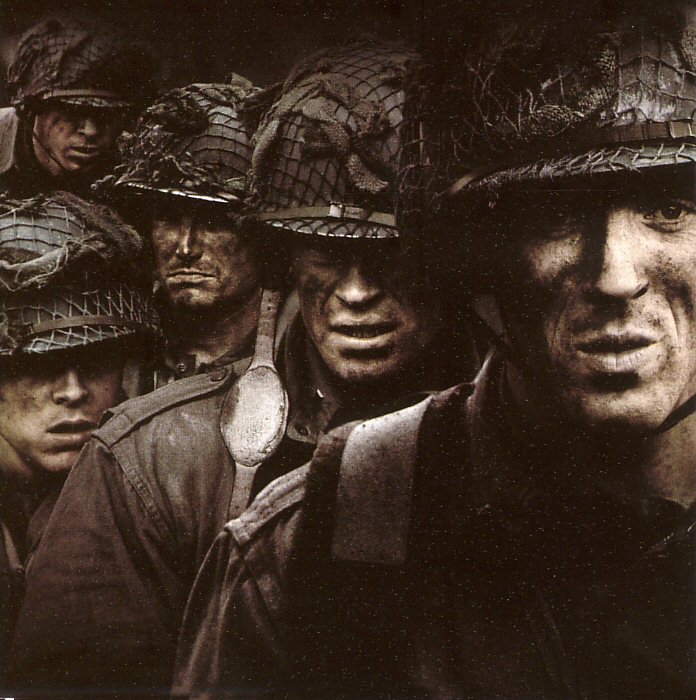
Band of Brothers, like pretty much everything else HBO has done, is truly remarkable -- the more so because (from what I'm gleaning) has no pro- or anti-war agenda. It is really just about the experiences of a specific company of soldiers from Normandy onward, and does an extraordinary job of rendering what I imagine things were actually like (this of course being the sticking point -- I can only imagine). I find it slightly ironic that the series was produced by Tom Hanks and Stephen Spielberg; it is everything that Saving Private Ryan tried, and failed, to be. If ever there was a film trying desperately to be anti-war that ended up becoming a cliched glorification, that was it.

The Harper's article I'm referring to is titled "Valkyries over Iraq" is sort of an extended review of the film Jarhead, something I'd had no interest whatsoever in seeing, but now am keen to do so (for a very intelligent and thoughtful consideration of the film, see Mister Eano's comments here). The film is based on the memoir by Anthony Swofford, a marine sniper who saw action in the original Desert Storm; the Harper's article focuses on a particular scene in which marines are riled up to a bloodthirsty fervour by being shown war movies -- and the movie in question is Apocalypse Now; the scene depicted is the infamous "Ride of the Valkyries" raid by Robert Duvall's airborne cavalry on a village at the Mekong Delta so the film's main characters can begin their journey upriver.
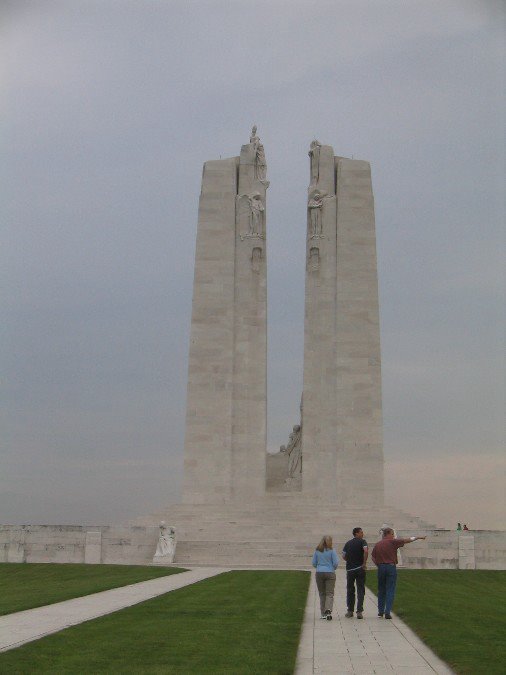
As the article points out, Apocalypse Now is eminently an anti-war film: yet here a movie theatre full of marines, all intimately familiar with the sequence, shout in enthusiasm, speak the lines in unision with the film, and generally get entirely juiced by the depictions of violence meant to give audiences a sober consideration of war's horror.


The thing is, the scene is pretty thrilling -- not so much because of the violence, but because it's a piece of first-rate filmmaking. The very genius of the sequence is to inspire a certain engagement ... it really wouldn't work otherwise, and to a certain portion of the audience, our satisfaction and empathy is the most horrifying thing about it. We can't help liking Robert Duvall's psychotic colonel, and somewhere in ourselves agreeing that we love the smell of napalm in the morning.

But of course, here is the problem with aestheticizing war (or anything, for that matter): nuance only works for some. Which is not to make a simplistic division between "smart" and "stupid" audiences -- we all have our own idiosyncratic buttons, and that which pushes those buttons and inspires a certain reaction in me will do something entirely different for someone else. No, what I mean is that any engagement with something emotionally charged one way or another poses dangers for the artist in that if one wishes to approach something truthfully there is, necessarily, the need to embrace it. The world is full of bad art that is pedantic. Really, that should be left to professors like me.

But all this is central to the whole issue of remembrance, too ... how do we pay homage to our veterans while abhorring war? It's questions like this that make me understand the appeal of conservatism: if war is invariably a valid option, there's no concern here. Unfortunately I cannot quite separate myself from my liberalism, nor can I embrace the other militant side of the equation that tars all militarism with the same brush. Hence, I found myself in a strange emotional situation about a week ago ...

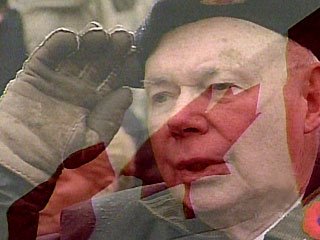
I got the poppy I've been wearing this past week from a very frail-looking elderly veteran sitting at a card table outside the liquor store near campus. He was in his dress uniform with a myriad of honours pinned to his chest, reading a paper, and looking (to my overly sentimental mind) rather lonely. And so very very old and tired. It occurred to me there that we will very soon no longer have any living witnesses to this century's two world wars, no more actual people to remind us of those momentous, excruciating and tragic events, and our collective memory will be relying on archives, history books and (sigh) Hollywood.

I'm not given to weepiness, but I found myself actually fighting back tears. I dropped a ten-dollar bill in the donation box, which prompted a pleased and surprised "Thank you" from the veteran. I wanted to say, "No, thank you," but I didn't actually trust myself to respond, so just nodded, pinned on the poppy, and left.

It was a very odd moment. While being an avid consumer of war movies, novels and history books, I'm hardly a pro-military aggression person. Quite the opposite: in so very many ways I am the stereotype of the anti-war milquetoast lefty liberal. I abhor what's currently happening in Iraq; I was pleased beyond words that our Prime Waffler kept us out of that war; and I adhere to the quaint notion that wealthy nations with advanced and powerful militaries are morally obligated to lead with the olive branch, even when that entails suffering at the hands of a lesser force. My fascination with representations and histories of war in fact has much to do with not really getting it, not understanding the drive to aggression. I watch and read and study in the hopes of understanding. That, and there's the added fascination that comes with instinctively knowing I would be a thoroughly crappy soldier.

At the same time, I am immensely proud of my country's military history. Little known fact: we have the third best-trained military in the world, just behind Israel and Switzerland. And so on Remembrance Day I always make a point of paying tribute to our soldiers, particularly considering that my little brother was one for a while.
I have at times be given grief over this by leftier or pacifist acquaintances, who have considered this mere glorification ... who have believed that straightforward denunciation of militarism in all its incarnations is the only acceptable moral stance -- ergo, wearing a poppy in tacit support of both veterans and active soldiers is the equivalent of celebrating violence and warfare.

Suffice it to say, I consider this mere idiocy -- simplistic, reductive idiocy that is the flip side of unthinking jingoism. And worse, it's lazy thinking. Not even Noam Chomsky buys that line of thinking.

It is in fact Chomsky that made what is, for me, the most critical distinction between systemic militarism and individual action: namely, that the individual soldier's behaviour on the battlefield has more to do with the general philosophy or lack thereof informing those at the helm of the war machine. He was speaking specifically about Vietnam, saying that such tragedies as the My Lai massacre, while horrific, should be, in the morass of ambiguity about that that war was about, hardly surprising. Chomsky actually decried the practice of villifying soldiers returning from Vietnam -- arguing that while, yes, they had their own morality to answer to and should certainly not be excused for war crimes, the genuine criminals are those who prosecute such a war. And while he was talking about Vietnam, I think the events at
Abu Ghraib are of a similar character; it is criminally naive to imagine that this was merely a few bad eggs acting outside any authority. There is, to my mind, a direct causal line from Donald Rumsfeld to Lynndie England. If there's a metaphor for the US presence in Iraq, Abu Ghraib would be it.

Actually, as with so many things, Shakespeare said it first. A soldier in Henry V's army warns the disguised king -- not knowing to whom he's speaking --
that if the kings cause for war "be not good, the king himself hath a heavy reckoning to make, when all those legs and arms and heads, chopped off in battle, shall join together at the latter day and cry all 'We died at such a place'."

I say all this by way of saying that, whether we agree with the motives behind a given war or not (and as far as WWII is concerned, I think that's a no-brainer); whether we abhor the violence of warfare or not; whether one believes in the need for a military or not -- I believe we have a debt of gratitude to our soldiers, active or retired, living or dead. If the cause be not good, deplore the war and those who orchestrate it, but honour those who fight it.

Wow, this was a long post. If you made it to this sentence, thanks for your tenacity. :-)

Tuesday, November 08, 2005

The Command Module, or My Niece the Cyborg

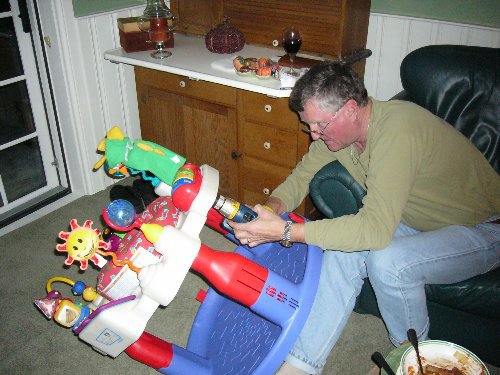
Some assembly required.

"Ah, at last -- my cybernetic augmentations!"
"The firing system for the lasers must be somewhere here ... "

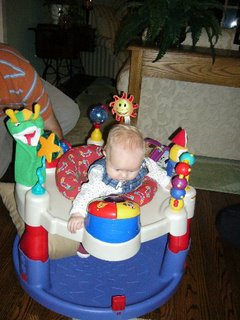
"Ahh! Dad, no! I haven't finished merging with the machine yet!"

"That's better. Now, to world domination and beyond!"
Sunday, November 06, 2005

I exist! At long last, I exist ...

... at least in terms of the English Department's web site, where I'd been a nonentity since my arrival in August. But now I'm listed on the faculty page, along with my specializations, educational background, and contact info. Of course, now the margins on the page are screwed up, and they've got my office phone number wrong, but who am I to complain?

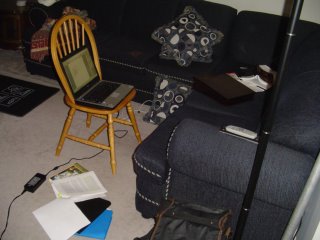
So, riddle me this: at long last I have a living space with my very own office, and yet when I've been doing work at home this weekend and last, I set up my laptop in the living room thusly:


I'm truly insane, I think. It's not even a particularly comfortable way to work, but it's proving to be a whole lot more productive than when I work in my office. This I do not understand, but then doing work at home as opposed to the office has proven sketchy at best this year -- so if this setup is working I'm not going to knock it, other than to offer a big ????? about my dodgy psyche.

I do wonder however if I've managed to effect such a radical separation of home and office that my home-office -- or "study" I imagine would be the better word now -- is anathema to getting work done ... and having the laptop set up on a chair in the living room emphasizes to some idiotic part of my subconscious that this is merely temporary and we'll be getting back to the couch-melding and TV-zoning that is the room's primary function -- and in the process perform a psychological sleight-of-hand that lets me actually get a productive day of work at home done.

It's a good thing my subconscious is kind of stupid.

------------------------------

Well, it's definitely November here in St. John's, as was heralded by our first actuall snowfall yesterday. That did however give way to a brilliant fall day this afternoon, so I went for a long walk enjoying the crispness of the air.

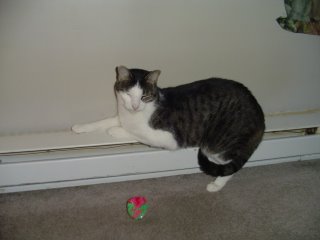
It's also nice that the temperature is now holding steady, as opposed to the up-and-down oscillations that make the question of where to put the thermostat a bit annoying ... finding yourself by turns waking up to a freezing room, or coming home to something slightly short of a sauna, depending on what the weather's doing outside. At least steady cold answers the question for you, and also provides cute pictures of a cat deprived of sunbeams:
Thursday, November 03, 2005

Morning and Arcadia

I'm starting to get the hang of this early-rising thing. I've been in my office by 7:15 every day this week. It's still excruciating to get myself out of bed when the alarm goes, but I'm getting into the groove of putting in that hour or so of work before the rest of the department starts trickling in. The only person there when I arrive is a very sweet member of our janitorial staff (sweet, because she forgave me for accidentally scratching the hell out of a hallway she'd spent a week waxing, when I dragged my bookcases all the way from a storage room into my office).

Anyway, we have our routine ... when she sees me she says, "Put out wit' the cat this mornin, were ya?" To which I always say, "No, no ... the cat gets to sleep in."

Not the most witty repartee, but when there was someone else doing the rounds one morning, I missed it. Odd how these things settle into you.

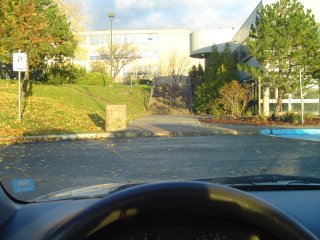
The waking process has been made easier this week by daylight savings time ... although it's now invariably dark when I get home, I get to drive to work in the daylight, and my office is nice and bright when I walk in. In fact, this morning it was quite brilliant out -- enough to give me pause. And for once I had my digital camera on me.

It occurs to me I haven't posted any campus pictures. Well, here's the view from my car in the parking lot at 7:15 this morning:

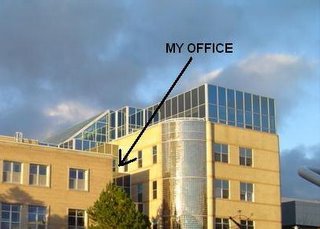
My building:

This is where my office is. Unfortunately, you cannot see it here -- the window looks out on the roof joining the original Arts & Admin Building and its newer Annex. It's on the third floor there, just tucked around the corner. Not the best view, but at least it lets in light.

In other news, I was reminded the other day that the English Department's November show at UWO is up and running! Something near and dear to my heart, given that I directed it three years running, 2001-03 -- Rosencrantz and Guildenstern are Dead, Major Barbara, and Macbeth. Ah, memories ... My fondest memories are for Macbeth, except for a single cast member who will remain nameless (in part because you're not supposed to say his name, especially in theatres -- you know who I'm talking about, people). Possibly the best cast & crew I ever worked with, again with that one exception.

Which makes me delighted that my magnificent Lady Macbeth, Jo Devereux, is directing this year's show. And she's chosen one of my all-time favourites, Tom Stoppard's Arcadia. Which makes me deeply, deeply jealous that I cannot be involved in any way. And missing, quite painfully, that theatre community we had there. Break a leg, everyone ...

So for my London readers, GO SEE ARCADIA! Two nights left (well, three nights, but I'm guessing that if you're not already on your way to the theatre right now, you're probably not planning on seeing it tonight). 8pm, Talbot Theatre on UWO campus. First of all, it's an amazing play, one of Stoppard's best -- even rivaling Rosencrantz and Guildenstern. Secondly, with Jo at the helm it promises to be a solid production. Thirdly, it stars my dear friend Scott Brubacher, a wonderful actor and brilliant composer (he did the music for the show). And fourthly, if you go closing night, hang out to help strike the set and mention my name, you might just be permitted into the cast party. Apparently, they're continuing the sangaria tradition I started, which is enough of a reason in and of itself (way to carry the torch there, McCubbin!).

Jo sent me some rehearsal pictures, so here's one I thought was nice: Scott as the tutor Septimus Hodge, and Seema (whose last name I don't know, sorry) in the lead as the precocious Thomasina:
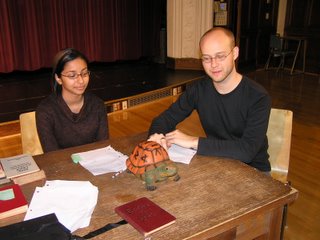

Don't let the surroundings fool you -- that's a rehearsal shot in Conron Hall. I'm going to guess that the sets and the costumes in Talbot Theatre will be somewhat more lavish ...

I especially like the tortoise. Apparently he was found at Canadian Tire.
Wednesday, November 02, 2005

Serendipitatious

I torment my students on occasion with "fun with words," impromptu little vocabulary or etymology lessons. Sometimes it's apropos of what we're studying; sometimes it's just me getting exuberant over certain words I just think are cool. Lately, the mot du jour was "specious," which gave me an excuse to quote Lisa Simpson's use of it vis a vis the bear patrol. That of course led into a explication of certain logical fallacies, most notably post hoc, ergo propter hoc. Which, incidentally, is a phrase I know solely for the fact that it was used on the West Wing once.

Wow, I can really get pedantic sometimes, no? Ah well. Deal.

Other favourite words: malevolent, quotidian, melifluous, amsculescent, putative, dessicated, illuminati, liminal, interstitial.

OK, I made one of those up.

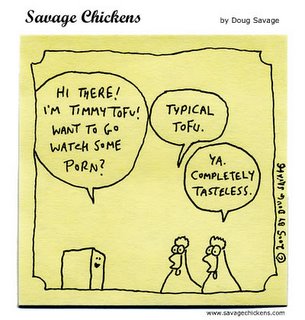
Anyway, the one running through my head today is an all-time favourite: serendipity. Defined basically as a happy coincidence. It's making the rounds because of today's Savage Chickens posting. Savage Chickens, listed among my favourite links here, is a blog of insane chicken cartoons that range from the groanworthy to the inspired ... and I used one a few posts ago to punctuate my entry on the fading appeal of boneless-skinless-chicken breasts (yet another fascinating episode in my intellectual musings). During the post I briefly considered and quickly dismissed the possibility of turning to tofu. And then this morning? This cartoon:

Glass houses, chicken-dudes. But seriously, if you haven't yet done so, check out Savage Chickens ... truly inspired.