Friday, May 19, 2006

Step into my office ... that would be the second booth on the left in the Grad Club ...

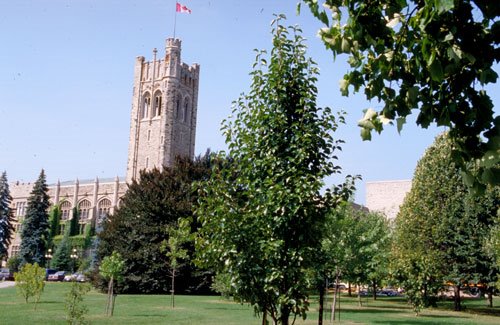
Well, I've been in London a week now, and it is rather nice to be back. It has been strange being here after almost a year away -- it feels on one hand like I never left, and on another like years and years have past. I think one (rather wonky) part of my subconscious half expected to find the place deserted and overgrown with trees and brush like some Rip Van Winkle post-apocalyptic nightmare. But no ... just the same as I left it, ivy-covered faux-medieval architecture and all.

I should probably offer two apologies: first to friends here in London I have not yet contacted, and people back in St. John's I really owe an email or two to. To the first group: coming soon! I've spent the last week getting settled, and getting into something resembling a routine. I think an evening of beer and Rick McGhie at the grad club is necessary, but I also want to see people on individual bases ...

That being said, it is perhaps unsurprising just how many people I've seen just sitting at the Grad Club. Sooner or later, everyone comes through ...

Because yes, in the absence of something resembling office space, I have more or less ensconced myself in one of the GC booths, where I spend mornings and most afternoons reading and making notes ... reading and making notes ... interspersed by visits to the library and a lunchtime workout. Not a bad gig, really ... I saw my former student Sarah on Tuesday while working away, and then again this morning while in more or less the exact same place and attitude, prompting her to ask whether I had actually moved in all that time. I should probably pay the GC rent or something.

I'm liking this whole research term sans teaching thing. It's lovely to be able to devote my whole attention to a single (well, three) projects ... I feel studious again for the first time in a while.

And what projects am I devoting my time to, you ask? (Actually, I'm fairly sure you didn't ask, and I'm fairly certain you don't care, but hey -- who's blog is this, anyway?) Three big ones, and a few odds and sods ... first off is my next major research project, for which I have to submit a fairly hefty grant proposal in September. And I thought the SSHRC doctoral fellowship application was intense! This one, wow. Danine was kind enough to give me a copy of hers from this last year, and it was only as I was flipping through that MASSIVE sheaf of papers that I fully appreciated the task.

So that's number one. I'm also developing a web-based course on modern American poetry, which I've been having fun with. And I have to return to my thesis, and get serious about getting into book form in order to shop it around to publishers ... a process that I look toward with about as much anticipation as I would a root canal, but it must be done.

Occupying my attention this week and next however is one of those typical academic corners we like to paint ourselves into, the writing of a conference paper based on an proposal written months ago. It never fails -- we see a conference we'd like to or feel obliged to attend, whip up a 500-word abstract, get accepted as a presenter, and then forget all about it until a few weeks (or days) before the actual conference ... at which point we're looking at what we proposed and slowly realizing that this subject might not actually be workable.

Ack. Well, I can happily say my paper isn't in a situation quite so dire, but it's still experiencing some rather nasty birth pains. Fortunately, it's a fun topic ... I'm doing a paper at the Congress of the Humanities under the auspices of the Film Studies Association of Canada (FSAC) on that lovely 1960 film The Apartment, directed by the inimitable Billy Wilder (Double Indemnity, Some Like it Hot) and starring Jack Lemmon and a disturbingly gorgeous young Shirley Maclaine. I won't bore you with the details, other than to say if you've never seen this film, rent it! And then rent Double Indemnity. Seriously. Good for the soul.

So anyway, I hope everyone has a great May TwoFour ... K and I will be keeping a low profile and relaxing at home with good food and good wine. The weather -- she don't look so good for the weekend. So cocooning seems in order. We will of course be thinking of The Laura, who for reasons passing understanding agreed to go camping with some people from work. When the weather reports looked not happy, she decided to back out, but Oh! Got guilted into it. Alas. So we'll be drinking our coffee tomorrow morning and looking out at the rain and thinking of Laura's sodden sleeping bag with something approaching smirks on our faces.

Sunday, May 14, 2006

Day 'o da moms

Just a quick blog today in honour of Mother’s Day—a paean to mothers everywhere, but especially my own, who is possibly one of the most amazing people I have ever known.

While Kristen and I drove up to see her mom today here in London, we passed a lot of people very obviously on the same sort of mission: the tall young woman precariously balancing a large flower arrangement, numerous people at the Superstore mobbing the flowers kiosk, and one big burly biker-looking guy walking down Adelaide with a 24 of Canadian slung over one shoulder and a carton of cigarettes in one hand.

Of course, it’s entirely possible that this guy wasn’t en route to see his mom, and the beer and smokes weren’t Mother’s Day gifts, but I prefer to be optimistic on this. And anyone who’s ever been east of Adelaide here in London recognizes the distinct possibility.

So: to mothers everywhere, but especially to my own, happy Mother’s Day!

Friday, May 12, 2006

Road listens

As already mentioned, I spent much of my time on the road this past week in silence, lost in thought, reflecting on both the year past and the one upocoming. I didn't spend it totally in silence however; I also passed a great deal of time listening to dramatic CDs ... not music for the most part, but a great selection of old-fashioned radio plays courtesy of my friend Gregg and the good people at his operation at Decoder Ring Theatre.

I've blogged about Gregg's stuff before; the original six episodes of The Red Panda still stand, in my mind, as a classic homage to The Shadow. Gregg and his peeps are now up to episode nine of what I guess are the prequels: in the days before the Red Panda was Canada's greatest elite Nazi-busting spy, he was a superhero keeping the streets of Toronto safe with his sidekick the Flying Sqirrel.

And as an additional treat, he's also created six episodes (so far) of a hard-boiled series titled Black Jack Justice, which follows the noirish exploits of private dick Jack Justice and his partner Trixie Dixon, Girl Detective.

All episodes downloadable from the Decoder Ring Theatre website, link provided at the right here. A strongly recommended listen -- it certainly helped the miles fly by.

Thursday, May 11, 2006

Journey's end ... almost

Day 3 - Monday, May 8
Edmundston to Montreal

There's not much to say about this leg of the journey, except that the stretch of highway from Riviere de Loope to Montreal retains its title for most soul-destroyingly dull drive ever.


Seriously. Though my drive time was only slightly more than half as long as my previous two days, I was starting to go snaky after the first two hours. It felt as if it was a ten-hour drive, whereas my two previous ten-hour drives passed quite quickly and happily. This was exacerbated by my rude re-introduction to traffic ... after two days of blessedly empty highways, I was suddenly jockeying for position with hundreds of cars and trucks. It was enough to make me claustrophobic.

The payoff however is that this stretch of highway does ultimately bring you, however excruciatingly, to Montreal .... Montreal, where the rude re-introduction to traffic continued and I realized just how accustomed I had become in the previous nine months to the streets of St. John's and that city's particular dimensions. I was staying with my friend Amanda, who works as a manager at the downtown Chapters on Rue St. Catherine ... trouble was, I couldn't remember exactly where on Rue St. Catherine the store was, so I essentially circumnavigated the city center for about an hour until I found, after two abortive attempts, parking in the general vicinity of the Chapters. A hour of city driving ... in which time I could have crossed and recrossed St. John's about six times.

And to think, I used to be an urban driving pro ...

At any rate, destination found. I arrived in the city at 2pm local time, and found parking by 3:00. Amanda got off work at 6:30, so I went in search of lunch -- having a lovely sandwich at Cafe L'Etranger -- and then set myself up in the Chapter's Starbucks with my laptop, a latte, and a good view of the street below. As I expected, Amanda eventually saw me as she wandered past, and, taking my bag into the back room for safekeeping, sent me out for wine for dinner.

Amanda's partner Michael (the guy on the far left in the picture in my post about Jer) is in Shanghai on business (the business of designing and testing video games -- jealous anyone?), and her mom was there to help out with their daughter Sarah. So we had a very hearty dinner (cheese and onion pie!), and then sat up fairly late working through the wine and talking.

Amanda's one of my favourite people, another alumnus from the notorious Richard III production mentioned a few posts ago: costume designer extraordinaire (also working on the Macbeth I directed in 2004), den mother for helpless actors, and great friend. We can, and did, talk for hours ... and with a significant amount of wine in our systems, it made for a rather groggy morning as I drove her to work and then continued on to TO the next day.

Departed Edmunston: 10:00 am (local)
Price of gas: $1.15
Price of gas in Quebec: $1.13
Arrived in Montreal: 3:00 pm (2:00 local)
Found parking: 4:00 pm (3:00 local)

Total distance: 541 km
Total driving time: Five hours exactly (more or less, not counting city exploration)


Day 4 - Tuesday, May 9
Montreal to Toronto

Everyone will have noticed by now that I have been keeping track of gas prices. This is because it seems that the farther west you go, the cheaper it gets -- to the point where, gasing up just outside of Kingston, the price had dropped as low as $0.99 a liter. That's a twenty-one cent difference between St. John's and Ontario. My point? People in Ontario aren't allowed to complain about gas prices to me this summer.

The last leg of the journey was uneventful ... the biggest excitement coming in simply trying to get out of Montreal, as my St. John's driving mentality again caught me out unprepared. Rush hour in St. John's is between 8:30 and 9:00 ... I'd forgotten that rush hour in a big city like Montreal effectively starts at 7am and basically runs until ten. So leaving Amanda's place at 7:30, I was thinking to myself in satisfaction that I'd be ahead of the madness.

Ha.

It took me a little over an hour to make it past the city limits.

Departed Montreal: 7:30 am
Left city: 8:35 am
Price of gas: $1.08
Price of gas just over Ontario border: $0.99
Arrived Toronto: 1:50 pm

Total distance: 535 km
Total driving time: Five hours, twenty minutes

TRIP TOTALS
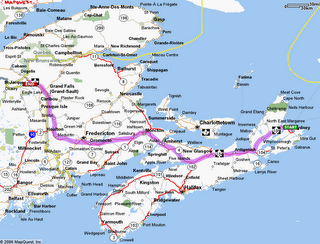
Distance: 2959 km
Time: Twenty-nine hours, twenty-five minutes
$$$ spent on gas: $271.40


But as my title indicates, the journey isn't entirely over ... the last leg awaits on Saturday, a mere two hours to London. So hear that, London peoples! I'm back in town soon. Let the kegs be tapped! I'll be sending out an email soon to everyone with contact info ...

And as for the TO types, I'll be back in town for five or six days for the Congress of the Humanities at the end of the month. More updates to come.

Wednesday, May 10, 2006

30 hours on the road

OK, so my original plan had been to give updates all the way along, posting from whatever computer was available. And it's not that those opportunities weren't there ... I just found, oddly, that after ten hours behind the wheel my preferred activity was motionlessness.

I write now in my parents' study, having pulled into TO yesterday afternoon, the end of the fourth of four days of driving. It was as if the world had suddenly turned green; the leaves and buds in St. John's hadn't yet emerged, and the landscapes alongside the highways I drove, especially as I got closer to Ontario, were generally blasted and dun-coloured. So turning off of Bayview Ave. and into my parents' neighbourhood -- an area very well-treed -- was to be dazzled by the depths of the greens and the sumptious spectrum of flowers and buds in the many gardens. It was like a very sudden shift from early spring to mid-summer.

It's good to be home.

And now for the much-delayed travel log.

Day 1 - Saturday, May 6
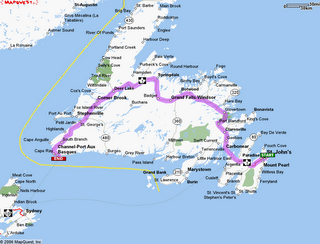
St. John's to Port-aux-Basques

In spite of reports of rainy and foggy weather for the weekend that had been looming, I couldn't have asked for better weather for the cross. The only nastiness came in the form of a brief but extremely thick bank of fog blanketing the isthmus connecting the Avalon Penninsula to the rest of the Rock, and then in the last hour or so driving into Port-aux-Basques. More on that in a moment.


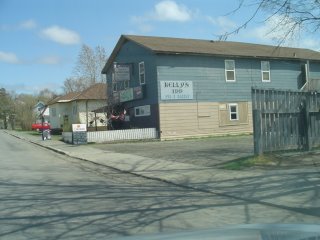
I stopped for lunch in Grand Falls-Windsor at 1:00, and spent some time driving around in search of a lunch that would be something more substantial than merely fast food. I finally stopped at a sort of skanky-looking pub called Kelly's Inn, but then I've often found that, pub-wise, a skanky exterior sometimes disguises some halfway-decent local colour.


Walking in, we went abruptly from skanky to skeezy, and for a moment I feared for my life as the denizens -- a group of guys slumped around a table crowded with empties, all of whom made the Trailer Park Boys look like the cast of Seventh Heaven -- swivelled the heads to stare at me. No, there was no food to be had here (thank god). The one woman at the table, who I took to be the one actual employee of the place, helpfully made some eating suggestions, and I exited as nonchalantly as I could.

And found myself a mere block or so away at a lovely little bistro called the Bluefish, eating braised BBQ beef on a crusty bun with a garden salad. Talk about going to extremes.

As I mentioned in my previous entry, the drive was quite pleasant, and I made very good time ... it only started to drag a bit toward the end, in the last hour or two as I made my way to the south-western extremity of Newfoundland. It was at this point that the weather changed rather dramatically: where the temperature had oscillated between about eighteen and twenty degrees all day, it suddenly dropped to seven, and I found myself driving through a chill, acrid fog that got thicker as the sun went down. Driving at ten o'clock from the Hotel Port-aux-Basques to the ferry docks was a wee bit scary, as there were no streetlights, and the rain that was falling through the now-impenetrable fog did not wash off the dead bugs on my windshield so much as smear them in a translucent film that diffused what light there was into bewildering hazy shapes.

But I made it, and after a short wait was loaded onto the ferry. I very fortunately had a cabin, and so slept the way across.


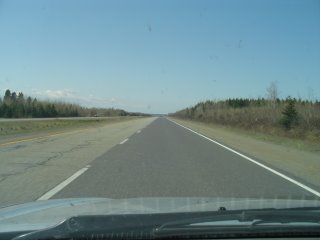
One of the typical views to which you're treated through the eastern half of the island:


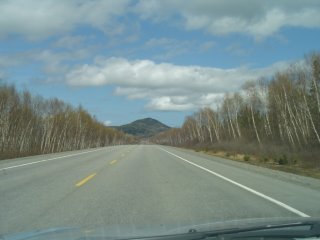
A tunnel of birches:


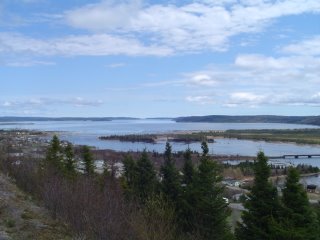
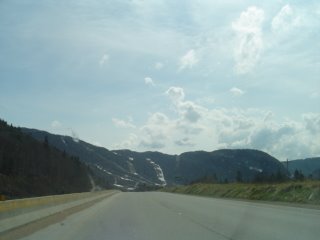
An initial view of the more mountainous west coast:

Departed St. John's: 8:20 am
Price of gas: $1.20/L
Arrived Grand Falls-Windsor: 1:00 pm
Departed: 1:45 pm
Arrived Corner Brook: 4:15
Departed: 4:45
Arrived Port-aux-Basques: 6:45

Total Driving Time: Eight hours, forty minutes
Total Mileage: 928 km

Arrived at ferry docks: 10:20 pm
Boarded ferry: 10:45


Day 2 - Sunday, May 7
North Sydney to Edmundston


I was woken up in my cabin at 6:30 by the announcement that we would be pulling into the docks in an hour; so I dozed for another twenty minutes, and was in the process of getting myself together when the half-hour warning came on. I dragged myself out of my cabin and down to the cafeteria to wake myself up with a coffee that tasted something like warmed-over battery acid while the gray water slid by outside. I was rainy and foggy still, and would be all the way through Cape Breton.

There's something very cool about driving on and off ferries. I'm not entirely sure what the novelty about it is, unless it's the odd feeling of "docking" your car with a larger vessel ... sort of like boarding the mother ship or something. Anyway, there was a sort of sense of satisfaction in watching the vehicles beside me driving off and down the ramp onto the highway, and then following them myself.

The fog and the wet lasted exactly as long as Cape Breton lasted -- emerging as I did finally into sunshine just before the Canso Causeway that takes you across to the mainland. It was a bit of a shame that the beautiful Cape Breton landscape was shrouded in fog, but there was something haunting about it, too ... making it rememble Scotland just that much more, perhaps.

The drive to Edmundston was pretty uneventful. I stopped for food and gas in Amherst, just short of the New Brunswick border, and for gas again in Fredericton. I had planned to play this leg of the journey by ear -- to see how tired I was before pushing on past Fredericton. I was feeling pretty energized still however, and so decided to go for it and make for Edmundston, almost right on the Quebec border.

It was a long drive, but it didn't feel long ... I spent much of it with the music turned off, just sort of being in my head and thinking. The Trans-Canada through New Brunswick parallels a series of long lakes connected by rivers, and I couldn't help thinking that the highway's architects wanted us to think of the original water routes that explorers had to take ... barrelling along at speeds unimaginable only a century ago, it's rather humbling to think of how much we take the ease of travel for granted. My most significant preparation for travel, besides packing, was to buy a cell phone in the event of a flat tire or similar breakdown ... an inconvenience of a few hours, as opposed to the catastrophes of weather and landscape and food stores that confronted our predecessors. (Though given the predominant food offerings along the way, scurvy could still be a very real factor).

I made it into Edmundston at 5:30, and holed up for the evening in a Comfort Inn that was perched on a promontory like a castle or fortress.


If I owned that particular franchise, I would consider dressing it up like a castle or a fortress ... it could become a tourist attraction in its own right.

Drove off ferry into North Sydney: 7:50 am (7:20 local)
Price of gas: $1.16
Arrived Amherst: 11:45 am
Departed: 12:30 pm
Arrived Fredericton: 2:30 pm
Price of gas: $1.14
Departed: 3:00
Arrived Edmundston: 5:30 pm

Total Driving Time: nine hours, fifty-five minutes
Total Distance: 955 km

More tomorrow!

Saturday, May 06, 2006

Across the Rock

I write this entry on the computer in the lobby of the Port-aux-Basque Hotel. Pulling into Corner Brook -- where I'd planned to spend the night, then push on to Port-aux-Basque tomorrow to catch the evening ferry -- at 4:15, it occurred to me that I had made great time, the weather was amazing and it was too bad I didn't have the ferry booked for tonight. And then I remembered -- bookings can be changed! What a wonderful world we live in.

So I called Marine Atlantic and switched my ferry ticket to tonight, hopped back in the car ... and here I am. Killing time in a hotel bar doing the Globe crossword and looking out at a very foggy night.

I'd been told by numerous people that the drive across the Rock along the Trans-Canada is mind-numbingly dull, so I was pleasantly surprised to discover otherwise. Oh, don't get me wrong -- there are some painfully long sections of forested blandness, but they are fortunately punctuated by some lovely scenery. The drive is such that you frequently catch glimpses of picturesque inlets and coves and lakes; it's kind of like Ontario cottage country for about the first two thirds, and then once you're into the more mountainous western region starting around Deer Lake, it becomes more consistently beautiful. Pictures to come.

As I said, I made good time ... I looked up three different estimates for the duration of the drive from St. John's to Corner Brook: MapQuest, Google Maps, and the time/distance guide on my Rand McNally map of Newfoundland. MapQuest was the closest to the actual time it took me at 7:44. Google and Rand McNally, on the other hand, would seem base their estimates on the likelihood of the driver being a 90-year-old man driving an antiquated Dodge Dart: 9:56 and 9:11, respectively.

My driving time, not counting stops? 6:40. Add a further two hours even on that from Corner Brook to Port-aux-Basque, and I fell just short of a nine-hour day of driving. And yet, it flew by. Quite the pleasant outing, if I do say.

Plus, I saw a moose.

Friday, May 05, 2006

Thoughts before departure

On the eve of departing for Ontario, I find myself reflective. Leaving somewhere for three months requires a lot of thought, particularly when a significant part of my transportables consists of research materials. One way or another, I know there's a significant book or file I've left behind ... but then, I guess that's what libraries are for.

It feels odd, returning to London for such a long stretch of time. It will feel even odder, I'm sure, going back in August, as I'll be returning to St. John's at more or less the exact same time a when I first arrived in the city last year. Full circle.

As for now, the feeling is that of a year come to an end, my first year at MUN and my first year as tenure-track faculty. What's heartening is that I leave this school year extremely excited about next year's prospects ... heartening that after the growing pains, hard lessons and occasional near-exhaustion of the past eight months, I'm not looking at this summer as recuperation so much as simply continuing on a somewhat different tangent.

I feel as though I switched gears mentally at some point, and finally shifted out of the part-time mentality that by necessity worries incessantly about the next period of employment and, because of that, has difficulty visualizing long range plans. Or, I suppose I shouldn't generalize: that's how my mind worked in that situation.

(As an aside, I was quite surprised by the quasi-firestorm my entry on tenure issues touched off. Kind of cool, actually -- I never know what subject matter is going to push buttons. I do love starting a vigorous debate! A number of people here who follow my blog were quite intrigued by the whole interchange).

Anyway ... part of the reason I'm stoked about next year is that we're starting to see the faculty turnover happening in a serious way. MUN's Department of English is seeing twelve full-time faculty retiring in the next three years, this on the heels of some more substantial retirements that have happened in the years previously. We've hired a new Americanist (yay!) with whom I'm looking forward to working; and we had the great good fortune of having a spousal hiring dropped in our lap (for the non-academic: when someone with a spouse in academia is hired into a tenure-track position, he or she can make the hiring of their partner into whatever is his/her discipline a part of the contract negotiations; such hires, when and if they go through, do not cost the home department anything and do not count against future hiring considerations). In this case, MUN's Math department wanted to hire a new professor who happens to be married to a friend of mine, whith whom I'd done my MA at U of T. Nancy, a protege of Linda Hutcheon, is a remarkable young scholar (I look at her CV and suddenly feel the intense need to work 20-hour days), and an extraordinarily cool person too.

So the posse forms. Next year we'll be hiring (we hope) at least two, preferably three new people ... and after that? It's an odd feeling to know that by the time I qualify for tenure, I'll effectively be senior faculty.

Also, we've been interviewing candidates for the position of Dean of Arts, all of whom have to deliver a public presentation to the faculty. My thoughts of late have been turning to issues of curriculum and change anyway ... but listening to these people coming through has added a certain amount of fire to these thoughts.

This, I think, is the best part of this job -- by which I mean this job at MUN specifically, as opposed to academia generally -- that is, that the radical change and renewal that is happening at universities across the country is particularly magnified here. And I get to be a part of that.

Which is a comfort, knowing that I'll have a lot on my mind as I drive the 24+ hours from St. John's to London ... I'll have a lot to think about.

Wednesday, May 03, 2006

Leeaaavin' ... on a jet plane

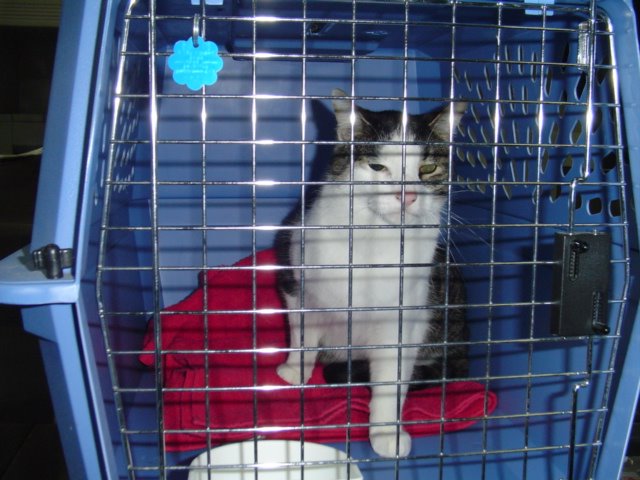
Not me, but Clarence ... this was my last view of him this morning at about 5:30am as the Air Canada Cargo guy took him away to await boarding his 7:15 flight to Toronto. The poor guy! He looked simply bewildered as he was carted off. I felt like Dr. Mengele.

But as it happens, he made the flight without incident, and my Dad picked him up at Pearson this morning. Apparently, he's still a little freaked out ... when my Mom got home from work and tried to pat him, he ran off to hide under their bed. Very un-Clarence like behaviour. He's usually a suck for the affection, and when he's not he lets you know with his claws. Not a run-and-hide kind of cat.

Though I miss him already, there's an upside in that as I clean my apartment in preparation for leaving, he's not underfoot. Any time I scrub the bathtub or do any similar kind of cleaning here, he's right at my elbow, getting in the way, watching what I'm doing with fascination. It's almost as if he's unaccustomed to seeing me engaging in such activities ...

I leave on Saturday, not to return until August ... spending the balance of the summer back in London, ON. This, as I've said before, is the sweetest part of the full-time gig: the fact that when I received my teaching assignment this time last year, the summer term was simply designated "research." It will be the first time in recent memory that I haven't had to worry about summer teaching to pay the bills. Three months (well, three and a half -- two and a half in London, one in St. John's, and two weeks in between to take in the sights in a more leisurely fashion when driving back out) of dedicated research time! Be still my heart.

So, I get to get reacquainted with the Weldon Library and, more importantly, I get to make use of the Grad Club again. And while I'm there I will be scheming to figure out a way to uproot it by the foundations and have it shipped to MUN.

So all that remains is the packing and the cleaning and getting my subletter settled in. And then -- road trip! Two days across the Rock, then three to TO with a stop at Montreal along the way. I'll have my digicam handy and keep a photo journal along the way ... hopefully I can fin hotels with wireless so I can post while en route, as opposed to all at once at the end ....

Tuesday, May 02, 2006

Stephen Colbert should have a constellation named after him

Oh. My. God.

Stephen Colbert at the White House Correspondents' Dinner? It rivals Jon Stewart on Crossfire.

"I believe democracy is our greatest export. At least until China figures out a way to stamp it out of plastic for three cents a unit."

"So the White House has personnel changes. Then you write, 'Oh, they're just rearranging the deck chairs on the Titanic.' First of all, that is a terrible metaphor. This administration is not sinking. This administration is soaring. If anything, they are rearranging the deck chairs on the Hindenburg!"

Ha.

Thursday, April 27, 2006

No hatching or dispatching, but a fair bit of matching this summer ...

O, I have pass'd a miserable night,
So full of ugly sights, of ghastly dreams,
That, as I am a Christian faithful man,
I would not spend another such a night,
Though 'twere to buy a world of happy days,
So full of dismal terror was the time!
(Richard III 1.4: 2-7)

The mopey-looking fellow in the foreground here is my dear friend Jeremy Worth, playing the doomed Duke of Clarence in the 2000 UWO Summer Shakespeare's production of Richard III. Some of you may remember him from various posts in the comments section of this blog, where he variously goes by Clarence or Jer ... and yes, he is (or his character here) is my cat's namesake. I got the little guy (the cat, not Jer) the summer I directed Richard, and in honour of that remarkable experience decided to name him after one of the characters from the play. I'd narrowed it down to Ratcliff, Catesby or Clarence ... but when I got him, he was a tiny whiny thing, and so Clarence it was.

Jer's responsible for the most oft-repeated phrase of the summer. At the beginning of his most famous speech, quoted above, the "Oh ..." at the start of the first sentence came out in this rolling, sonorous North London (England) timbre, which got affectionately picked up by the rest of the cast. At random intervals, backstage and during rehearsals and, well, any time cast members were together, you could pretty much guarantee hearing an "Aaaoooooooohhh ..." with a pronounced downward intonation pronounced by someone in the cast or crew. It's still sort of like a secret handshake for anyone who'd been in the show.

Anyway ... two big pieces of news down Jeremy-way! First, the little guy with the huge voice is getting married this summer. AND, he's been hired into a tenure-track position by the Department of French at the University of Windsor. So a great huge congratulations and shout-out from me & my blog.

ALSO ... on Canada Day, I just found out, yet another good friend of mine it tying the knot -- the tiny & perfect Emylene Aspilla, with whom I went through my undergrad at York with, is marrying her longtime boyfriend Roach (yes, Roach -- much tidier and better-looking than the name suggests). They've been living in SanFran these past few years, so it will be lovely to see them both before, on and after their big day.

Yet more evidence that we're all ostensibly growing up. Disturbing.

Wednesday, April 26, 2006

The migrant-worker model for university employment

Well, this is worrisome. Not for us in Canada, not yet -- it's a report issued by the Secretary of Education's Commission on the Future of Higher Education, addressing the issue of high university tuitions and asking why this is so. I found this on Michael Berube's blog, and his commentary on it is funnier and more incisive than whatever I'm about to write. Which doesn't mean I'm not going to write it, just that you should go read his first, and then come back.

To sum the report up: tuition has shot up by leaps and bounds because of (1) tenure, (2) inefficiency. Tenure actually falls under the larger inefficiency rubric, but it is emblematic of the universities' stubborn adherence to outmoded systems of adminitration, as is the practice of having faculty (“neither trained in nor committed to management”) in all the key administrative positions -- Deans, Presidents, Department Chairs, etc.

Tenure, so the report states, is particularly pernicious, not just because it creates a situation in which tenured professors are unassailable and unfireable, but because it is anathema to good business practice. How to correct this? Unsurprisingly, the report suggests relying increasingly upon limited-term contract hires and part-time instructors, which will be significantly less expensive for universities than full-time, tenure-track positions.

So let's think about this for a moment: what would a university without tenure look like?

This is what I tend to think of as the migrant-worker model. Imagine hundreds of PhDs and ABDs lining the roadside every morning while a truck with a university president in the flatbed with a megaphone cries out the daily needs and capriciously selects hungry part-time profs to fill teaching positions for the day.

OK, I exaggerate, but it is a model that slowly encroaches on all universities -- increasingly, courses are taught by part-time people who get paid by the course and contractual faculty with a one to three year contract.

Well, you ask: what is the problem with that? Shouldn't universities be subject to the same market forces as anyone else?

My answer -- which is only partially derived from the fact that I'm four or five years away from tenure myself -- is No! in thunder.

Yes, I have a stake in the game now myself and obviously want to maintain the benefits that accompany full-time tenured employment. But there is a misconception in the popular imagination that imagines professors cease working after that magic moment ... that they earn their salaries for teaching six to nine hours a week and doing nothing more, all the while reaping the benefits of sabbaticals and grants. (At least once a year, someone -- usually Margaret Wente -- writes an op-ed column on this very subject, invariably suggesting that professors be "forced" to work forty hours a week ... which inevitably leads professors to comment dryly that they would love to be forced to work forty hours a week -- it would cut their work-weeks by twenty hours or more).

To begin with: to use my own case as an example, I went through thirteen years of school before arriving at the point I now find myself. Five years on a BA, one on an MA, seven on a PhD. In the eight years since graduating the BA, I have seen countless friends and acquaintances get hired in solid and occasionally lucrative jobs; pay off their student loans; buy homes; etc etc. I don't begrudge them that by any stretch -- I made my choice, and lived as a student for eight years longer than was strictly necessary, all the while racking up more loans and wasting money on rent because at no point did I have the capital to buy a house. Again, not bitter about that. My point is, it's not as if I emerge from the other end of that to take on a six-figure salary. I have (almost) no complaints about my salary, but it is hardly lucrative. Even after tenure, I'm still going to be falling far short of friends and acquaintances' incomes who have been establishing themselves in their respective professions for the past eight years.

So: having been in school for thirteen years, with significant debt and no assets, it strikes me that the material trade-off is rather a disappointment. But I didn't get into this for the money -- and anyone who does is really too stupid to live. I got into this profession because I am deeply invested, philosophically and spiritually, in education, reading & writing, and the value of the intellectual in society. If I'd been interested in a high salary I'd have done law school right out of my BA.

Of course, here's the sticking-point: I'm not so altruistic to have gone through all that if there had been no prospect whatsoever of full-time employment. If the academic landscape were entirely populated with contractual jobs and part-time work, why would I put myself through all that?

Which brings me to argument #1 against the migrant-worker academy: within a generation, your ready supply of PhDs would dry up, for the precise reason I articulated above.

Argument #2? Even if there were people still keen to do PhDs, there would be no graduate programs left, for the simple reason that graduate programs by design and definition need tenured faculty to exist. How do you advise a grad student when you're on a two-year contract? How do you attract grad students to begin with without a solid and well-established roster of active and engaged professors?

Argument #3: even if we accept the demise of grad programs as they exist and radically ratchet back the standards for the hiring and accrediting of professors, undergraduate programs themselves would suffer. Why? Because of a lack of depth. We're all familiar with the stereotype of the socially inept, head-up-his-own-ass prof who is a brilliant researcher but a crappy teacher; and not a school year goes by where I don't hear someone lament the absence of some sort of set of standards in the classroom to be applied to professors (and I don't doubt that occasionally I am the object of such anger). A fair point, but in my experience that pedagocially inept professor is the exception to the rule ... more often than not, professors are quite engaged in the classroom, they want to share their ideas and research and passions with the students, and they have an investment in teaching. The point here is that I am at my best in the classroom teaching that which I know best -- I can offer my students a more nuanced, informative experience of the material when it somehow radiates from my own research and investigations. And that is something that will only get better.

Research, in other words, isn't simply about grants and excuses to travel or take sabbaticals -- it informs not just one's own teaching, but the character of a department. When teaching part-time, professors must take on a significantly higher teaching load to make ends meet; when on contract, they are similarly loaded down with an excess of courses to the extent that the job becomes a mechanical exercise in preparation and grading, with no time or energy left over for reflection and inquiry ... to say nothing of the fact that a significant number of the courses one teaches are, at best, tangential to one's own research areas (my first part-time teaching assignment? Shakespeare ... not that I don't love that topic, but as a twentieth-century Americanist, I'm not exactly the most qualified. Couple that with the fact that it was my first real teaching attempt, and I'm often tempted to send all the students in that class notes of apology).

The desire to apply business models to education, which is what essentially informs this report, is exceptionally dangerous and damaging -- just look at the education system in Ontario after ten years of Mike Harris' Common Sense Revolution, which treated grade schools and high schools with this very sort of business model. "Efficiency" was the watchword there too, and Ontario schools won't recover for years. The point of education is that it is singularly inefficient. Why? Because it is something whose "product" is not goods and services, but people and minds. Indeed, the "product" of the modern univeristy as theorized by Immanuel Kant and Wilhelm von Humboldt was citizens -- or more specifically, an intelligent, educated, informed and engaged citizenry. Not, you will note, "taxpayers." Citizens. We don't hear that word much anymore, do we?

OK, I've ranted long enough. I just hope our dear prime minister doesn't read that report and start getting any ideas.

Monday, April 24, 2006

Revising sucks

Whenever I set myself to the task of revising a paper or article, I always think of that opening scene in Glengarry Glen Ross when Alec Baldwin comes into the real estate office and harrangues the staff with an expletive-strewn pep talk whose bottom line is "A-B-C! Always Be Closing!" And at one points shouts at Jack Lemmon, who's gone to get himself a cup of coffee: "Put the coffee down! Coffee is for closers!"

Yup. I don't get any coffee. Because it takes me forever to close. Because I hate revisions with the white-hot intensity of a thousand stars.

Of course, part of it is just the annoyance that only I seem to recognize my own brilliance and that what I write should be accepted unvarnished with fanfare and palm leaves strewn on the ground before.

I am SO misunderstood in my own time.

Grr. Argh. Back to the revisions.

Sunday, April 23, 2006

First Signal Hill hike of the season

Well, after two days of crappy-rainy-sleety weather, today was a gem. Not too warm -- only about +5 -- but the sun made it easy to forget that, unless you were in the teeth of the wind. Which I did in fact manage to be all the way around Signal Hill. How is it that, no matter where on the hill I was, I managed to have the wind blasting into my left ear?

No matter. It was worth it, and it was entirely refreshing to get out and soak up the vitamin D.

The fog, she do roll in quick, don't she?

Wednesday, April 19, 2006

President Harper

Here's a lovely little opinion piece in The Star today by my favourite-ever professor Arthur Haberman from York University (thanks to my Dad for finding it and sending me the link). True to Arthur's classroom style, this succinct op-ed frames the issue at hand in a very lucid and persuasive manner ... and puts its finger on my general unease about Harper's performance so far and clarifies a host of concerns. President Harper indeed.

Two thoughts on our current goverment: first, I'm starting to think of this as a faux-minority, a minority numerically but not practically. Serendipitously, a few minutes after reading Arthur's piece I heard a report on CBC radio about the recent bit of daycare legislation. Harper's "bring it on" attitude, i.e. his determination to open this up to a non-confidence vote, makes it fairly obvious he is slavering to have this government brought down and a new election called. He's been very smart: keeping things low-key, lowering the media profile of the government, and basically staying as far away from hot-button topics as possible. In other words, he hasn't given the country any excuse to toss him out in a new election, and with the Liberals in a leadership vacuum, he could only consolidate his party's hold -- possibly getting a majority. And of course the Liberals are aware of this, and I'm sure the last thing they want between now and establishing their new leader is an election. So they'll likely have to eat the daycare legislation, and pretty much anything else Harper wants to put through in the short term. As long as he doesn't try anything that would mobilize people seriously against him, he can theoretically get an awful lot of legislation through this way.

The other thing is that we're seeing the Liberals' "hidden agenda" campaign strategy biting them in the ass. Harper has gained steadily in polls since the election, largely, I would argue, because he is in fact being low-key. That's the problem with demonizing someone to such an extent: when the time comes, if he doesn't actually show his fangs, he actually seems like a pretty good guy in comparison to what had been predicted. Arthur's argument that Harper is trying to carve our executive-style power for himself is, I think, spot-on and pretty disturbing; but in the absence of him actually beating Dickensian orphans with a cudgel on the lawn of 24 Sussex and throwing Molotov cocktails at gay bars, a significant amount of those in the political center are currently thinking, "Hey, he isn't so bad after all."

Tuesday, April 18, 2006

And yet, being "phlegmatic" is suppose to be a good thing

I have uber-antibodies. I really do. I hardly ever get sick, and usually sail through cold and flu season with nary a sniffle. And when I do get sick, I usually kick it within a day or so. It makes a lot of people annoyed.

But then there's always one viral equivalent of Andre the Giant that gets me in a bearhug every year, usually at the most inconvenient time, and doesn't let go. That's where I've been for about the last week or so -- true to form, this one hit just in time for the final marking putsch. It started with a fever too, which was the first I'd had in a long time -- I had a really weird fever dream in which my body was an airport.

Well, I think I finally kicked it today, but it didn't leave wilingly. I woke up with a massive sinus headache, which I think was this cold's final assault. It honestly felt like someone had hooked an air compressor up to my nostrils and ears and cranked my psi up to danger levels.

And then suddenly -- it was all gone. And not in a very pleasant manner.

There's a scene in Midnight's Children by Salman Rushdie where the massive-nosed main character Saleem Sinai, after years of blocked sinuses, finally managed to, um, void his passages (I just realized that my copy of the book is at home. Damn. I'd have quoted the passage.) Not a very pretty scene.

Anyway, that's sort of what it was like for me at around eleven o'clock this morning.

So HERE's the question I'm puzzling over today ... way back in the day, around 400 BC, this Greek doctor Hippocrates theorized that our health and personality was governed by four substances that existed in an equilibrium in our body: blood, choler (yellow bile), melancholy (black bile), and phlegm. Each corresponded to certain traits and qualities. Hence, someone with an overbalance of blood is courageous, ebulient, cheerful (sanguine); yellow bile, quick-tempered and irascible (choleric); black bile, depressive and despondent (melancholy); and phlegm, calm, stoic and undemonstrative (phlegmatic).

There were also various diseases and ailments associated with each of these humours ... and this was the height of medical science until they invented the iron lung, more or less.

So having had a rather phlegmmy morning, I have to wonder: what exactly was going through Hippocrates' mind when he had the flash of inspiration associating the quality of logical calm with a runny rose? Because believe me, when I was doing my Saleem Sinai impersonation this morning, I was anything bt calm and undemonstrative. I was a lot like the character of Deja Vu in Top Secret, who opines that "Each of us in his own way must learn to deal with adversity in a mature and adult fashion," and then sneezes massively into his hands, and, seeing the mucal mess he made, screams hysterically and jumps out a window.

It's a good thing I live on the first floor.

Monday, April 17, 2006

The life of a horticulturalist

For some reason, for the last little while, I've had a Dorothy Parker line running through my head. At a party playing word games, she was told to use the word "horticulture" in a sentence. And in true Dorothy Parker fashion, she said "You can lead a horticulture, but you can't make her think."

In my darker moments teaching, I tend to think of that as a useful summary of the more annoying aspects of my job.

Which is, admittedly, very uncharitable -- I should add a caveat that every time I get grumbly about my students, it really has more to do with my own dissatisfaction with my own performance as a teacher.

Still, "horticulture" is a fun word. I suppose there's a whole cheesy metaphor I could spin out about the cultivation of minds, but that isn't really my style. Unless we add something in there about fertilizer.

Thursday, April 13, 2006

Aaaaaaaaaaaaaaaaaaahhhhhhhhh ...

That, dear friends and neighbours, is the sound of me completing all my teaching duties for the year. Done. Done done done. Just submitted all my final grades a moment ago, and I will momentarily perform the deeply satisfying task of filing my course folders away in the filing cabinet, and moving the "Teaching 2005-06" folder off my computer desktop and into "My Documents." Small gestures, but very symbolic. Doubly so, seeing as how this marks the end of my first (teaching) year at MUN ... there is still the summer term to go, but -- and this is the cool part -- I don't have to teach this summer! First time in four years. So very very sweet.

And with that, I am off to go stock my larder. I was looking forward to a lazy brunch downtown tomorrow, but apparently this city shuts down tight on Good Friday -- NOTHING will be open. %$##@# Christians.

Wednesday, April 12, 2006

Sweatpants, like, galore ...

Well, it's that time of year again -- when undergraduate hygiene and fashion sense goes out the window, and one feels the palpable, frantic near-panic that pervades campus.

Yup, it's exam time -- a time whose inchoate anxiety is compounded by professors like myself who tend to set late deadlines for final essays, so the mad rush to finish writing increases exponentially the exam panic. Mwuh ha ha.

It's a time of ponytails and scrunchies, hair escaping in disheveled and frizzy clumps, sweatpants and hoodies, and even in some cases pyjama bottoms and slippers or flipflops. That, and the smell of fear.

There was however a revolution in exam-period fashion a few years ago -- one that, I became convinced, had its epicenter at UWO. All at once, it seemed, we went from shapeless sweats to form-fitting, hip-hugging and low-riding creations. So fashionable were these new avatars of comfort that they became de rigeur throughout the school year proper -- so one could only discern exam periods by the smell of fear.

I became convinced that this was a Western invention because it allowed typical exam-period dress to become fashionable, thus closing those troubling fashion-gaps that so irked the Gap-clad hordes at UWO. So, Western fashionistas, I salute you -- your innovation has ensconced itself out here on the Rock, thus spreading to the extremities of our nation.

Speaking of the end of the school year, it occurs to me that a lot of my former students back at the old school are entering what is, for a lot of them, their last-ever exam period as undergrads. Good luck, peoples.

Monday, April 10, 2006

"Exhuming McCarthy" -- not just a song by REM

All right, it's a slow day -- I'm here in my office so that students can hand in their papers to me, and beyond that I don't have much to do (well, actually, I have a lot to do, but I'm taking this time to take a deep breath before a rather insane 48 hours of essay grading). So I thought I'd write a blog entry.

Aaaaaannd it got a little away from me. So if you're about to start reading, be warned that it goes on for quite a while. So go get a coffee, maybe a snack. Do you like music when you read? Perhaps you should turn some on.

Are you sitting comfortably? Then we'll begin ...

--------------------------------------

Well, on the heels of my last post ranting about the egregious idiocy of Bill O'Reilly seems as good a time as any to write a post on something that's been rattling around my head for a while now. I blogged a little while back in passing about right-wingnut David Horowitz and his book The Professors: The 101 Most Dangerous Academics in America. In and of itself, the book is yet more pap emerging from the conservative think tanks south of the border, and not really worth mentioning. I certainly couldn't do a better job of debunking the book than Michael Berube does on a regular basis on his blog (of course, as someone actually listed as one of the 101 most dangerous professors, Berube is in an ideal position to take on Horowitz, and does so with elan and ironic humour, something his shrill and thin-skinned opponent is notably lacking. For an example of what I mean, see here).

No, what's been sort of rattling around in my head lately has to do with some recent efforts on the far right in the States to recuperate Senator Joseph McCarthy's reputation. Granted, this does tend to come from the more hysterical of the pundits (Anne Coulter is perhaps the Senator from Wisconsin's greatest advocate these days, though there are some revisionist histories in the works as well), but the fact that it rather neatly parallels the entire Bush-wiretapping issue is somewhat disturbing.

It is still a fairly significant insult to be accused of "McCarthyite" tactics, and so the good Mr. Horowitz bristles rather quickly when anyone ventures to suggest that his book is all about "naming names," though he is quite glib when it comes to accusing his detractors of tactics similar to those of Tailgunner Joe.

With the frequency with which McCarthy's name gets tossed around by people on both the left and the right, it's only good and proper that we hear it with a grain of salt and see it for what it is most of the time: namely, a reified term that simply connotes a bad guy in a black hat, a cartoon villain whose identification as a bombastic crypto-fascist buffoon tends to go largely unexamined and unquestioned in the popular imagination -- much in the same way that a Stephen Spielberg film uses Nazis as the bad guys, because they come with a whole series of qualities and traits that require no thought to decipher.

The problem is that Horowitz's tactics are genuinely McCarthyite. The Professors, in and of itself, is a joke, a punchline, that is not only poorly researched and reads like a cut-and-paste from some uberconservative version of Wikipedia, but also evinces a laughable ignorance of the realities of university life. A pervasive conspiracy on the part of over 50,000 professors to "purge" the academy of conservatives?? Please. Anyone who's ever sat in on a faculty meeting and watched a group of professors try to agree on changing the wording for an entry in the course calendar would have a good chuckle over that one. "Herding cats" is the phrase that comes to mind -- any conspiracy by academics would be stillborn at the first meeting during the fight that would ensue over what to name the cabal.

Further, the basis for Horowitz's book is the idea that these professors are "dangerous" not so much for personal politics as for their indoctrination of their students into leftist and anti-American sentiments. So: that being said, one would think that a key component of the book would be testimonials from students who were browbeat into writing Marxist essays, failed for articulating conservative ideas, and generally forced into a leftist mold, right? Not so much -- just the aforementioned brief bios. There is in fact no evidence offered at all that any of the 101 professors use their classes as soapboxes. I imagine that some probably do -- it is hard in any classroom context, never mind the humanities, not to let one's personality show through. But to suggest that this process is something akin to brainwashing gives professors way to much credit and students not enough. I can attest -- based on both class experience itself and course evaluations -- that in any given classroom context, a portion of the students think that what you say is brilliant, a portion think you're full of shit, and a (probably the largest) portion copy down what you say rather indifferently, spit it back on essays and exams, and promptly forget the keynotes of the course in a post-exam binge.

Hm. Look at that -- I had not intended a sustained critique of The Professors, and yet couldn't help myself. Sorry about that. Anyway, as I was saying, Horowitz's tactics are in fact eminently McCarthyite. The Professors is merely symptomatic, and in and of itself not worth talking about (except insofar as it makes me mad and liable to rant). More troubling, and what gives rise to this post, is the website DiscoverTheNetwork.org. Better than me explaining it, go and check it out. I'll wait.

Back? Disturbed yet? My favourite page is the list of individuals, laid out helpfully along a grid. More on this in a moment.

DiscoverTheNetwork was launched in 2005, spearheaded by Horowitz and various cronies from ultraconservative think tanks and publications. The overall premise of this site is that there exists a "network" of people, groups and organizations left of center who (a) sympathize with terrorists, (b) are anti-American, and (c) constitute a "shadow-party" influencing the Democrats.

I wish this site had been around while I was writing my thesis: it is pretty much a paradigm of conspiratorial thinking. Like most conspiracy theories, or manifestations of which Richard Hofstadter famously termed "the paranoid style in American politics," it proceeds from flawed deductive reasoning. When we think about it, conspiracy in its actual, documented forms as a criminal charge (conspiracy to commit murder, conspiracy to defraud) is something that is investigated and uncovered using inductive reasoning -- that is, working from the particulars to a general rule (investigators uncover evidence, find connections, establish which connections are valid, and arrive at the shape of the conspiracy). Deductive reasoning, conversely, works from a general rule to particular instances (the famous example being All men are mortal, Socrates is a man, ergo Socrates is mortal). What happens in conspiratorial thinking is that the theorist ("paranoid spokesman," to again cite Hofstadter) assumes the conspiracy's existence from the outset and then formulates connections whose existence is predicated on -- what? Well, there is a conspiracy, therefore there must be connections. Something of a tautology, yes.

Senator Joseph McCarthy pretty much perfected this strategy. Starting with his infamous declarations in the Senate -- "There are [x number of] card-carrying communists in the state department!" -- he then proceeded in the HUAC hearings to defame individuals based on the flimsiest of conjectures and associations. The entire process was predicated on the acceptance of his basic premise: that the U.S. government and other high-profile organizations were riddled with communist agents actively working toward the demise of capitalism and apple pie. Or something.

Today, those intent on exhuming McCarthy invariably point to the fact that there were communists at large in America, and that some were exposed by the hearings ... Alger Hiss being the most notorious example.

This is true enough. Also undeniable however is the collateral damage done by HUAC to people whose only crime had been attending a meeting out of curiosity in the 1930s, or owning albumns by Paul Robeson, or having a next-door neighour who had confessed to marxist sympathies -- people whose jobs were lost, who found themselves faced with the impossible choice of naming names they knew to be innocent or getting blacklisted.

The point of the McCarthyite conspiracy theorizing however was manifestly not uncovering actual card-carrying communists so much as attacking the vestiages of 1930s-era, New Deal-style politics as manifested in the figure that so fired McCarthy's hatred: the east-coast, Ivy League liberal intellectual. Actual card-carrying communists were not all that hard to find: the American Communist Party never actually went underground, and remained in visible (if occasionally tenuous) existence throughout the most egregious years of McCarthy's inquisitions. The hapless individuals handing out pamphlets on streetcorners and harranguing factory workers were not his target.

Nor was actual ideology ever a point of questioning. Communism was not the object of inquiry, it was the weapon. The tireless "rooting out of traitors" proceeded along oblique and suggestive lines. The now-notorious "Are you now, or have you ever been, a member of the Communist Party?" was followed by questions about books the witness owned, their associations with liberal groups, the magazines to which they subscribed; "Your next-door neighbour admitted to attending a communist meeting in 1937" is the kind of bludgeon those called before the committee could expect.

Communism was thus figured not as a series of political philosophies so much as personal proclivities. McCarthy's most striking characterization was the commie-as-queer: spitting vitriol about "Whiny egg-sucking phony liberals," he established a series of associations starting with the limp-wristed intellectual and cringing liberal, connecting these to New Deal politics, New Deal liberalism with socialism, and socialism with communism. Not only was “Communism” divorced from theory, philosophy and ideology, but the imputation of intellectualism itself became a sign of Communist tendencies. It followed essentially the same logic as that which once stipulated that good girls don't chew gum -- because a girl who chews gum will smoke, a girl who smokes will drink, and a girl who drinks! Well, everyone knows what a girl who drinks will do ...

Turning back to DiscoverTheNetwork, let's look again at the page labelled "Individuals." Here is Horowitz's defense of it: "The picture grid is not a list of anything, except a small fraction of the raw contents of the site. It is an enticement not a thesis. It does not suggest any connections between these individuals, except in the sense that they all belong in a database about the left."

To claim that this grid does not suggest any connections here is simply disingenuous. Of course Horowitz cannot claim that Barbara Streisand is in cahoots with Sami Al-Arian, someone actually brought up at one point on terrorism charges: I'm hazy on libel laws, but I'm pretty sure that would be close to the line. Articulating concrete charges is not what this site is about: it is about establishing suggestive links between the left's own wingnuts -- our equivalents of Anne Coulter and Pat Robertson -- and the liberal mainstream. The classifications at the top of the page, I would argue, are designed to be incidental. The real point of the grid is imagistic rather than prescriptive: it works by proximity, not argument. Hence, we have an array (the grid is itself suggestive of a non-arbitrary ordering principle, a gesture to Weberian rationality) of individuals with less to do with each other than apples and oranges. We have apples and sea otters. Yet, the continuum proceeds by increments, taking us from idiots like Professor Ward Churchill (who called the victims of 9/11 "little Eichmanns") or a dictator like Fidel Castro, through well-respected academics like Cornell West or populist filmmakers like Michael Moore, to such innocuous celebrities like Streisand, Bruce Springsteen and Martin Sheen (the picture of Sheen, incidentally, is cropped from a publicity still from The West Wing).

This particular page is, effectively, the entire site in microcosm. Horowitz's protestation that it is "not a list of anything, except a small fraction of the raw contents of the site," ignores the fact that the rest of the site is more or less organized according to the same principle. Significantly lacking is anything outlining the structure of the "network" -- we are invited instead to "discover the network" for ourselves (interesting, in this respect, that Horowitz calls the Individuals page an "enticement"). Hence, we are invited to collapse the gulfs that lie between Sheik Omar Abdel and Howard Dean, Fidel Castro and George Clooney, Louis Farrakhan and Garrison Keillor (because, as we all know, the author of Lake Wobegone Days constitutes a serious threat to American national security); between the ACLU and the IRA; between the Black Panthers and the Rainforest Alliance.

The temptation to laugh at the sheer absurdity this site represents is immense; as blogger Rox Populi quips, "I haven’t had this much fun since I was handed a Lyndon LaRouche tract that tied the Hapsburgs to the Challenger explosion." I could add dozens of comparable examples that I encountered while researching my thesis, all just as absurd and laughable. It is the logic however informing this web site that makes me uneasy ... coupled with the knowledge that, in hindsight, Senator McCarthy was just as laughable. The student of a colleague, upon seeing Good Night, and Good Luck apparently liked the film, but thought the guy playing McCarthy was "overacting" (the film used actual footage of the Senator, not an actor) ... but McCarthy was believable back in the day, and the fact that certain elements are now trying to exhume his bones gives me pause.
Wednesday, April 05, 2006

The giant head strikes again

I make a concerted effort not to let the idiocy of the Fox News pundits get to me ... otherwise, I would spend my life in an infuriated fog of disbelief at the stuff that comes out of the collective mouth of Hannity, Coulter, et al. Life's too short. But then every so often one of them will say something that so far surpasses the bounds of decency, so defies belief, or exhibits such a flagrant disregard for truth, history and actuality that I simply cannot pass it by without comment.

Well, this time it's Bill O'Reilly, or as Keith Olbermann calls him, "the big giant head." In response to a caller's assertion that the deep racial rifts between black and white in the U.S. and the problems that plague the African-American community are rooted in decades of enslavement, O'Reilly denied that this was the case. His evidence? Well, the Irish were oppressed by the British, but emigrated to America overcame that injustice. Ergo, the African-American community has no recourse to blaming slavery -- since the Irish prevailed, then the same opportunity has been afforded blacks in America:

"My people came from County Cavan in Ireland. All right? And the British Crown marched in there with their henchman, Oliver Cromwell, and they seized all of my ancestors' lands, everything. And they threw them into slavery, pretty much indentured servitude on the land. And then the land collapsed, all right? And everybody was starving in Ireland. They had to leave the country, just as Africans had to leave -- African-Americans had to leave Africa and come over on a boat and try to make in the New World with nothing. Nothing."

I'm not certain if I'm more aghast at O'Reilly's apparent attempt to claim some sort of twisted solidarity with black America (echoes of The Commitments -- "The Irish are the blacks of Europe!"), or with this bizarre rewriting of history in which the Irish diaspora is placed on par with the violent kidnapping and enslavement of thousands of Africans. In O'Reilly's revisionist account, it sounds like the "emigration" of the Africans had some element of choice involved.

Africans did not cross the Atlantic to start a new life with nothing. They were forcibly relocated from the lives they were living. And they didn't have nothing -- they had less than nothing. At least the Irish owned themselves.

Arrgh.

Saturday, April 01, 2006

On the healing power of a sunny day

I don't think I quite appreciated my vitamin D deficiency until stepping out into today's brilliant sunshine. It was so glorious, I began to suspect a divine April Fool's Day joke.

Walking from my place down to Water Street for my typical Saturday lunch at Nellie's over the G&M (and the new Harper's, which was the icing on the cake) was itself remarkably restorative. Most picturesque of all were the many rivulets of water from the runoff of melting snow, trickling in wide swathes down the hills toward the harbour -- all warmed by the sunshine on the black roads, and in contact with the brisk cool breeze emitting shallow gusts of mist so that the streets themselves looked like steaming new asphalt. It all contributed to a long-overdue euphoric sense of well-being. Life is good ... the semester winds down, and my two and a half month sojourn in Southern Ontario feels for the first time like it's in striking distance.

Friday, March 31, 2006

Remember remember the Fifth of November ...

... Gunpowder, treason, and plot!

Saw V for Vendetta last night, one result of which is that I now have that rhyme running endlessly through my head. "I see no reason why gunpowder, treason / Should ever be forgot."

I wasn't sure what to expect, especially considering I have not read the original graphic novel. I knew the broad strokes -- a dystopian post-apocalyptic England set twenty-odd years in the future, in which a fascist-religious party has seized power and rules with an iron fist. Into the mix comes a vigilante in a Guy Fawkes mask determined to bring revolution to England and throw out the totalitarian regime.

This being the Wachowski brothers' first major project since The Matrix trilogy, I was expecting a lot of flash and style ... and certainly wasn't disappointed on that front. Among other things, the film is a pretty big hunk of eye-candy, with many shots and sequences (perhaps unsurprisingly) very reminiscient of The Matrix. Plus, the character of V is voiced by Hugo Weaving, aka Agent Smith, so there are some resonances there as well.

On the balance, I thought this was a good film, and independent of academic considerations, I really enjoyed it -- I suspect it's one of those films you'll either buy into and let it push your buttons, or instinctively resist and end up hating it.

The simple enjoyment factor is not what I'm concerned with, however ... I do think that this is a film that should be talked about. It is by no means a a straightforward indictment of the Bush Administration, as some critics have interpreted it: though the basic framework has been retooled such that the "apocalypse" of the original series, which was a nuclear war, is now the implosion of the "war on terror." The global state of affairs in the film -- in which England has been purged of "undesirables" and the U.S. has devolved into civil war -- is pretty specifically rooted in the current Iraq war. The suggestion (never stated explicitly) is of an untenable escalation of hostilities to the point where the western powers overextend themselves and collapse. Into the vacuum in England steps the quasi-Nazi "Norsefire" party, who are essentially allowed by the people to establish a regime of fear and intimidation replete with Orwellian surveillance, concentration camps and gestapo-tactics.


The key element of the film, and what makes it worth discussion, is the figure of V himself, who enjoins the people of England to recognize that "something is wrong with this country" and throw off the fear that has allowed the regime to maintain total control. From what I understand, the film is not nearly as nuanced as the graphic novel (big surprise), and the filmmakers cleaned up V so that he lacks the nastier qualities he posesses in the original. Still, there is enough ambivalence in his character to make this film worth a watch and to make it a point of discussion.

There are a significant number of problems I have with the story: first and foremost is the suggestion that revolution and change are necessarily violent. V's tactics are ruthless, and he acknowledges his own identity as, in part, a monster. If history teaches us anything, it is that the more violent the revolution, the more violent the backswing; one only has to look at events like the French Revolution to see how quickly they become their own antitheses. Arguably, the most profound change comes with non-violent but inexorable pressure like that exerted by Gandhi in India, or the Civil Rights movement in the U.S. And there is a climactic moment of this sort in V for Vendetta, but it is capped by a massive explosion.

There is also the suggestion that torture is a somehow clarifying, purging experience.

And I'm pretty certain I'm uncomfortable with the embracing of Guy Fawkes as a great hero and martyr.

On the other hand, it is these very ambivalences that make the film interesting to me -- if nothing else, it is a point from which to start reconsidering language and symbols reified and emptied of referents in the service of power, and the ways in which fear becomes a political tool in a massive game of bait-and-switch played out in the White House press room. In an odd way, I think this film makes a suitable companion piece to Ian McKellen's Richard III, in which Shakespeare's play is reinvented along the lines of an alternative history that sees a rise of fascism in 1930s England. Richard's oily right hand Buckingham plays the fear card at a crucial moment that facilitates the seizure of the throne:

Marry, my lord, lest, by a multitude,
The new-heal'd wound of malice should break out,
Which would be so much the more dangerous
By how much the estate is green and yet ungovern'd ...

At any rate ... a film, I think, well worth seeing. And more importantly, worth talking about.

Thursday, March 30, 2006

Things that were never a factor in Ontario

From one of the several new posts we receive over email every day here at MUN:

"Campus Enforcement and Patrol has discovered a large piece of whale vertebrae in a snow bank adjacent to the Arts and Administration Building. Anyone missing this piece is asked to contact CEP."

Yes. I read that twice before it registered. A large piece of whale vertebrae.

No wonder whales are facing extinction. What kind of hope does a species have when it gets drunk, wanders inland, and leaves significant portions of its bone structure in snowbanks?

At least they don't get rowdy and pick fights. That would have to be one big-ass paddy-wagon.

Monday, March 27, 2006

Snow Day

I'd like to think that this is winter's last gasp, but I fear that might be speaking too soon ... but at least I'm getting a half-day off (so far) out of it. I'm learning -- slowly, but I'm learning. DO NOT wander out of the apartment without checking all weather sources and notice boards! Yes, I have finally clued in to the fact that this university is actually quite resonable about shutting things down in the face of unreasonably inclement weather.

So here I sit, cozy with coffee, until the next notice to be posted at eleven o'clock, and thinking that I have been delinquent this past week with my blog. But without anything much on my mind this morning except the conflicting annoyance with weather / delight at a morning off, I figured this was an ideal time to do some blog housekeeping. I haven't been very good at updating my list of links, largely because it involves going into the template and mucking about with the code ... but I think I've hit critical mass, and it is necessary to make some changes.

All things being equal, it's not a monumental change or anything, but there are a few things I want to draw everyone's attention to. The first is my colleague Brad Clissold's site -- Brad is doing some very cool research on the postcard as a uniquely modernist form of communication, and has a blog in which he invites people to contribute their own ideas/anecdotes/etc involving postcards.

I've also put up my new favourite blog, which my friend Matt turned me onto -- that of Michael Berube, a professor of English and Cultural studies at Penn State. Berube is a very prominent and well-published scholar, whose blog is both prolific and entertaining. He's listed under "The Liberal Media" as opposed to the academic links because much of what he writes is about the so-called "culture wars," in which the American academy is under fairly consistent attack from right-wing elements who believe universities to be hotbeds of anti-American Marxist terrorism sympathizers. Berube's principal opponent on this front is the somewhat hysterical self-styled defender of academic freedom David Horowitz, whose recent book The Professors: The 101 Most Dangerous Academics in America has been making the rounds of late. The Professors is an extended screed against the supposed "leftist indocrtrination" to which the balance of academics ostensibly subject their students in the classroom. The book is composed of 101 profiles of liberal, left-leaning, leftist and Marxist professors ranging from Noam Chomsky (of course), Fredric Jameson, Eve Kosofsky Sedgwick, and Berube himself.

I'll post at greater length on Horowitz and his hysteria at a later date -- suffice it to say, Berube (who has frequently gone head-to-head with Horowitz) deals with all this with intelligence and, more importantly, a great sense of humour ... something Horowitz entirely lacks, and further cannot take even the slightest criticism without getting his back up. Very amusing to follow, in fact.

On that front, I've also posted some of my favourite websites that respond to the conservative domination of the American airwaves (liberal media, my ass). Most notable is Media Matters for America, aka Bill O'Reilly's nemesis. This is a great website that takes the various misrepresentations surfacing in the news on a daily basis and debunks them. It is a very carefully done, fair bit of reporting -- more often than eschewing commentary altogether and just providing the full transcripts for the readers' benefit.

That's all for now.

Saturday, March 18, 2006

Some reads, new and old

I remember writing way back when, when my blog was still in its infancy and I was still new to Newfoundland (a newfie newbie, as it were), that I was in a reading rut. Not so much right now -- never mind the endless articles, essays, and parts of books that all get funnelled into whatever I happen to be writing, I have been running through a fairly large number of books for both teaching purposes and for my own pleasure and entertainment. I have been striking a nice little balance between books I love that I have been rereading, and new stuff.

I guess that this is one of the small payoffs of working through my various degrees and into this job -- both of my courses this semester have reading lists assembled to a large extent based on books I love. So I have had the exquisite pleasure of immersing myself back into narratives that were deeply affecting the first read-around, and have lost nothing for their familiarity -- quite the opposite, in fact. It is like renewing acquaintances with old friends. Here's Elizabeth Bennet and Mr. Darcy in Pride and Prejudice; the screechings of Mrs. Bennet and the wry interjections of Mr. Bennet, the obsequious pomposity of Mr. Collins and the imperious absurdity of Lady Catherine DeBourgh. I felt anew a sentimental triumph when Mr. Darcy rounds on Elizabeth in frustration and declares, "You are too generous to trifle with me. If your feelings are still what they were last April, tell me so at once. My affections and wishes are unchanged, but one word from you will silence me and this subject for ever."

Too cool.

Or the surreal, nightmarish southern gothic of William Faulkner's Absalom, Absalom!, where one is never certain where the nightmare ends and the reality begins, where the doomed Quentin Compson desperately tries to unravel the tortured tapestry of his family's history and the history of the South.

The haunted scarecrow faces of the migrants in The Grapes of Wrath -- Steinbeck's sustained howl of rage at the indignities visited by humans on one another, which is yet eminently hopeful in the depiction of community and commitment.

We begin Time's Arrow next week in my first year class, speaking of howls of rage. There's novel that loses nothing upon rereading: Martin Amis' backward narrative implicitly agrees with Theodor Adorno's statement that "there can be no poetry after Auschwitz" by running time backward -- from the death of a Nazi death-camp doctor, through a baffling world in which everything runs in reverse and where the world does not make sense until we are back in the camps ... and then the Germans call down the souls of the Jews from the smoke-filled skies to be made whole in the ovens, and where for the first time the doctor appears to heal his patients rather than inflicting wounds on them and sending them back out through the doors of the emergency rooms in which he worked under assumed names in America.

This was, I think, my fifth reading of Amis' novel -- and, having finished it just this morning, I am still in the haze of shock that my first reading gave me some ten or twelve years ago.

I have also recently had my first-ever encounter with Ian McEwan in the form of his most recent novel Saturday, which follows the events in a single day in the life of a London doctor; it is February, 2003, on the eve of the invasion of Iraq and the day of the massive protest that marched through London. We follow the doctor as he runs errands and prepares for a family dinner, and are carried by his thoughts as he muses on the imminent war and the change in the world since 9/11. McEwan has a remarkable talent for depicting the mundane: though there is action and conflict at points, the most compelling parts of the novel (for me) are the quotidian details.

On a lighter and more humorous note, I've also recently finished Royal Flash, the second instalment of the "Flashman Papers," a series of historical novels that follow the eventful life of Harry Flashman -- war hero, raconteur, world traveler and acquaintance of kings, lords, ladies, politicians and generals. Decorated by Queen Victoria, known to the Duke of Wellington, Otto von Bismark, Robert E. Lee, and a host of other historical luminaries. Except that these papers are his personal candid memoirs: written in his eighties and not discovered until the mid-twentieth century, they reveal that Flashman was, in reality, a coward, a cad, a drunk, a womanizer and general rotter. Our hero cheerfully recounts his failings and his many escapades in which he unscrupulously stole, wheedled, lied, seduced, fled, and occasionally murdered his way through almost every major conflict and historical upheaval of the nineteenth century, and somehow managed not only to come through these rather terrifying adventures without revealing to the world his true nature, but actually comes out smelling like a rose and covered in glory.

In Royal Flash, good old Flashy gets himself embroiled in a series of German intrigues masterminded by no one less that Otto von Bismark himself. All seems bleak for our hero: but with his usual cowardly vim, he manages to flee danger whenever it rears its ugly head (though he does get caught up in some unavoidable swordplay), as well as add a few more notches to his already well-notched bedpost.

I was first turned on to these books by my friend Sean, and I have in turn gotten my father hooked. A lot remains to be read: Royal Flash is only the second book in a series now up to its twelfth instalment. That's a lot of fleeing from danger, drinking to excess and womanizing to get through ... but I'm sure our man Flash is up to it.

Friday, March 17, 2006

I wear my green on the inside


Well, here we are again -- a day of tricolour scarves, wigs, green paper leprechaun hats and green beer (when everyone who knows anything knows that the true colour of Irish beer is black).

Last year in my pop culture class, I gave my students a quiz when we started our unit on advertising and consumer culture -- two quizzes, actually, each of ten questions. For the first, I put up a series of ten images of brand name logos and told the students to identify them. As you might imagine, the entire class scored ten out of ten -- and were quite pleased with themselves. The next ten images were of people and things they should know ... Pierre Trudeau, Malcolm X, a trillium, as well as a handful of flags (the point of this exercise, as you have likely guessed, was to demonstrate how instinctual recognition of brand logos has become, whereas actual honest-to-god knowledge of stuff comes a bit harder ... not that being able to recognize a photo of FDR gets you into law school or anything).

The point of this is that one of the flags I tossed up was the Irish flag -- thinking that would be a gimme. But less than one third of the class recognized it ... at which point I shook my head at them and said "OK, everyone who got it wrong has to stay home on St. Patrick's Day this year," and some hearty soul in the back row shouted out his support with a "YEAH!"

At any rate, that incident stuck with me, and I gave my students a St. Patrick's Day quiz on March 17 ... a tradition I'm maintaining this year with the following quiz.

SO -- a score of less than 8/15 and you have to stay home tonight. Honour system here, people! No consulting Wikipedia!


1. What is the capital of Ireland?

2. Name one of the original four counties of Ireland (double marks for all four).

3. Name three Irish writers who are not James Joyce or W.B. Yeats.

4. In what year did the Easter Rising take place?

5. What revolutionary leader is famous for leading a French-aided uprising on the west coast of Ireland in 1798?

6. Fill in the blanks: “If you ever go across the sea to Ireland / It may be at the closing of the day / You can sit and watch the moon rise over Claddagh / And watch the sun go down on ______________”

7. What is the name of Ireland’s mythical female incarnation?

8. What ecological catastrophe in the mid-nineteenth century caused massive emigration from Ireland and gave New York City a tradition of Irish cops?

9. What is the name of the political wing of the IRA? (double points if you also give its English translation)

10. What tasty mixture of stout and ale is also the nickname for the feared Loyalist paramilitaries that targeted Republicans between 1920-22?

11. What British parliamentarian and general is notorious for his brutal invasion of Ireland and his avowed intention to send all Catholics “To Hell or Connacht!”?

12. At what famous landmark outside of Dublin did U2 film their video for “Pride (In the Name of Love)”?

13. How do you say “Ireland” in Gaelic?

14. What was the name of the Republican splinter group that came to prominence in the late 1960s, and which is usually blamed for the “Troubles”?

15. What popular Irish proponent of Home Rule in the late 1800s fell from grace when his affair with married woman Kitty O’Shea was revealed?

Thursday, March 16, 2006

March Madness! Fredric Jameson over Stanley Fish, 102-97

I entered my first-ever basketball pool yesterday -- actually, my first-ever sports pool, period. At first, I protested that I know nothing about basketball, especially not NCAA teams. However, apparently I'm not unusual. This is an English department, after all ... not exactly what you'd call a hotbed of sports fans (outside of hockey and, since the olympics, curling). So some people have some unique methods of choosing teams. My friend Danine, for instance, is making choices based on the colours of team jerseys; someone else, on places he'd like to visit (so, Florida over Wisonsin, that sort of thing).

Me, I'm going with prominent English professors. Which schools have the big names? Well, they're taking through all the way, baby.

Indiana does well in my plan -- not so much because of profs, but I used a lot of books from Indiana University Press in my thesis, so they've got a good run. Penn State does well because they've got Michael Berube, but they come up against Duke in the Final Four, and, well, Duke's got Fredric Jameson ... on the other side of the tournament, U of Illinois gets carried to the final by Stanley Fish. It's a tight battle then between postmodern Marxism and reader-response Milton, but in the end The Jameson prevails.

At which point I will celebrate my victory in the pool with a glass of Jameson's Irish Whiskey.

Tuesday, March 14, 2006

Cyberniece

I was doing some work in the office on Sunday, and my brother messaged me ... and treated me to this image on his webcam:

Not as good as being there, obviously, but still enough for some serious entertainment. She does love to bounce in that device.

Friday, March 10, 2006

I have nothing to do, and it weirds me out

I have nothing to do right now. It's very strange. I have inadvertently contrived to arrive at about an hour and a half of non-activity, and it's giving me something like existential vertigo. I just handed back student essays and have completed the tasks most immediately at hand ... and in an hour and a half I'm delivering a paper for our ongoing departmental colloquium. I suppose I could rehearse it, but then I've already done that a few times and don't want to over-rehearse.

Very strange feeling, especially after a week of coming in early and working late -- working on, among other things, this very paper.

Nothing to do.

So it occurs to me that it's been a while since my last Morgan update:


Ain't she sweet? I think my favourite is the serious concentration she displays in trying to chew through her toy (sort of eerily reminscent of my brother trying to gnaw through a chicken wing after seven or eight beers), but I do rather love the Team Canada jammies. If my niece isn't the next Cassie Campbell, it won't be because of a lack of exposure to hockey paraphernalia in her formative years.

OK, I guess I'll look over my paper one more time: "Weapons, the Masses, and Destruction." Good or bad, I think I have a definite talent for titles. And between the film clip I'm showing and the slide show of shiny explosions, I think I can distract from any suckiness that might be present in the paper. Give 'em the old razzle-dazzle, that's my motto.

Wednesday, March 08, 2006

A morning complaint

I'd like to meet the person who's responsible for deciding that radio morning shows should involve a lot of talk, inane contests, manic hosts, and a lot of bad jokes rather than music conducive to waking up. Yes, I'd like to meet that person. And then I'd like to punch him in the face.

The breaking point came this morning as I was waiting on a left hand turn, when the guy talking (I won't grace him with the title of "DJ") made a joke about Billy Ray Cyrus getting on the gay cowboy bandwagon with a new song "Brokey-Backy Heart."

And as if that wasn't bad enough, he sang it.

Why can't morning DJs just play music? And if they must talk, instead of acting as if we lived in a ritalin-free world, why can't they be briefly comiserative of the fact that everyone's tired and in need of coffee, and then continue with the music?

Anyone remember the episode of WKRP in Cincinnati when Johnny Fever had left the station for another job and come back, but his regular slot had been filled so they gave him the 1-5am slot? And he spoke in dull, fatigued tones and went by the air-name "Heavy Early"? That's my ideal morning DJ -- someone who'll just accept that we're all still half asleep and greatly irritated by manic men-children who think crank calls and topical song parodies are the height of human wit, and who'll just play another fucking song.

So ends another brief foray into commercial radio. Back to CBC for me.

Saturday, March 04, 2006

I love living in Nifindlind!

OK, so to begin with: Larry King is a fucking moron. I'm sure we all knew this in some capacity or another, but tonight more or less sealed the deal. I would think that at the very least we should expect of veteran newscasters that they should be able to master basic pronounciation: "ou" is not pronounced as a short "i", nor is "a" -- ever! Now, I have been coached on the vagaries of how you say "Newfoundland," and spent many conversations correcting my mother when she said NewFOUNDland, and was myself chastised by a friend and colleague to pronounce the province's name along the same vowel sounds and cadence as UNDERSTAND. But it takes a particularly idiotic idiom to name the province as Larry King did this evening.

Of course, that only set the stage.

You know, when I was in grade two, seven or eight years of age, I saw images of cruel hunters clubbing cute baby seals and was outraged. I organized a protest and petition -- which did not reach outside my second grade classroom, but then I did not have quite the same professional connections I have today. Still, I was absolutely outraged at the sight of baby seals being killed, and absolutely earnest in my attempts to mobilize my fellow eight-year-olds.

I was eight years old. So what's Sir Paul McCartney's excuse for imbecillity?

Honestly, the man needs to get a job. And to divorce his idiot wife, who makes Yoko Ono look like a Rhodes Scholar by comparison.

I just finished watching, as many of you will have gleaned, Sir Paul's interview on Larry King Live vis a vis the seal hunt. To which our eminent Premier Mr. Danny Williams was the rebuttal witness. Sir Paul and his wife hoped that, in "bringing this amount of attention" to this event, they might bring pressure to bear on the Canadian government to end the seal hunt.

First: Heather, Sir Paul's wife, said of our new prime minister that "We've heard he's a very compassionate man." Um, OK. Seriously? Who told you that? I fear you are the object of a nasty hoax here, Heather ... I'm rather certain that the only reason Stephen Harper isn't out there clubbing baby seals himself is (a) his suddenly busy schedule, and (b) it would be a really bad photo op. He'll have to satisfy himself with strangling puppies at 24 Sussex. Off camera, of course.

Second: Heather is now officially the queen of hyperbole. She compared the seal hunt to, among other things, the killing of her own baby. Which in and of itself itself would be an excusably, if egregious, comparison, if she hadn't then attacked NL Premier Danny Williams for his entirely reasonable question to the McCartneys: i.e., you're attacking one form of subistence hunting, why aren't you making the same crusade against the hunting of white tail deer, of caribou, of the wholesale slaughter of cattle, pigs, and poultry? To which Lady Heather responded (again and again) that Danny what changing the subject.

No, you stupid bint, he really wasn't. He was raising the very real and relevant question of why you think baby seals are worth defending, and baby cows are not.

As ambivalent to my premier as I am, I have to say that he made a good show of it. He was measured and reasonable in the face of what was, for lack of a better word, a pretty damn shrill and strident opposition. Living in Newfoundland for all of seven months has made me aware of a number of issues facing this province, the whole seal hunt thing among them. And I've come to realize, much to the chagrin of my eight-year-old self, that the killing of baby seals constitutes a small fraction of the hunt -- smaller now then it was several decades ago, and ever shrinking. For those who watched the CNN special tonight: there was not a single clip of hunters clubbing baby seals. They were plying their brutal trade among the adults -- the reason being that the key point of the hunt is not the superciliousness of fur but the necessity of food. We're not talking about the selling of pelts to fashionistas in Milan, we're talking abour Flipper Pie -- a Newfie delicacy I have yet to partake of. We're talking about what happens in the fishing inudstry off season.

(As an aside: the premier of our province was interviewed tonight on American TV, and Larry King called him "Danny," as opposed to "Mr. Premier." Now, I can imagine that this was likely a strategy of Danny's media people, or possibly Danny himself, in the interests of maintaining his folksy persona, but I ask you: on CNN, is this how we want to play cricket? Dammit, he should have been "Mr. Premier").

I should point out: I'm hardly a candidate to go out on the floes clubbing seals, but I do recognize that our relatiomship with the natural world is way too complicated to let everything be. One of Danny's (Mr. Premier's) points is that the seal population has tripled in the last decade or so ... leaving them be would mean they would exterminate themselves as they depleted their food sources. Which brings us back to the observation that before Sir Paul and Lady Heather go after the seal hunt, they should perhaps protest hunts of deer designed to cull a population already artifically maintained by a human presence.

In the end, what I find most ironic about this affair is that the original excusion Sir Paul and Lady Heather took to find a photogenic seal cub took longer than expected because there were very few ice floes on which a helicopter could alight. That's right: the ice floes were few and far between this year. Hmm. Perhaps, rather than baby seals, do you not think there is a greater issue to throw your celebrity behind, Sir Paul? Global warming, perhaps?