Greetings from Saskatoon! I flew in yesterday morning and have been reconnecting with many many people I haven't seen in ages. It's sort of Old Home Week. So many academics all concentrated in the same place. At Pearson Airport yesterday morning, waiting for the plane to board, I played "spot the academic" in the departure lounge. Conservatively, I think half the plane were Congress-bound types, at least gauging by the number of people feverishing still working on papers.
Not me this year ... I decided that this time I wanted to have my paper done well in advance, principally so I could enjoy my time and see friends. I still have a few sentences to write in conclusion, but that's always the case. I'll talk more about my paper in my next post.
For now: I have to say I'm pleasantly surprised by Saskatoon, and floored by just how beautiful U of Saskatchewan's campus is (I'll try to post some pictures soon). The weather has been beautiful, and they certainly don't exaggerate about the prairie sky.
That's it for now -- just a quick teaser. I'm off to see a friend's paper, and then to lunch.
Sunday, May 27, 2007

Wednesday, May 16, 2007
What's that, Lassie? Tigger's in jeopardy? Down at the well?
Oh ... Tigger's ON Jeopardy, and presumably she's doing well.
Just a reminder, sports fans, that everyone's favourite stage manager and trivia freak will be asking Alex Trebeck questions tomorrow night -- that's Thursday, May 17. And for those who get their Jeopardy courtesy of CTV, you might have to do some creative channel flipping b/c those idiots are showing a rerun of Lost for some reason. The Jeopardy is out there though ... you just have to look!
And a wee preview that Tigger emailed around:

Just a reminder, sports fans, that everyone's favourite stage manager and trivia freak will be asking Alex Trebeck questions tomorrow night -- that's Thursday, May 17. And for those who get their Jeopardy courtesy of CTV, you might have to do some creative channel flipping b/c those idiots are showing a rerun of Lost for some reason. The Jeopardy is out there though ... you just have to look!
And a wee preview that Tigger emailed around:
Friday, May 11, 2007
Mutual of Omaha presents ...
Today, a treat for my gentle readers: the first in our series of English Professors Observed in Their Natural Environments: Burrows.
Yes, the burrows of English professors (or "offices" as they insist on calling them) are as varied and idiosyncratic as the individuals who inhabit them. Consider for instance the burrow of the Nancy Pedri (Comparatus Wordnimaginius), a recent newcomer to the hills and dales of Newfoundland:
 Note the spare, even Spartan arrangement of space, the careful placement of discrete objects; the Nancy herself sits poised in imitation of the image on the wall behind her to confuse and intimidate possible antagonists.
Conversely, we consider the burrow of the Andrew Loman (Hawthornica Americanus), also a species only recently introduced into this environment. Note the barricading effect of the books and papers that the Loman surrounds himself with, a labyrinthine defense that only the deftest of predators can negotiate:
 Tune in next time as our intrepid wildlife photographer attempts to enter and photgraph some of the more dangerous burrows in this remote wildlife preserve.
Yes, the burrows of English professors (or "offices" as they insist on calling them) are as varied and idiosyncratic as the individuals who inhabit them. Consider for instance the burrow of the Nancy Pedri (Comparatus Wordnimaginius), a recent newcomer to the hills and dales of Newfoundland:
Note the spare, even Spartan arrangement of space, the careful placement of discrete objects; the Nancy herself sits poised in imitation of the image on the wall behind her to confuse and intimidate possible antagonists.Conversely, we consider the burrow of the Andrew Loman (Hawthornica Americanus), also a species only recently introduced into this environment. Note the barricading effect of the books and papers that the Loman surrounds himself with, a labyrinthine defense that only the deftest of predators can negotiate:
Tune in next time as our intrepid wildlife photographer attempts to enter and photgraph some of the more dangerous burrows in this remote wildlife preserve.
Wednesday, May 09, 2007
Cleaning off my desk
OK, so it's not quite as dramatic on film as it is when you have to sit in the midst of it, but I took a good chunk of this afternoon to clean off my desk and organize my office.
Before:
 After:

Sorry about the long blog lag. I've been in a headspace where every time I think about writing a new post, I honestly can't think of anything to say -- at least, nothing I feel like writing down. So in the interests of keeping everyone more or less up to date, here's the highlights of the last two weeks:


And to end on a cute note, because I haven't posted any pictures of Clarence recently, here he is enjoying a recent discovery of his -- the exhaust fan on the back of my computer. Whenever I've worked in my office at home, Clarence keeps me company ... except now I'm more likely to be presented with his butt while he leans down behind my CPU to feel the fan blowing through his whiskers ...

Before:
After:Sorry about the long blog lag. I've been in a headspace where every time I think about writing a new post, I honestly can't think of anything to say -- at least, nothing I feel like writing down. So in the interests of keeping everyone more or less up to date, here's the highlights of the last two weeks:
- I've bought a barbecue. Of course, I have no space for a barbecue, so I'm keeping it in Andrew Loman's backyard for the time being; and the last two weekends we've had bbq parties -- the first one in the midst of snow and sleet, which is a testament to just how desperate I was for grilled food. I'll post some pics from that one when I get them.
- Facebook is getting weird -- or weirder at any rate, at least insofar as I've reconnected with a host of people going all the way back to elementary school.
- One of the friends from grad school I've reconnected with is Jen Hale, aka Nikki Stafford -- a name known to Buffy fans as the author of the book Bite Me. I've posted Jen's/Nikki's blog to the right here. Anyone who's a fan of Lost or Heroes, or really any TV at all should check it out for her hilarious commentaries.
- Independently of Facebook, I've also reconnected with Robert Hamilton, my best friend through high school, undergrad, and a good chunk of grad school. We lost touch when he moved to Japan to teach and then stayed -- but I recently received an invitation to his wedding in August (!!), fortunately to be held in Richmond Hill and not Tokyo -- which means I can afford to go. His blog / wedding lead-up chronicle is also posted to the right here.
- I'm in the midst of my travel plans to head to Saskatoon for this year's Congress of the Humanities, which also means I'm feverishly trying to write the paper I'll be presenting. I'll be stopping off in Toronto and London for a week beforehand.
That's more or less it, aside from the fact that spring is slowly, slowly showing its face here in St. John's after a few tantalizingly false starts. The temperature today is fifteen degrees and sunny, which after the past week feels positively sauna-ish.
And just for variety, here's a couple of pictures I took while walking home from work the other day. It had been a gorgeous day -- the dark clouds in the distance caught up to me about five minutes from home and managed to dump a significant amount of rain on me.
And to end on a cute note, because I haven't posted any pictures of Clarence recently, here he is enjoying a recent discovery of his -- the exhaust fan on the back of my computer. Whenever I've worked in my office at home, Clarence keeps me company ... except now I'm more likely to be presented with his butt while he leans down behind my CPU to feel the fan blowing through his whiskers ...
Sunday, April 29, 2007
Herding cats
The way the world thinks of English professors:

The way I think of English professors after departmental meetings:

Thursday, April 26, 2007
I can read!
The most glorious thing of this encroaching spring, beyond the sun and relative warmth (it's indicative of this past winter that seven degree celcius feels like the height of summer), is the loosening of time ... the freedom now to start reading that stack of books I've had to ignore these past few months. I have this past week been taking an hour or so in the morning with my coffee to simply read ... and between that and the sun streaming in through my living room window, it has felt positively decadent.
I have spent part of this semester using up the last bit of the startup grant MUN gives new professors; we're strongly encouraged to use it all by the end of our second year. And so, finding myself with somewhere in the neighbourhood of $1200 left, I've been putting mileage on my credit card ordering from Chapters.ca.
I love love love subsidized book-buying.
So anyway, I now have a massive stack of books to work through -- many of them pragmatic purchases in history or theory to fill holes in my library, some of them speculative buys toward possible courses I might propose in the future, but also a lot of texts I've either been meaning to read for some time or simply capricious buys that struck my fancy.
One of the courses I'm toying with proposing is a special-topics course tentatively titled "Postmodern Warfare." I've taught some texts and films under this rubric in the past, and last year presented a paper on the subject at our departmental colloquium. To give credit where it's due, at least part of this idea owes its genesis to Tim Blackmore's excellent book War X (which will certainly find its way onto the reading list), as well as his legendary course "Killer Culture" at Western.
At any rate, one of the books I've read this past week is Tim O'Brien's fiction/non-fiction collection of stories based on his tour of duty in Viet Nam, The Things They Carried. It's a haunting series of interlaced narratives following the members of his squad, their friendship and the inarticulatable experience of warfare. The title is also the title of the first story and refers to the massive amount of weight in terms of gear, weapons, and personal items the soldiers had to shoulder on their missions into the oppressively hot jungle; it also of course refers to the weight of the experience itself that the soldiers continue to stagger under after their tours.
(Also on the list to read is Tim O'Brien's novel In the Lake of the Woods, Anthony Swofford's Jarhead, Michael Herr's Dispatches and Mark Bowden's Black Hawk Down ... all of which, should the course ever happen, will explore the blurry boudaries between memoir, fiction, journalism and myth in the representations of contemporary warfare).
I've also recently finished Cormac McCarthy's No Country for Old Men ... and if you've never read McCarthy, you're denying yourself a rare pleasure. He's one of William Faulkner's heirs apparent, with spare impressionistic narratives set in the American South, most frequently along the Texas-Mexican border. No Country seems at first glance a typical potboiler in which a man stumbles across a drug deal gone sour in the desert, where everyone is dead and a case with two million dollars is there for the taking. And while it unfolds predictably in some ways, in McCarthy's hands what would otherwise be a formulaic narco-drama becomes something infinitely more terrifying and profound.
Incidentally, a film version directed by the Coen brothers is set for release in August. Holy crap. If the collaboration of Cormac McCarthy and the Coen brothers isn't a recipe for something brilliant, then I'm quitting show business.
I'm also almost done Black Dogs by Ian McEwan. It's the story, presented as a memoir, of a long and difficult marriage, recounted by the estranged couple's son-in-law. McEwan is always astonishing, and this book is no different. I hate him for the understated elegance of his prose.
Anyway ... I'm ready to move on, and can't decide what to start next. The choices are:
Cast your votes! Polls close tomorrow at midnight ...
I have spent part of this semester using up the last bit of the startup grant MUN gives new professors; we're strongly encouraged to use it all by the end of our second year. And so, finding myself with somewhere in the neighbourhood of $1200 left, I've been putting mileage on my credit card ordering from Chapters.ca.
I love love love subsidized book-buying.
So anyway, I now have a massive stack of books to work through -- many of them pragmatic purchases in history or theory to fill holes in my library, some of them speculative buys toward possible courses I might propose in the future, but also a lot of texts I've either been meaning to read for some time or simply capricious buys that struck my fancy.
One of the courses I'm toying with proposing is a special-topics course tentatively titled "Postmodern Warfare." I've taught some texts and films under this rubric in the past, and last year presented a paper on the subject at our departmental colloquium. To give credit where it's due, at least part of this idea owes its genesis to Tim Blackmore's excellent book War X (which will certainly find its way onto the reading list), as well as his legendary course "Killer Culture" at Western.
At any rate, one of the books I've read this past week is Tim O'Brien's fiction/non-fiction collection of stories based on his tour of duty in Viet Nam, The Things They Carried. It's a haunting series of interlaced narratives following the members of his squad, their friendship and the inarticulatable experience of warfare. The title is also the title of the first story and refers to the massive amount of weight in terms of gear, weapons, and personal items the soldiers had to shoulder on their missions into the oppressively hot jungle; it also of course refers to the weight of the experience itself that the soldiers continue to stagger under after their tours.
(Also on the list to read is Tim O'Brien's novel In the Lake of the Woods, Anthony Swofford's Jarhead, Michael Herr's Dispatches and Mark Bowden's Black Hawk Down ... all of which, should the course ever happen, will explore the blurry boudaries between memoir, fiction, journalism and myth in the representations of contemporary warfare).
I've also recently finished Cormac McCarthy's No Country for Old Men ... and if you've never read McCarthy, you're denying yourself a rare pleasure. He's one of William Faulkner's heirs apparent, with spare impressionistic narratives set in the American South, most frequently along the Texas-Mexican border. No Country seems at first glance a typical potboiler in which a man stumbles across a drug deal gone sour in the desert, where everyone is dead and a case with two million dollars is there for the taking. And while it unfolds predictably in some ways, in McCarthy's hands what would otherwise be a formulaic narco-drama becomes something infinitely more terrifying and profound.
Incidentally, a film version directed by the Coen brothers is set for release in August. Holy crap. If the collaboration of Cormac McCarthy and the Coen brothers isn't a recipe for something brilliant, then I'm quitting show business.
I'm also almost done Black Dogs by Ian McEwan. It's the story, presented as a memoir, of a long and difficult marriage, recounted by the estranged couple's son-in-law. McEwan is always astonishing, and this book is no different. I hate him for the understated elegance of his prose.
Anyway ... I'm ready to move on, and can't decide what to start next. The choices are:
- Julian Barnes, Arthur & George
- Anthony Swofford, Jarhead
- Norman Mailer, The Gospel According to the Son
Cast your votes! Polls close tomorrow at midnight ...
Monday, April 23, 2007
Transitioning
While back home in Toronto last weekend, I was speaking to a family friend who asked me about where I was at in terms of the school year. I responded that classes were over and than I had grading to do, but after that I was done. "Oh, and what are you doing this summer?" Well, I answered, I'll be catching up on research that had to be put on the back burner in the winter term, as well as finally turning back to rewrite my thesis.
"It's nice that the university lets you work on your own stuff!" the family friend enthused.
I refrained from correcting her by saying that "lets you" is perhaps better phrased as "compels you" ... because really, on the balance, right now I feel like I've got the best job in the world. Never mind that I just came off a winter term that had me feeling buried alive, or the the work the university is "letting" me do this summer will be crucial come my formal interim tenure review in September ... nevertheless there is a deep satisfaction right now in looking at a summer term free of teaching --a feeling I didn't quite have time to savour this time last year, as I was busy preparing to drive back to Ontario for three months.
I spent today in my office thinking ... just thinking. I organized some books and files, made a few notes and made a library trip, but really today was just about being lost in thought and slowly working through the substance of my summer projects. I've been chomping at the bit to get started these past few weeks, but I resisted the temptation to jump in and run off madly in all directions, having learned from experience that, while productive in the short term, it would ultimately just muddy the waters.
A day of thinking -- I highly recommend it. It's very calming ... and odd, too, that as someone who is more or less a professional thinker, I so rarely have the opportunity.
"It's nice that the university lets you work on your own stuff!" the family friend enthused.
I refrained from correcting her by saying that "lets you" is perhaps better phrased as "compels you" ... because really, on the balance, right now I feel like I've got the best job in the world. Never mind that I just came off a winter term that had me feeling buried alive, or the the work the university is "letting" me do this summer will be crucial come my formal interim tenure review in September ... nevertheless there is a deep satisfaction right now in looking at a summer term free of teaching --a feeling I didn't quite have time to savour this time last year, as I was busy preparing to drive back to Ontario for three months.
I spent today in my office thinking ... just thinking. I organized some books and files, made a few notes and made a library trip, but really today was just about being lost in thought and slowly working through the substance of my summer projects. I've been chomping at the bit to get started these past few weeks, but I resisted the temptation to jump in and run off madly in all directions, having learned from experience that, while productive in the short term, it would ultimately just muddy the waters.
A day of thinking -- I highly recommend it. It's very calming ... and odd, too, that as someone who is more or less a professional thinker, I so rarely have the opportunity.
Friday, April 20, 2007
On not living in fear
I was eating lunch at the student center here on Tuesday, when I was approached by a reporter and a cameraman (from NTV, I later discovered), who, upon ascertaining that I was a professor, asked if he could ask me some questions. I said sure, and he led with "What do you think of the events at Virginia Tech?"
Can I first comment on how stupid and clumsy a question that is? I answered, "Well, other than abject horror, there really isn't much more of a response." Which is true -- what else can you say? I continued, "But I suspect what you're getting at is how those events impact my own feelings of security as a professor here at MUN." He nodded. "I don't think we can live in fear, nor do I think it is wise to barricade ourselves in with heightened security and metal detectors -- not that I think anything like that, in the end, will prevent a determined lunatic from acting like the one in Virginia."
OK, I'm embroidering my answer a bit in hindsight, but that's the gist of what I said. Predictably, in the aftermath of the shootings the second item on the news -- after updates on what we knew about Virginia Tech -- was the question "Are our campuses safe?" replete with man-on-the-street interviews with students. And I'm happy to say that, with only a few exceptions, most responses tended to echo my own. University campuses are no safer or more dangerous than, really, anywhere else, and the prospect of turning them into an armed camp in the hopes of deterring a random psychotic with a gun fills me with dismay.
If it weren't for fear, I think the news media might just whimper and die. Or possibly return to just reporting the news. I see the "are our campuses safe" angle as incredible cynical and indeed irresponsible ... especially considering that civilian deaths in, say, Iraq, in numbers comparable to Virginia Tech, are not tragic bolts from the blue but the daily norm. What are we afraid of?
If ever a lunatic walks armed into my classroom I promise you I will shit myself in terror. But not until then. And were it to happen, I hope I have the courage that one professor had who died trying to protect those in his classroom.
Can I first comment on how stupid and clumsy a question that is? I answered, "Well, other than abject horror, there really isn't much more of a response." Which is true -- what else can you say? I continued, "But I suspect what you're getting at is how those events impact my own feelings of security as a professor here at MUN." He nodded. "I don't think we can live in fear, nor do I think it is wise to barricade ourselves in with heightened security and metal detectors -- not that I think anything like that, in the end, will prevent a determined lunatic from acting like the one in Virginia."
OK, I'm embroidering my answer a bit in hindsight, but that's the gist of what I said. Predictably, in the aftermath of the shootings the second item on the news -- after updates on what we knew about Virginia Tech -- was the question "Are our campuses safe?" replete with man-on-the-street interviews with students. And I'm happy to say that, with only a few exceptions, most responses tended to echo my own. University campuses are no safer or more dangerous than, really, anywhere else, and the prospect of turning them into an armed camp in the hopes of deterring a random psychotic with a gun fills me with dismay.
If it weren't for fear, I think the news media might just whimper and die. Or possibly return to just reporting the news. I see the "are our campuses safe" angle as incredible cynical and indeed irresponsible ... especially considering that civilian deaths in, say, Iraq, in numbers comparable to Virginia Tech, are not tragic bolts from the blue but the daily norm. What are we afraid of?
If ever a lunatic walks armed into my classroom I promise you I will shit myself in terror. But not until then. And were it to happen, I hope I have the courage that one professor had who died trying to protect those in his classroom.
Thursday, April 12, 2007
Reason #23 why no one takes Hollywood seriously when they speak of environmental responsibility, conservation or, well, anything ...
Angelina Jolie and Brad Pitt are buying a $268 million yacht which will be 280 feet long, complete with a swimming pool, a helipad and a submarine.
The helipad and submarine are egregious enough, but what really gets me is the swimming pool ... because apparently there won't be enough water for them in, you know, the ocean.
On the other hand, there will be enough space on this leviathan for them to adopt another dozen third world kids. Two dozen, if they don't want to spoil them ...
The helipad and submarine are egregious enough, but what really gets me is the swimming pool ... because apparently there won't be enough water for them in, you know, the ocean.
On the other hand, there will be enough space on this leviathan for them to adopt another dozen third world kids. Two dozen, if they don't want to spoil them ...
Tuesday, April 10, 2007
The top ten reasons I know I'm in essay-grading avoidance
10. I'm thinking seriously about doing my taxes, even though I've still got twenty days, fourteen hours and thirty minutes until midnight, April 30.
9. I keep looking at my bulletin board, thinking that it's time I rearranged everything on it.
8. I'm writing a blog post.
7. It seems to me to be the height of disorganization that ALL my books aren't alphabetized.
6. I'm somewhat disappointed that the coffee kiosk downstairs in my building is staying open for exams, because that means a trip to get coffee only takes a few minutes.
5. I'm surprised that the roulette wheel has never caught on as a means of assigning grades.
4. The overwhelming compulsion to go home and do laundry.
3. The obsessive hour and a half I spent last night making up possible reading lists for my courses next year -- which I don't yet know for certain if I'll be teaching.
2. I really want to go to the gym RIGHT NOW.
... and the #1 reason I know I'm in essay-grading avoidance?
1. I brought a copy of my thesis into the office today to begin rewriting it as a book!
9. I keep looking at my bulletin board, thinking that it's time I rearranged everything on it.
8. I'm writing a blog post.
7. It seems to me to be the height of disorganization that ALL my books aren't alphabetized.
6. I'm somewhat disappointed that the coffee kiosk downstairs in my building is staying open for exams, because that means a trip to get coffee only takes a few minutes.
5. I'm surprised that the roulette wheel has never caught on as a means of assigning grades.
4. The overwhelming compulsion to go home and do laundry.
3. The obsessive hour and a half I spent last night making up possible reading lists for my courses next year -- which I don't yet know for certain if I'll be teaching.
2. I really want to go to the gym RIGHT NOW.
... and the #1 reason I know I'm in essay-grading avoidance?
1. I brought a copy of my thesis into the office today to begin rewriting it as a book!
Wednesday, April 04, 2007
The shallow end of the alphabet
My principal task this morning has been to write a 500-word abstract for a conference, and damn if it doesn't make me want to jump off a bridge. When did writing something so short become so painful?
Anyways ... as is my wont as I sit in front of the computer agonizing over writer's block, I turn my head and stare blankly off in space. As it happens, this has me looking at the bookcase right beside my door, the bookcase I think of as the "Shelves of Theory" ... five shelves of critics, theorists, philosophers and literary historians arranged alphabetically -- the only shelf I have arranged alphabetically, as it happens.
So as I sit here not writing my abstract, staring at the Shelves of Theory, I notice the odd phenomenon that the vast majority of the authors there fall into the first half of the alphabet. Given that A-M is the first half, and N-Z is the second, we don't have that M-N transition (When Alan Nadel picks up the baton from Elaine Tyler May) until almost at the end of shelf #4. Which means that -- taking into consideration that the first half of shelf #1 is taken up with anthologies and essay collections -- the A-M crowd account for three and a half shelves, while the N-Zers have just slightly more than one.
So I'm wondering if this bespeaks a broader trend in surnames to fall into the first half of the alphabet? Or whether something more insidious is at work: that on a deep genetic level, the first thirteen letters make you more inclined to engage in the exercise of literary criticism? Or perhaps there is a secret conspiracy on the part of academic presses giving precedence to the A-M fraternity (in which case, dudes -- I'm an "L"! just barely in the first half, perhaps, but there nonetheless). Mysterious.
Upon reading back over this post, I'm a little leery of offering this insight into the inner workings of my mind while in the throes of composition. Little wonder my writing process is glacial.
I do want to point out however that I'm very pleased with the title of my post, and I think someone should use it as the title of a novel.
Anyways ... as is my wont as I sit in front of the computer agonizing over writer's block, I turn my head and stare blankly off in space. As it happens, this has me looking at the bookcase right beside my door, the bookcase I think of as the "Shelves of Theory" ... five shelves of critics, theorists, philosophers and literary historians arranged alphabetically -- the only shelf I have arranged alphabetically, as it happens.
So as I sit here not writing my abstract, staring at the Shelves of Theory, I notice the odd phenomenon that the vast majority of the authors there fall into the first half of the alphabet. Given that A-M is the first half, and N-Z is the second, we don't have that M-N transition (When Alan Nadel picks up the baton from Elaine Tyler May) until almost at the end of shelf #4. Which means that -- taking into consideration that the first half of shelf #1 is taken up with anthologies and essay collections -- the A-M crowd account for three and a half shelves, while the N-Zers have just slightly more than one.
So I'm wondering if this bespeaks a broader trend in surnames to fall into the first half of the alphabet? Or whether something more insidious is at work: that on a deep genetic level, the first thirteen letters make you more inclined to engage in the exercise of literary criticism? Or perhaps there is a secret conspiracy on the part of academic presses giving precedence to the A-M fraternity (in which case, dudes -- I'm an "L"! just barely in the first half, perhaps, but there nonetheless). Mysterious.
Upon reading back over this post, I'm a little leery of offering this insight into the inner workings of my mind while in the throes of composition. Little wonder my writing process is glacial.
I do want to point out however that I'm very pleased with the title of my post, and I think someone should use it as the title of a novel.
Monday, April 02, 2007
Monday cuteness -- an overdue Morgan update
My brother Matt sent me these photos about a week ago. How unreal is his little girl?
A few things:
(1) She's talking more now, with an ever-expanding vocabulary.
(2) I have a name now -- she recognizes me in photos (though not, I'm sure, making the connection to who I am in relation to her), and calls me "Dis." Uncle Dis.
(3) She LOVES the Toronto Science Center. Matt and Michelle take her there every sunday, and apparently she is so excited when they pull into the parking lot that she's practically vibrating.


A few things:
(1) She's talking more now, with an ever-expanding vocabulary.
(2) I have a name now -- she recognizes me in photos (though not, I'm sure, making the connection to who I am in relation to her), and calls me "Dis." Uncle Dis.
(3) She LOVES the Toronto Science Center. Matt and Michelle take her there every sunday, and apparently she is so excited when they pull into the parking lot that she's practically vibrating.


Sunday, April 01, 2007
Hibernation, bad blogging, and the weirdness that is Facebook
Hm. Five entries for all of March—that’s some pretty lazy blogging on may part, if I do say so. Possibly my worst month yet. I don’t entirely know why; I suppose I’ve been busy, but I also really haven’t had much to report. I have only recently felt as though I’ve started emerging from winter hibernation, only recently started feeling energized again as the season slowly (so painfully painfully slowly) sloughs off its skin.
It’s odd: even as I feel utterly spent as far as the teaching and administrative parts of work go, my recent glimmerings of energy are all to do with my own research and writing—stuff long since relegated to the back burner this semester. Actually, saying that my own research has been on the back burner suggests that it has still be cooking away all this time, when in reality I think I’m dangerously close to having removed it, cooled it, repackaged it and returned it to the store.
Can I beat a metaphor to death or what?
So anyway, hopefully this newfound energy translates into more and better blogging.
Though to come to my third subject here, it’s a sign `o the times that I have begun to feel as though blogging has become quaintly antiquated, a charming affectation like parchment paper and fountain pens; Facebook is the new blogging, as well as the new email and the new … well, everything. I wondered a while back why so many of my former students from UWO whose blogs I link to had become so lackadaisical in their posting. I was assuming it was symptomatic of spiritual ennui and moral bankruptcy, until it was pointed out that everyone had simply migrated to Facebook—from whence they carried on all of the activities previously inefficiently separated into different forums like email, conversation, social gatherings and the like. Now we’ve arrived at this spectacularly efficient means of wasting time. We truly live in marvelous times.
I signed up for Facebook largely to see what the fuss was about, and for the first little while was a little creeped out—creeped out by me, that is, because as more and more people (students, generally, both current and former) started linking to me I realized that they were all at least a dozen years younger. I felt as though I had blundered into a social scene dominated by people in their early twenties who collectively wondered who the old guy was wandering blindly around.
Fortunately, I have discovered that the ranks of those on Facebook are not limited to twentysomethings (though they do tend to dominate) and undergrads; a few professor friends, and a lot of grad students now link to me. And what’s even better is that in some cases I’ve reconnected with old friends that I haven’t spoken to in a while. So that’s all right then. And really, I’m relieved, because I’d been running out of strategies for wasting time ….
It’s odd: even as I feel utterly spent as far as the teaching and administrative parts of work go, my recent glimmerings of energy are all to do with my own research and writing—stuff long since relegated to the back burner this semester. Actually, saying that my own research has been on the back burner suggests that it has still be cooking away all this time, when in reality I think I’m dangerously close to having removed it, cooled it, repackaged it and returned it to the store.
Can I beat a metaphor to death or what?
So anyway, hopefully this newfound energy translates into more and better blogging.
Though to come to my third subject here, it’s a sign `o the times that I have begun to feel as though blogging has become quaintly antiquated, a charming affectation like parchment paper and fountain pens; Facebook is the new blogging, as well as the new email and the new … well, everything. I wondered a while back why so many of my former students from UWO whose blogs I link to had become so lackadaisical in their posting. I was assuming it was symptomatic of spiritual ennui and moral bankruptcy, until it was pointed out that everyone had simply migrated to Facebook—from whence they carried on all of the activities previously inefficiently separated into different forums like email, conversation, social gatherings and the like. Now we’ve arrived at this spectacularly efficient means of wasting time. We truly live in marvelous times.
I signed up for Facebook largely to see what the fuss was about, and for the first little while was a little creeped out—creeped out by me, that is, because as more and more people (students, generally, both current and former) started linking to me I realized that they were all at least a dozen years younger. I felt as though I had blundered into a social scene dominated by people in their early twenties who collectively wondered who the old guy was wandering blindly around.
Fortunately, I have discovered that the ranks of those on Facebook are not limited to twentysomethings (though they do tend to dominate) and undergrads; a few professor friends, and a lot of grad students now link to me. And what’s even better is that in some cases I’ve reconnected with old friends that I haven’t spoken to in a while. So that’s all right then. And really, I’m relieved, because I’d been running out of strategies for wasting time ….
Sunday, March 25, 2007
I'm all about the 1930s crime fighting
 I have written several times of my friend Gregg's radio-show exploits -- the two serials he writes, directs, produces and posts online -- the tales of Canada's geatest crime-fighting superhero, The Red Panda, and the hard-boiled adventures of Black Jack Justice.
I can't recommend these wonderful sagas enough. But now you have an even better reason to tune in -- the most recent Red Panda episode features none other than yours truly.
That's right -- unsatisfied with being interviewed about potholes in The Telegram, doing public lectures, and being interviewed about Nick Hornby novels on TV, I've sold out and whored myself out to that most commercial of media: web-based homages to 1930s radio serials.
That's right. I hear you condemning me for selling out. But wait: don't judge me until you've heard the show. You might think it's all about the money and the glamour, but I truly think I've managed, in that Gemorrah of voice-work, to do something truly avant-garde. Playing the part of the gentle but determined Father Michael, I satirize the legions of American actors with crappy Irish accents by doing just that -- you think Leonardo DiCaprio was abysmal in his Irishness in Gangs of New York? Just listen to my cutting critique of his wanna-be accent in my first few moments in The Red Panda. And it doesn't stop there -- though my part in this episode was recorded last May, see how I presciently affect a Danny Williams impersonation after I get going, so very very timely to our sputtering premier's criticisms of the federal budget.
It may be that my genius is only appreciated years and years from now. But you, gentle readers, can appreciate it now ... listen, and understand, and tell your friends. And take note, when others scoff at my embracing of such a crass, commecialized medium, that in the end I go uncredited. Because for me, it's all about the art.
That's right -- unsatisfied with being interviewed about potholes in The Telegram, doing public lectures, and being interviewed about Nick Hornby novels on TV, I've sold out and whored myself out to that most commercial of media: web-based homages to 1930s radio serials.
That's right. I hear you condemning me for selling out. But wait: don't judge me until you've heard the show. You might think it's all about the money and the glamour, but I truly think I've managed, in that Gemorrah of voice-work, to do something truly avant-garde. Playing the part of the gentle but determined Father Michael, I satirize the legions of American actors with crappy Irish accents by doing just that -- you think Leonardo DiCaprio was abysmal in his Irishness in Gangs of New York? Just listen to my cutting critique of his wanna-be accent in my first few moments in The Red Panda. And it doesn't stop there -- though my part in this episode was recorded last May, see how I presciently affect a Danny Williams impersonation after I get going, so very very timely to our sputtering premier's criticisms of the federal budget.
It may be that my genius is only appreciated years and years from now. But you, gentle readers, can appreciate it now ... listen, and understand, and tell your friends. And take note, when others scoff at my embracing of such a crass, commecialized medium, that in the end I go uncredited. Because for me, it's all about the art.
Thursday, March 22, 2007
George Orwell: Republican schill?
OK, so normally I generally try to ignore everything that comes out of Anne Coulter's mouth, but this one is too mind-bendingly idiotic to let go. While discussing an anonymously-created anti-Hilary attack ad parodying Apple's infamous 1984 homage to Orwell (the "think different" ad in which the woman throws the sledgehammer into the screen displaying Big Brother's face), Coulter stated "That is an amazingly powerful ad. I don't know how anyone can vote for a Democrat again after that." The problem with this evaluation is that it's a pro-Obama ad. I'm not entirely sure why it necessarily follows that a "powerful" ad promoting Barack Obama makes one more inclined to vote republican, but that's just the palate-cleanser -- the massive "Huh?!" comes a few seconds later when Coulter says "I don't know how anyone can vote for a Democrat after reading Orwell's 1984."
Let's all just think about this a moment. Savour the absurdity, if you will.
Who was it again who introduced the Patriot Act? Suspended habeas corpus? Consigned hundreds of people to the purgatory of Guantanamo Bay, or the hell of Abu Gharib, without recourse to representation? Introduced secret wiretaps to keep tabs on the domestic population? Has rolled civil liberties back to pre-1930s levels? Invoked executive privilege more than the last dozen administrations combined?
I don't know about you, but when I reread 1984, it ain't the Dems I think about. But then, I guess as Anne would maintain, we've always been at war with Oceania.
Of course, I know I'm making a mistake in paying any attention to this at all. For her, saying "I don't know how anyone can vote for a Democrat after reading Orwell's 1984" is approximately on the same level as saying "I don't know how anyone can vote for a Democrat after drinking a glass of milk" or "I don't know how anyone can vote for a Democrat after doing the dishes."
Let's all just think about this a moment. Savour the absurdity, if you will.
Who was it again who introduced the Patriot Act? Suspended habeas corpus? Consigned hundreds of people to the purgatory of Guantanamo Bay, or the hell of Abu Gharib, without recourse to representation? Introduced secret wiretaps to keep tabs on the domestic population? Has rolled civil liberties back to pre-1930s levels? Invoked executive privilege more than the last dozen administrations combined?
I don't know about you, but when I reread 1984, it ain't the Dems I think about. But then, I guess as Anne would maintain, we've always been at war with Oceania.
Of course, I know I'm making a mistake in paying any attention to this at all. For her, saying "I don't know how anyone can vote for a Democrat after reading Orwell's 1984" is approximately on the same level as saying "I don't know how anyone can vote for a Democrat after drinking a glass of milk" or "I don't know how anyone can vote for a Democrat after doing the dishes."
Tuesday, March 20, 2007
Springtime, for St. John's, and New-ew-foundland!
I may be speaking too soon on that front, given that it was -2 when I got in the car this morning, but at least the feel of spring is in the air. It is perhaps inevitable that there will be more snow before all is said and done; however, winter's back has been broken, I think, and any more blizzards will just be the petulant expression of a season that has overstayed its welcome.
Hear that winter? Get out! Get your lazy ass off our collective couch and go home.
Loving the early Daylight Savings Time. Best idea George W. Bush ever had. Well, the only good idea he's ever had. Quite the epitaph for his legacy.
Anyway, sorry for the long blog hiatus. I'm back and am in fact wearing black. The end is in sight: the last day of exams is less than a month away, and I have that date circled on my calendar. There is much to get through between now and then, of course, but at least I feel more energized than I have since, oh, september. Amazing what a little sun can do.
Hear that winter? Get out! Get your lazy ass off our collective couch and go home.
Loving the early Daylight Savings Time. Best idea George W. Bush ever had. Well, the only good idea he's ever had. Quite the epitaph for his legacy.
Anyway, sorry for the long blog hiatus. I'm back and am in fact wearing black. The end is in sight: the last day of exams is less than a month away, and I have that date circled on my calendar. There is much to get through between now and then, of course, but at least I feel more energized than I have since, oh, september. Amazing what a little sun can do.
Tuesday, March 06, 2007
Doodling
In the first year of my PhD, after one of my classes, a classmate of mine who was an exchange student from Wales came up to me
"I'm on to you, Christopher," she said
"What do you mean?" I asked, taken a little aback.
"Next week I'll be doing my first seminar presentation in this course. And I've realized that if I look down at you and you're intently drawing precise, geometric doodles in the margins of your page, it means you're listening very closely to what I'm saying. But if I look down and you're madly writing away, you're not paying any attention at all, and what you're writing has nothing to with anything going on in the class."
Well, she certainly had me figured out. I've never been much of a note taker -- not much of a multitasker, I guess. I find I miss stuff when I'm writing, especially in a seminar class. But it's a nervous habit -- I like to keep my pen moving. And so in any situation when I'm sitting listening but without the particular need to take detailed notes, these abstract geometrical compositions creep up and down my margins, like fractals.
I'm thinking of this because in the last ten minutes of tidying up my office I happened across about a half a dozen half-filled pages on odd pads of paper ... the remnants of various meetings, I'm suspecting. Anyway, a gallery of doodles:


"I'm on to you, Christopher," she said
"What do you mean?" I asked, taken a little aback.
"Next week I'll be doing my first seminar presentation in this course. And I've realized that if I look down at you and you're intently drawing precise, geometric doodles in the margins of your page, it means you're listening very closely to what I'm saying. But if I look down and you're madly writing away, you're not paying any attention at all, and what you're writing has nothing to with anything going on in the class."
Well, she certainly had me figured out. I've never been much of a note taker -- not much of a multitasker, I guess. I find I miss stuff when I'm writing, especially in a seminar class. But it's a nervous habit -- I like to keep my pen moving. And so in any situation when I'm sitting listening but without the particular need to take detailed notes, these abstract geometrical compositions creep up and down my margins, like fractals.
I'm thinking of this because in the last ten minutes of tidying up my office I happened across about a half a dozen half-filled pages on odd pads of paper ... the remnants of various meetings, I'm suspecting. Anyway, a gallery of doodles:
Friday, March 02, 2007
Snow clearing
Sorry for the post lapse. I've been burning the candle at both ends for the last two weeks or so, and, frankly, haven't had much to talk about or report. Just the same-old, same-old ... and a lot of snow.
One of the hardest things to communicate about St. John's in the winter is the sheer magnitude of the snow accumulation. Because of the nature of the city, with its fairly narrow streets, sidewalks basically disappear after the first big snowfall. So do cars parked at the roadside. The ploughs do a very good job of clearing the streets in pretty short order (most of them), but because there's not a lot of space for the snow to go, it gets heaped up in massive berms and inevitably encroaches on the road to the point where some streets are effectively reduced to a single lane. It's a good thing people are generally polite and courteous: driving along any residential street at this time of year involves taking turns with the oncoming traffic through the bottlenecks.
And then comes the snow removal: a slow, systematic process of closing off streets and reclaiming the streets and sidewalks from the snow. A caterpillar digger scoops the snow out and piles it into a dump truck. The results are rather dramatic: whereonce were unruly mountains of snow are now seemingly precisely machined cliffs ending at the sidewalk, perfectly perpendicular to the ground.
My question is: where does the snow go? Where is it carted off to? Is there a snow landfill outside the city? A snow dump? Or is it tossed in the ocean?
Here's my idea: we should find a cliff on the sea north of St. John's and manufacture our own glacier there ... a small but compact glacier formed by the sheer weight of the snow dumped there. Then, in mid-May, when tourists begin showing up looking for icebergs, we shove this glacier off the cliff, thus guaranteeing at least one iceberg per season. Also, I'll finally get to see an iceberg ... it's a source of some bitterness to me that global warming really seems to have kicked in just in time for me to move to Newfoundland, and the only icebergs I get to see are in postwards.
One of the hardest things to communicate about St. John's in the winter is the sheer magnitude of the snow accumulation. Because of the nature of the city, with its fairly narrow streets, sidewalks basically disappear after the first big snowfall. So do cars parked at the roadside. The ploughs do a very good job of clearing the streets in pretty short order (most of them), but because there's not a lot of space for the snow to go, it gets heaped up in massive berms and inevitably encroaches on the road to the point where some streets are effectively reduced to a single lane. It's a good thing people are generally polite and courteous: driving along any residential street at this time of year involves taking turns with the oncoming traffic through the bottlenecks.
And then comes the snow removal: a slow, systematic process of closing off streets and reclaiming the streets and sidewalks from the snow. A caterpillar digger scoops the snow out and piles it into a dump truck. The results are rather dramatic: whereonce were unruly mountains of snow are now seemingly precisely machined cliffs ending at the sidewalk, perfectly perpendicular to the ground.
My question is: where does the snow go? Where is it carted off to? Is there a snow landfill outside the city? A snow dump? Or is it tossed in the ocean?
Here's my idea: we should find a cliff on the sea north of St. John's and manufacture our own glacier there ... a small but compact glacier formed by the sheer weight of the snow dumped there. Then, in mid-May, when tourists begin showing up looking for icebergs, we shove this glacier off the cliff, thus guaranteeing at least one iceberg per season. Also, I'll finally get to see an iceberg ... it's a source of some bitterness to me that global warming really seems to have kicked in just in time for me to move to Newfoundland, and the only icebergs I get to see are in postwards.
Thursday, February 22, 2007
Insomnia and the storm that was
I can't sleep at the moment, so I've decided to try and fatigue myself with an overdue blog entry. I'm not holding out great hopes. But at least I will be a good blogger and get something new in before or at the one-week-since-last-post deadline I unofficially hold for myself
It has been a while since my last post. Has anything of import happened in Newfoundland since then? Hmm, let me think .... Yes, yes, I do seem to remember a giant motherfucker of a storm. Only vaguely, though. I seem to remember glancing out my window into my parking lot and seeing something like this:

And that's after the plough came through. The second time
Yes, as you might have noticed if you watched the national news for more than a nanosecond the last few days, we got hit with one of those storms I'd like to say we get once or twice a winter here -- if it weren't for the fact that we get them a few more times than once or twice. Say, three or four or twelve times.
And poor Kristen seems to have a talent for visiting me just in time to experience them. Last February she came, and had her flight cancelled because of a comparable storm. All in all, we discovered, not such a bad thing! She ended up staying for an extra two days. So when we woke up on tuesday morning to an ongoing blizzard, we were quite delighted ... until we realized that Air Canada was being a bit cagy and not cancelling her flight, only delaying it by degrees. It was supposed to have left by one in the afternoon ... and then two, and then two-thirty, and the four ... so instead of a lovely extra day of visiting, we were left checking the A/C website every fifteen minutes in the hope that the flight was cancelled. Which it wasn't. Arrgh.
That on top of the fact that we'd had to cancel our dinner reservations the evening before because of the storm. That of course didn't stop us from putting a pizza delivery person through the agony of driving through the snow. Gotta love the gumption of the Giovanni Cabot's people. They're the like the Post Office, only tastier.
Anyway, Kristen made it out yesterday (Tuesday), though her flight was delayed four hours. And driving her to the airport was entertaining, to say the least -- both for the occasional terror of the road conditions, and the perennial amazement I have in watching this city dig out from these storms. I wish I'd had my camera on hand to document the anthill-like activity. Everyone will have to be satisfied instead with some pics I snapped on campus this afternoon:
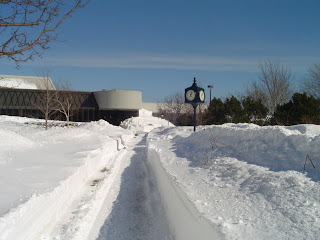

And downtown:

It has been a while since my last post. Has anything of import happened in Newfoundland since then? Hmm, let me think .... Yes, yes, I do seem to remember a giant motherfucker of a storm. Only vaguely, though. I seem to remember glancing out my window into my parking lot and seeing something like this:
And that's after the plough came through. The second time
Yes, as you might have noticed if you watched the national news for more than a nanosecond the last few days, we got hit with one of those storms I'd like to say we get once or twice a winter here -- if it weren't for the fact that we get them a few more times than once or twice. Say, three or four or twelve times.
And poor Kristen seems to have a talent for visiting me just in time to experience them. Last February she came, and had her flight cancelled because of a comparable storm. All in all, we discovered, not such a bad thing! She ended up staying for an extra two days. So when we woke up on tuesday morning to an ongoing blizzard, we were quite delighted ... until we realized that Air Canada was being a bit cagy and not cancelling her flight, only delaying it by degrees. It was supposed to have left by one in the afternoon ... and then two, and then two-thirty, and the four ... so instead of a lovely extra day of visiting, we were left checking the A/C website every fifteen minutes in the hope that the flight was cancelled. Which it wasn't. Arrgh.
That on top of the fact that we'd had to cancel our dinner reservations the evening before because of the storm. That of course didn't stop us from putting a pizza delivery person through the agony of driving through the snow. Gotta love the gumption of the Giovanni Cabot's people. They're the like the Post Office, only tastier.
Anyway, Kristen made it out yesterday (Tuesday), though her flight was delayed four hours. And driving her to the airport was entertaining, to say the least -- both for the occasional terror of the road conditions, and the perennial amazement I have in watching this city dig out from these storms. I wish I'd had my camera on hand to document the anthill-like activity. Everyone will have to be satisfied instead with some pics I snapped on campus this afternoon:
And downtown:
Friday, February 16, 2007
Why 24 has jumped the shark ...
The problem with shows based on a winning formula is that eventually they do become, well, formulaic. And I have to say, 24 has done a fairly decent job in terms of keeping my interest even when this became apparent around say season three, but lately things have become somewhat ridiculous.
To be fair however, the conception of 24 jumping the shark is sort of entertaining in itself -- one imagines Jack Bauer flashing his badge to Quint and Chief Brody, commandeering the great white "on matters of national security," then riding the shark and jumping it (a la Free Willy) over a jetty or something to have it land squarely on top of the lead terrorist and eat him. Betcha didn't see that coming, Fayed!
But I digress.
My problem is that, now that the show is working through the same basic storyline for the sixth time, in order to keep things from getting stale they've turned things up to eleven.
Bored with the relatively few civilian casualties in previous seasons? Let's start this time with a pre-existing state of emergency! Hundreds already dead!
Not satisfied with near-misses from nuclear weapons? Let's set one off in Los Angeles this time!
You think Jack Bauer's been given an easy ride so far? Let's make him the victim of three years of torture!
And wait! Let's have him kill his best friend to save a terrorist!
Enemies not sufficiently dastardly? Let's make the mysterious bluetooth guy from last season Jack's brother!
That not enough of a disfunctional family for you? Let's make Jack's father the evil mastermind! (Paging Dr. Freud ...)
Jack's willingness to torture has become a little wussy? Let's have him torture his brother! (Shall we start a pool betting on how many episodes it will be before he tortures Daddy?)
To be fair, the expectations game in television is a hard one to play ... shows that hit on a winning formula become understandably reluctant to tamper with it, even when it's painfully obvious that it's becoming tired. Television is a conservative medium in the truest sense of the word insofar as it fears change -- which is why almost every sitcom since The Honeymooners is essentially the same story, with just the characters, fashion and sexual vocabulary changing from year to year. I am in fact enjoying 24 this season, but I have to wonder where it's going to go from here -- what are they going to do next season to up the ante?
And there's the rub. This season we're already starting to venture into the absurd. What happens next?
When Jack was kidnapped by the Chinese at the end of last season, I got excited about the prospect of a 24 that would break all its own conventions and have as its story arc a daring rescue mounted by rogue CTU operatives in Manchuria ... away from their usual setpieces, away from LA, eschewing the comforts of home. Have Chloe set up in a remote trailer with jury-rigged equipment on a Chinese mountainside while Bill and Curtis (RIP, poor Curtis) and whoever else was still walking at the end of last season infiltrates the prison camp. Meanwhile, have the president, upon finding out what's going on, have to choose between running interference for his guys and risk an international incident or giving up his people.
That would have been cool. It would have been a departure. And it would have forestalled the shark-jumping for a season or two.
To be fair however, the conception of 24 jumping the shark is sort of entertaining in itself -- one imagines Jack Bauer flashing his badge to Quint and Chief Brody, commandeering the great white "on matters of national security," then riding the shark and jumping it (a la Free Willy) over a jetty or something to have it land squarely on top of the lead terrorist and eat him. Betcha didn't see that coming, Fayed!
But I digress.
My problem is that, now that the show is working through the same basic storyline for the sixth time, in order to keep things from getting stale they've turned things up to eleven.
Bored with the relatively few civilian casualties in previous seasons? Let's start this time with a pre-existing state of emergency! Hundreds already dead!
Not satisfied with near-misses from nuclear weapons? Let's set one off in Los Angeles this time!
You think Jack Bauer's been given an easy ride so far? Let's make him the victim of three years of torture!
And wait! Let's have him kill his best friend to save a terrorist!
Enemies not sufficiently dastardly? Let's make the mysterious bluetooth guy from last season Jack's brother!
That not enough of a disfunctional family for you? Let's make Jack's father the evil mastermind! (Paging Dr. Freud ...)
Jack's willingness to torture has become a little wussy? Let's have him torture his brother! (Shall we start a pool betting on how many episodes it will be before he tortures Daddy?)
To be fair, the expectations game in television is a hard one to play ... shows that hit on a winning formula become understandably reluctant to tamper with it, even when it's painfully obvious that it's becoming tired. Television is a conservative medium in the truest sense of the word insofar as it fears change -- which is why almost every sitcom since The Honeymooners is essentially the same story, with just the characters, fashion and sexual vocabulary changing from year to year. I am in fact enjoying 24 this season, but I have to wonder where it's going to go from here -- what are they going to do next season to up the ante?
And there's the rub. This season we're already starting to venture into the absurd. What happens next?
When Jack was kidnapped by the Chinese at the end of last season, I got excited about the prospect of a 24 that would break all its own conventions and have as its story arc a daring rescue mounted by rogue CTU operatives in Manchuria ... away from their usual setpieces, away from LA, eschewing the comforts of home. Have Chloe set up in a remote trailer with jury-rigged equipment on a Chinese mountainside while Bill and Curtis (RIP, poor Curtis) and whoever else was still walking at the end of last season infiltrates the prison camp. Meanwhile, have the president, upon finding out what's going on, have to choose between running interference for his guys and risk an international incident or giving up his people.
That would have been cool. It would have been a departure. And it would have forestalled the shark-jumping for a season or two.
Wednesday, February 14, 2007
Happy corporate-manufactured kitschy heart-and-Hallmark day!
I was very pleased with my Valentine's Day entry last year, and don't quite have the brainpower today to top it ... so, like so many people do when inspiration fails them, I'll let Savage Chickens express my feelings for me:

Monday, February 12, 2007
Ender's vindication

There’s an interesting article in the current Harper’s about “The Coming Robot Army,” dealing with the increasing presence in the American military of unmanned vehicles. The article’s author, Steve Featherstone, narrates his experiences at a handful of “industry” shows—where engineering firms, large and small, pitch their products to the military. Everything from tank-sized robot weapons platforms to tiny spybots (both airborne and ground-based) is on display, along with promotional videos featuring Full Metal Jacket’s R. Lee Ermy and MacGyver himself, Richard Dean Anderson.
What struck me was the frequent recourse the prostheletizers of robot warfare had to the language of video games when relating the user-friendliness of their machines. “If you can operate a game boy, you’re good,” says one representative. R. Lee Ermy, in full drill sergeant mode in his promo video, screams “The next time you start thinking about telling kids to put away that video game, think again! Some day they could be using those same kinds of skills to run a robot that will save their bacon!”
 This made me think of Orson Scott Card’s excellent SF novel Ender’s Game, in which, in which gifted children are recruited early into the military and taught the art of warfare. Ender Wiggin, our protagonist, proves talented beyond the dreams of his mentors and graduates into a specialized form of training, in which he plays simulations of space battles, networked to other children trained at the same academy he attended.
(Warning for those who have not read the novel: I’m about to give away the ending, so if you want to read it—and I recommend that you do—stop reading now).
The simulations get increasingly difficult, with increasingly greater odds against them and an enemy increasingly familiar with Ender & co.’s tactics. Ultimately they face the enemy at their homeworld with a pitifully small fleet against vastly superior enemy numbers. In desperation, Ender sends his fleet in a suicidal attack that destroys the entire alien planet.
The twist is that what Ender took to be a training simulation for when he would command actual fleets from a distance was in fact real—that the ships he and his cohorts commanded were not simulated but actual; and the final, total destruction of the enemy was an actual genocidal (or “xenocidal,” I suppose) massacre.
The point here is that every time I play an online first-person shooter game, I get killed rather a lot—and I suspect that many of the people killing me are all of about twelve years old, kids raised not so much on as in computer and video games, whose intimate familiarity with these virtual environment is second nature … while for me, having grown up with the archaic technology of Space Invaders, ColecoVision and the Commodore 64, the extra split second it takes to be aware of things in those sophisticated virtual worlds is the difference between virtual life and virtual death.
Hence, the insistence of military engineers’ on the Playstation-esque qualities of roboticized warfare makes me think that Orson Scott Card’s dystopian vision was pretty spot on. One of the principal criticisms of the novel was its lack of believability (always a dubious thing when talking about SF, but that’s another discussion), insofar as some readers couldn’t accept the premise of twelve-year-olds exhibiting the kind of expertise as those in the novel. I’m not so sure. In the CGI industry, firms don’t hire computer programmers and train them to be artists—that would be futile. Rather, they hire artists and train them to use computers, because a talent for art is not something that can be taught. If warfare ever does come down to the remote operation of machines from computer terminals, who then becomes the best candidate—the twentysomething soldier relatively new to the intimacies and nuances of cutting-edge technology, or the ten-year-old prodigy who wipes the floor with people twice his age at computer game competitions?
And would the generals let him know those are real people he’s wiping out?
What struck me was the frequent recourse the prostheletizers of robot warfare had to the language of video games when relating the user-friendliness of their machines. “If you can operate a game boy, you’re good,” says one representative. R. Lee Ermy, in full drill sergeant mode in his promo video, screams “The next time you start thinking about telling kids to put away that video game, think again! Some day they could be using those same kinds of skills to run a robot that will save their bacon!”
 This made me think of Orson Scott Card’s excellent SF novel Ender’s Game, in which, in which gifted children are recruited early into the military and taught the art of warfare. Ender Wiggin, our protagonist, proves talented beyond the dreams of his mentors and graduates into a specialized form of training, in which he plays simulations of space battles, networked to other children trained at the same academy he attended.
(Warning for those who have not read the novel: I’m about to give away the ending, so if you want to read it—and I recommend that you do—stop reading now).
The simulations get increasingly difficult, with increasingly greater odds against them and an enemy increasingly familiar with Ender & co.’s tactics. Ultimately they face the enemy at their homeworld with a pitifully small fleet against vastly superior enemy numbers. In desperation, Ender sends his fleet in a suicidal attack that destroys the entire alien planet.
The twist is that what Ender took to be a training simulation for when he would command actual fleets from a distance was in fact real—that the ships he and his cohorts commanded were not simulated but actual; and the final, total destruction of the enemy was an actual genocidal (or “xenocidal,” I suppose) massacre.
The point here is that every time I play an online first-person shooter game, I get killed rather a lot—and I suspect that many of the people killing me are all of about twelve years old, kids raised not so much on as in computer and video games, whose intimate familiarity with these virtual environment is second nature … while for me, having grown up with the archaic technology of Space Invaders, ColecoVision and the Commodore 64, the extra split second it takes to be aware of things in those sophisticated virtual worlds is the difference between virtual life and virtual death.
Hence, the insistence of military engineers’ on the Playstation-esque qualities of roboticized warfare makes me think that Orson Scott Card’s dystopian vision was pretty spot on. One of the principal criticisms of the novel was its lack of believability (always a dubious thing when talking about SF, but that’s another discussion), insofar as some readers couldn’t accept the premise of twelve-year-olds exhibiting the kind of expertise as those in the novel. I’m not so sure. In the CGI industry, firms don’t hire computer programmers and train them to be artists—that would be futile. Rather, they hire artists and train them to use computers, because a talent for art is not something that can be taught. If warfare ever does come down to the remote operation of machines from computer terminals, who then becomes the best candidate—the twentysomething soldier relatively new to the intimacies and nuances of cutting-edge technology, or the ten-year-old prodigy who wipes the floor with people twice his age at computer game competitions?
And would the generals let him know those are real people he’s wiping out?
Saturday, February 10, 2007
The week that wouldn't end
Normally weekends don't make much of a difference in my life, nor have they for a long time. I frequently work half- or full days on Saturdays and Sundays, either at home or at the office, and my weekly schedule is open enough that if I'm totally overwhelmed, I can take some me-time midweek. It's one of the reasons I love my job.
But all I could think this week was "My god, is it Friday yet?"
I'm not sure what it was, but this week seemed to last forever. Part of it -- or much of it, I guess -- was simply the intersection of a variety of tasks and concerns. We're hiring two new people for next year, a postcolonialist and a Shakespearean, and we saw candidates for both; as I'm on the search comittee for the former, monday and tuesday were taken up with the interview and squiring the candidate around campus to her various meetings. We had a department meeting on Wednesday (always fun), a candidate for the renaissance job thursday and friday, and we hosted a poetry reading last night -- which, being on the Pratt Comittee, I was partially responsible for organizing this week.
Oh, and there was that teaching thing I do as well. On tap for this week was Alfred, Lord Tennyson in my second-year class, and The Human Stain by Philip Roth, the film Dark City and some apparently blood-pressure raising writings by erstwhile neocon Francis Fukuyama. Good times.
And marking essays ... though I did not get as much to to attend to that as I would have liked, as my second-years can attest. Monday, guys, I promise!
All in all, not exceptionally mind-blowing ... I hear my computer network-guy brother tell of his not infrequent 36-hour (or more) marathons getting a new network up and running, or of the all-nighters he pulls when a network goes down somewhere, and it makes me feel positively lazy. I think part of my problem this week was just frustration with the glacial progress of my own research. Considering that I come up for a formal interim tenure review in September, I'm getting a bit anxious about getting some writing out there. I have three articles on the go, two relatively close to completion and a third a little more of a ways off, but what they all need is a few days of focused attention. Would that I were that enviously hated species of academic who can devote the odd half-hour of free time that surfaces in a day to productive writing. But no ... I'm one of those who requires a certain amount of momentum, and that first half-hour is usually taken up in necessary screen-staring.
However, as Danine pointed out to me yesterday in a much-appreciated reality check, I'm actually in pretty good shape for the review, and when it gets down to it I can use the summer to devote uninterrupted time to the articles. (Given that the ideal plan however is to finally perform major surgery on my thesis this summer -- a task I look forward to as much as I would to, well, major surgery -- I'd really rather have them out of the way).
OK, enough of me whining about my week. Given the administrative circus I've been engaged in this week, I would like to provide my non-academic readers with one occasional glimpses into the machinery of academia offered here on this humble blog. The topic du jour: the academic job interview.
I bring this up in part because of course I'm involved this year for the first time in the hiring process, but also because of a question raised by a student. I had let my second-years go a little early on Monday because I was heading directly from class to the two-hour interview with this week's candidate. One of my students commented, as we walked from class, "A two-hour interview? Wow, that's pretty intense." To which I responded: "That's just a fraction of the interview, actually."
You see, not satisfied with the various fiery hoops through which we have to jump over the course of a graduate degree -- comprehensive exams, ball-breaking scholarship applications, the thesis, the thesis defense -- universities impose a particular species of hell on prospective faculty members in the form of the day-and-a-half interview. First of all, there's the process of application, in which you send your CV, letters of reference, teaching dossier, and writing sample (the assembling of which represents a week of work in and of itself), which the search committee pores over with excruciating minuteness.
(Seriously -- I was quite amazed at the level of detail with which we examined the applications. When the cut comes down to a handful of comparably impressive candidates, any mistake or inconsistency can sink an applicant. It made me somewhat incredulous that I ever made it to the interview stage).
Some universities then perform a series of phone interviews with a long list, and on the basis of that narrow it down. Mercifully, we skipped that step.
Then, if you're called in for an interview, you fly out to wherever the university is (we had two candidates come in from the prairies, which made for a lot of travel time), and you a subjected to a series of meetings with a variety of administrative types -- the Dean of Arts, Dean of Graduate Studies, Vice-President Academic, Faculty Relations, Faculty Union, and of course the Head of the Department -- all of whom ask you questions that are variations on the same theme: namely, Why Should We Hire You?
You also deliver a half-hour or so lecture to the department to demonstrate your research chops, followed by a half-hour question period. And then of course is the interview with the search committee, which here lasts two hours.
Also on the roster: an open lunch to which all members of the department and graduate students are invited, and dinner with a three or four faculty members. And if there is one thing drummed into you -- if you come from a university nice enough to train its graduate students in how to interview well -- it's that there is no time during this process when you are not being interviewed. So in other words, limit yourself to one glass of wine with dinner, and keep your game face on. More than a few promising candidates have sunk their chances by saying something off-colour after one glass of wine too many.
The basic idea behind all this is partially to test the candidate's stamina. This is an exhausting process, even if you're gregarious and like to talk about yourself (as I do). I can't even begin to imagine the seven types of hell endured by people who are shy. At MUN, we're actually comparatively humane -- spreading it out over a day and a half gives the candidates a breather here and there, and our faculty is generally very friendly and courteous. Some universities however make a point of cramming it all into one endless day ... starting at 8am, leaving no time between meetings, and basically trying to run the candidate off his or her feet. Also, some people, even if they're otherwise very nice, will be difficult or even hostile in the job talk question period, or the interview -- principally to see if they can rattle the candidate, to get him or her to drop their guard.
Yes, we're all really rather mad here.
But all I could think this week was "My god, is it Friday yet?"
I'm not sure what it was, but this week seemed to last forever. Part of it -- or much of it, I guess -- was simply the intersection of a variety of tasks and concerns. We're hiring two new people for next year, a postcolonialist and a Shakespearean, and we saw candidates for both; as I'm on the search comittee for the former, monday and tuesday were taken up with the interview and squiring the candidate around campus to her various meetings. We had a department meeting on Wednesday (always fun), a candidate for the renaissance job thursday and friday, and we hosted a poetry reading last night -- which, being on the Pratt Comittee, I was partially responsible for organizing this week.
Oh, and there was that teaching thing I do as well. On tap for this week was Alfred, Lord Tennyson in my second-year class, and The Human Stain by Philip Roth, the film Dark City and some apparently blood-pressure raising writings by erstwhile neocon Francis Fukuyama. Good times.
And marking essays ... though I did not get as much to to attend to that as I would have liked, as my second-years can attest. Monday, guys, I promise!
All in all, not exceptionally mind-blowing ... I hear my computer network-guy brother tell of his not infrequent 36-hour (or more) marathons getting a new network up and running, or of the all-nighters he pulls when a network goes down somewhere, and it makes me feel positively lazy. I think part of my problem this week was just frustration with the glacial progress of my own research. Considering that I come up for a formal interim tenure review in September, I'm getting a bit anxious about getting some writing out there. I have three articles on the go, two relatively close to completion and a third a little more of a ways off, but what they all need is a few days of focused attention. Would that I were that enviously hated species of academic who can devote the odd half-hour of free time that surfaces in a day to productive writing. But no ... I'm one of those who requires a certain amount of momentum, and that first half-hour is usually taken up in necessary screen-staring.
However, as Danine pointed out to me yesterday in a much-appreciated reality check, I'm actually in pretty good shape for the review, and when it gets down to it I can use the summer to devote uninterrupted time to the articles. (Given that the ideal plan however is to finally perform major surgery on my thesis this summer -- a task I look forward to as much as I would to, well, major surgery -- I'd really rather have them out of the way).
OK, enough of me whining about my week. Given the administrative circus I've been engaged in this week, I would like to provide my non-academic readers with one occasional glimpses into the machinery of academia offered here on this humble blog. The topic du jour: the academic job interview.
I bring this up in part because of course I'm involved this year for the first time in the hiring process, but also because of a question raised by a student. I had let my second-years go a little early on Monday because I was heading directly from class to the two-hour interview with this week's candidate. One of my students commented, as we walked from class, "A two-hour interview? Wow, that's pretty intense." To which I responded: "That's just a fraction of the interview, actually."
You see, not satisfied with the various fiery hoops through which we have to jump over the course of a graduate degree -- comprehensive exams, ball-breaking scholarship applications, the thesis, the thesis defense -- universities impose a particular species of hell on prospective faculty members in the form of the day-and-a-half interview. First of all, there's the process of application, in which you send your CV, letters of reference, teaching dossier, and writing sample (the assembling of which represents a week of work in and of itself), which the search committee pores over with excruciating minuteness.
(Seriously -- I was quite amazed at the level of detail with which we examined the applications. When the cut comes down to a handful of comparably impressive candidates, any mistake or inconsistency can sink an applicant. It made me somewhat incredulous that I ever made it to the interview stage).
Some universities then perform a series of phone interviews with a long list, and on the basis of that narrow it down. Mercifully, we skipped that step.
Then, if you're called in for an interview, you fly out to wherever the university is (we had two candidates come in from the prairies, which made for a lot of travel time), and you a subjected to a series of meetings with a variety of administrative types -- the Dean of Arts, Dean of Graduate Studies, Vice-President Academic, Faculty Relations, Faculty Union, and of course the Head of the Department -- all of whom ask you questions that are variations on the same theme: namely, Why Should We Hire You?
You also deliver a half-hour or so lecture to the department to demonstrate your research chops, followed by a half-hour question period. And then of course is the interview with the search committee, which here lasts two hours.
Also on the roster: an open lunch to which all members of the department and graduate students are invited, and dinner with a three or four faculty members. And if there is one thing drummed into you -- if you come from a university nice enough to train its graduate students in how to interview well -- it's that there is no time during this process when you are not being interviewed. So in other words, limit yourself to one glass of wine with dinner, and keep your game face on. More than a few promising candidates have sunk their chances by saying something off-colour after one glass of wine too many.
The basic idea behind all this is partially to test the candidate's stamina. This is an exhausting process, even if you're gregarious and like to talk about yourself (as I do). I can't even begin to imagine the seven types of hell endured by people who are shy. At MUN, we're actually comparatively humane -- spreading it out over a day and a half gives the candidates a breather here and there, and our faculty is generally very friendly and courteous. Some universities however make a point of cramming it all into one endless day ... starting at 8am, leaving no time between meetings, and basically trying to run the candidate off his or her feet. Also, some people, even if they're otherwise very nice, will be difficult or even hostile in the job talk question period, or the interview -- principally to see if they can rattle the candidate, to get him or her to drop their guard.
Yes, we're all really rather mad here.
Friday, February 02, 2007
I'll take oddly-named stage managers for 500, Alex ...
Answer: Tiggers are wonderful things.
Question: What is the wonderful thing about Tiggers, Alex?
So this falls into the realm of the ultra-cool: one of my dearest friends will be a contestant on Jeopardy! The Lovely and Amazing Tigger Jourard -- Trivia Geek, Theatrical Martinet and Stage Manager Extraordinaire -- flies to sunny LA to tape her episode on February 7. And I'm betting that the only way she won't be kicking serious ass is if they decide to bring back Ken Jennings. Even then, Mr. Smartie-pants better bring his A-game.
Read about it all here.
For those who don't know Tigger, she and I were joined at the hip for all four plays I've directed ... and let me tell you now if you're thinking of dabbling in the directorial end of the theatrical pool, you need to find yourself a Tigger to be your stage manager. It helps that she was actually a professional stage manager for eighteen years, before finally leaving theatre for sanity reasons. I met her in winter of 2000 (well, I'd met her before, but only really got to know her at this point) when she agreed to come out of retirement as it were to stage manage a production of Joe Orton's Loot that a friend of hers was acting in. I was playing Hal (the last time I acted in a play, incidentally), and we hit it off immediately. That summer I made my first tentative foray into directing with UWO's Summer Shakespeare ... and I asked Tigger if she would be willing to stage manage.
The conversation went something like this. Tigger: "What play do you want to do?" Me: "Richard III." Tigger: "OK. What story do you want to tell?"
At first I thought the question was a bit wacky. What story? Richard III, of course! But then as I thought about it, it made increasingly more sense, and I realized the depth of this woman's wisdom. And the rest is history.
Here's Tigger relaxing with her hubby Bryan. Please note the Macbeth shirt he's wearing.

Answer: all our love and best wishes.
Question: What are we sending with Tigger to LA, Alex?
Break a leg, sweetie!
Question: What is the wonderful thing about Tiggers, Alex?
So this falls into the realm of the ultra-cool: one of my dearest friends will be a contestant on Jeopardy! The Lovely and Amazing Tigger Jourard -- Trivia Geek, Theatrical Martinet and Stage Manager Extraordinaire -- flies to sunny LA to tape her episode on February 7. And I'm betting that the only way she won't be kicking serious ass is if they decide to bring back Ken Jennings. Even then, Mr. Smartie-pants better bring his A-game.
Read about it all here.
For those who don't know Tigger, she and I were joined at the hip for all four plays I've directed ... and let me tell you now if you're thinking of dabbling in the directorial end of the theatrical pool, you need to find yourself a Tigger to be your stage manager. It helps that she was actually a professional stage manager for eighteen years, before finally leaving theatre for sanity reasons. I met her in winter of 2000 (well, I'd met her before, but only really got to know her at this point) when she agreed to come out of retirement as it were to stage manage a production of Joe Orton's Loot that a friend of hers was acting in. I was playing Hal (the last time I acted in a play, incidentally), and we hit it off immediately. That summer I made my first tentative foray into directing with UWO's Summer Shakespeare ... and I asked Tigger if she would be willing to stage manage.
The conversation went something like this. Tigger: "What play do you want to do?" Me: "Richard III." Tigger: "OK. What story do you want to tell?"
At first I thought the question was a bit wacky. What story? Richard III, of course! But then as I thought about it, it made increasingly more sense, and I realized the depth of this woman's wisdom. And the rest is history.
Here's Tigger relaxing with her hubby Bryan. Please note the Macbeth shirt he's wearing.
Answer: all our love and best wishes.
Question: What are we sending with Tigger to LA, Alex?
Break a leg, sweetie!
Monday, January 29, 2007
Thirty-five years, port and cigars, and the harlequin's disturbing package
I am now thirty-five years old, and wondering exactly when that happened. I certainly don't feel thirty-five; every time I think of my age, I have a little anxiety attack in which I think to myself that I haven't been doing anything with my life ... at which point I have to remind myself about the whole PhD thing and the tenure-track job. That doesn't seem entirely real yet though; I've come to the conclusion that grad school functions as a sort of extended adolescence, and when you finally get gainful employment -- which, society has been telling on a not-so-subliminal level should be happening in your mid-twenties -- the fact of that employment seems out of whack with your actual age.
Thanks to everyone who offered me birthday wishes in my previous post, and for everyone who called or emailed yesterday ... and let me wish a belated happy birthday to Rebecca, and an early happy birthday to my old friend Susan, who joins me in the 35-club on Friday.
One of the annoying things about turning 35? I can no longer refer to myself as being in my "early 30s," which of course I was doing up until Saturday ... I will now be mid-thirties until January 27th, 2012 ...
I celebrated making it halfway to 70 (seven-twentieths of a century!) by going out on Saturday with friends to the Duke of Duckworth, and drinking rather a lot. And in spite of my prohibition against the bringing of gifts, Danine and Jamie gave me a lovely bottle of port, and Nancy and Marco a rather splendid Cohiba. Port and cigars! A rather serendipitous pair of gifts, which I enjoyed yesterday evening. My gift to myself yesterday was a day of doing no work, of watching DVDs, and cooking myself a nice meal. I had settled on doing a prime rib roast, but the grocery store, annoyingly, did not have any ... so I had to resort to plan B, which was beef tenderloin. Beef tenderloin, roasted potatoes and asparagus, and grilled radicchio. Not bad, if I do say so.
And after dinner I treated myself to a few rounds of my current favourite computer game, a Risk-like nineteenth-century warfare game in which, yesterday, I was playing as the British Empire. I felt very British indeed, sipping port, smoking the cigar and kicking Napoleonic ass the hell out of Spain and Portugal. Good times.
Speaking of good times, Saturday night certainly was ... I love getting somewhat drunk with my friends here, not least because the conversations invariably take the most bizarre turns. Those of my in-town readers familiar with the Duke of Duckworth will also be familiar with the creepy-ass lamp they have in the back corner, where we'd plunked ourselves on Saturday night. The lamp is a very disturbing statue of a commedia del'arte-style harlequin with his arms folded over his chest and his hips thrust forward such that whoever sits in that corner, should he or she glance back over their shoulder, is presented with the harlequin's crotch (garbed of course in skin-tight tights) at eye level.
It takes one's fear of clowns to an entirely new level.
Anyway, much of the evening was spent laughing about the harlequin's disturbing package, and I kept thinking to myself "I have to replicate this conversation on my blog." Alas, age and alcohol intervened and, while I remember having the conversation, the details escape me. Except for the bit when we speculated on what superhero or supervillain the harlequin with the lamp in his head might be. Or would he be a sidekick? And would his disturbing package be the source of his super-powers? And would he sound like Hugh Grant, or more like Peter Lorre?
For those who wonder what kind of genteel intellectual discussions English professors have over drinks ...
Thanks to everyone who offered me birthday wishes in my previous post, and for everyone who called or emailed yesterday ... and let me wish a belated happy birthday to Rebecca, and an early happy birthday to my old friend Susan, who joins me in the 35-club on Friday.
One of the annoying things about turning 35? I can no longer refer to myself as being in my "early 30s," which of course I was doing up until Saturday ... I will now be mid-thirties until January 27th, 2012 ...
I celebrated making it halfway to 70 (seven-twentieths of a century!) by going out on Saturday with friends to the Duke of Duckworth, and drinking rather a lot. And in spite of my prohibition against the bringing of gifts, Danine and Jamie gave me a lovely bottle of port, and Nancy and Marco a rather splendid Cohiba. Port and cigars! A rather serendipitous pair of gifts, which I enjoyed yesterday evening. My gift to myself yesterday was a day of doing no work, of watching DVDs, and cooking myself a nice meal. I had settled on doing a prime rib roast, but the grocery store, annoyingly, did not have any ... so I had to resort to plan B, which was beef tenderloin. Beef tenderloin, roasted potatoes and asparagus, and grilled radicchio. Not bad, if I do say so.
And after dinner I treated myself to a few rounds of my current favourite computer game, a Risk-like nineteenth-century warfare game in which, yesterday, I was playing as the British Empire. I felt very British indeed, sipping port, smoking the cigar and kicking Napoleonic ass the hell out of Spain and Portugal. Good times.
Speaking of good times, Saturday night certainly was ... I love getting somewhat drunk with my friends here, not least because the conversations invariably take the most bizarre turns. Those of my in-town readers familiar with the Duke of Duckworth will also be familiar with the creepy-ass lamp they have in the back corner, where we'd plunked ourselves on Saturday night. The lamp is a very disturbing statue of a commedia del'arte-style harlequin with his arms folded over his chest and his hips thrust forward such that whoever sits in that corner, should he or she glance back over their shoulder, is presented with the harlequin's crotch (garbed of course in skin-tight tights) at eye level.
It takes one's fear of clowns to an entirely new level.
Anyway, much of the evening was spent laughing about the harlequin's disturbing package, and I kept thinking to myself "I have to replicate this conversation on my blog." Alas, age and alcohol intervened and, while I remember having the conversation, the details escape me. Except for the bit when we speculated on what superhero or supervillain the harlequin with the lamp in his head might be. Or would he be a sidekick? And would his disturbing package be the source of his super-powers? And would he sound like Hugh Grant, or more like Peter Lorre?
For those who wonder what kind of genteel intellectual discussions English professors have over drinks ...
Friday, January 26, 2007
Wanted: one quantum shower
So sunday is my birthday, and I've decided what gift I most want: I want a shower that stops time. I made this decision this morning when, running late, I had one of those luxurious hot rejuvenating showers, the pleasure of which was denuded because I was painfully aware the entire time that I was running late.
Thus, I need a shower that stops time when I step into it. A shower that will let me take as much time as I want letting the hot water wake me up. And when I step out of the shower, it will be exactly the same time it was when I got in.
That's not too much to ask, is it?
Thus, I need a shower that stops time when I step into it. A shower that will let me take as much time as I want letting the hot water wake me up. And when I step out of the shower, it will be exactly the same time it was when I got in.
That's not too much to ask, is it?
Wednesday, January 24, 2007
Snow Day #1

I have learned my lesson well, and I will under no circumstances be venturing outside today. Last year, a newbie to Newfoundland snow, I managed to get my car stuck in every single major snowstorm we had.
Not this year. I've learned: keep a cache of comfort food and comfort booze, DVDs you like, and blankets that might not necessarily be needed (because you've hiked the heating up in response to the storm), but which still provide a sense of smug satisfaction as you wrap yourself in them and look out at the snow.
This does put a bit of a crimp in my already-behind-the-eight-ball working schedule, as only about one-third of the things I was planning to get done today actually came home in my bag with me. On the other hand, today is an ideal day to get reading done: since getting up, I have read through the first third or so of Frankenstein, which we start next week in my second-year class. Having gone through two weeks so far of the nuts and bolts of reading poetry -- scansion, prosody, metrics, and all that rip-roaring fun stuff -- hopefully a good old-fashioned gothic novel will be a welcome break for my students.
My two classes are going well so far this semester, I think. Lestways, I'm having fun. However dry it might be, there is something deeply satisfying about teaching the basics of poetry. It's refreshingly concrete, and it lets you enjoy the poetry at the level of the language itself. And I've had enough students express enthusiasm for it to make me feel that I'm on the right track here.
The grad class is also going well -- I think. I say "I think" because we're really sort of early days here yet: we haven't started student seminars, and I'm front-loading a pretty broad range of theory and criticism on my students in order to establish the course's various meta-debates. The students are a good group, though (and I'm not entirely saying that because a know some of them read this blog) and the discussions we've had so far on the material have been promising. The first unit has been a little inchoate (partially by design, partially not) because of its topic (Sept. 11) and the principal text (Zizek's Welcome to the Desert of the Real! -- alas, one of those things that is currently sitting in my office, so I'll be doing some fast reading tomorrow morning!). But next week we start on Philip Roth's The Human Stain, and really get into some of the more focused issues at work in this course.
This semester so far has been an odd experience of going to extremes: introduction to scansion on one hand, and Slavoj Zizek's neo-Lacanianism on the other. I need to pass through a decompression chamber between wednesday afternoon and thursday morning.
Well ... the wind is howling outside and a fresh pot of coffee is ready, so I retire to my couch and read. I do so love my job.
Saturday, January 20, 2007
This just in: Stephen Colbert owns Bill O'Reilly
Just when you thought Stephen Colbert couldn't be more brilliant, you see this:
That's right ... Stephen Colbert being interviewed by Bill-O on the O'Reilly Factor. And the most brilliant part of this is that Stephen does it in character. That is to say: he puts on the persona he plays on The Colbert Report of the irrational right-wingnut modelled explicitly on -- and who pays slavish devotion to -- Bill O'Reilly himself.
Talk about holding a mirror up to nature.
I think what I love most about this is that O'Reilly so obviously wants to nail Colbert as an effete liberal elite, but runs up against his own "interview" tactics at every turn -- and you can see that he's conflicted because Stephen's persona keeps heaping lavish praise on him, and though he knows it's an act, his ego just can't help responding.
I love the fact that both times O'Reilly has taken on Colbert and Jon Stewart on his show, he's run up against a wall. Stewart's interview wasn't funny like Colbert's, but in a lot of ways it was more telling. He played it so cool that O'Reilly had nowhere to go. He kept trying to bait Stewart (try counting just how many times he calls The Daily Show's audience "stoned slackers"), but Stewart never rose to it. O'Reilly kept prodding and prodding, saying ever more ridiculous and absurd things, and Stewart basically gave him just enough rope to hang himself.
And I reiterate:

Get Lewis Black as the press secretary, Rob Cordry as Secretary of Defense and Samantha Bee as Chief of Staff and we're off to the races.
Thursday, January 18, 2007
The blogging prof
So I was interviewed this week for a feature in the student newpaper The Muse. The subject? Professors who blog. The news editor Sheena Goodyear (whose own blog is linked to the right here) contacted me last semester and asked if I'd be willing to be interviewed ... then postponed it when she had difficulty finding other blogging professors.
But find some she did, and the interview went forward this week. It's a nice piece (click here), though the picture of me is pretty horrible. I'm not sure how I'm sitting, but I seem to have managed to retract my chin into my neck. Ick.
I was afraid that too much would be made about the Untitled Newfoundland Zombie Project, and at first glance that seemed to be the case (my quotable quote under my picture, in much bigger font in the paper than online, is zombie-centric), but that didn't prove the be the case -- a well-written, balanced bit of work, especially impressive considering that Sheena's tape recorder turned out not to have worked, and I didn't get my emailed comments to her in time, so she was essentially writing from memory. Nicely done.
Two things though, a correction and an attribution. First, here's a section of the article:
He first realized he had student readers after he posted a proposal that all TV shows exist in the same universe, using specific references. “This student came up to me and said, ‘You watch the Gilmore Girls?’” he said, laughing. “At first I wondered how he knew that, then I realized he must have read it on the blog.”
The student in question was actually a she, a student named Elsa from my English 2000 class last year. Just so she knows I wasn't referring to her in the interview with the masculine pronoun.
Secondly, "His friend summed up the secret to his success when he told Lockett, 'You only post when you have something to say.'" I don't entirely know that that's necessarily the case, but it was a nice compliment, and it was courtesy of Jeremy Worth, aka the Duke of Clarence. Thanks for that one.
But find some she did, and the interview went forward this week. It's a nice piece (click here), though the picture of me is pretty horrible. I'm not sure how I'm sitting, but I seem to have managed to retract my chin into my neck. Ick.
I was afraid that too much would be made about the Untitled Newfoundland Zombie Project, and at first glance that seemed to be the case (my quotable quote under my picture, in much bigger font in the paper than online, is zombie-centric), but that didn't prove the be the case -- a well-written, balanced bit of work, especially impressive considering that Sheena's tape recorder turned out not to have worked, and I didn't get my emailed comments to her in time, so she was essentially writing from memory. Nicely done.
Two things though, a correction and an attribution. First, here's a section of the article:
He first realized he had student readers after he posted a proposal that all TV shows exist in the same universe, using specific references. “This student came up to me and said, ‘You watch the Gilmore Girls?’” he said, laughing. “At first I wondered how he knew that, then I realized he must have read it on the blog.”
The student in question was actually a she, a student named Elsa from my English 2000 class last year. Just so she knows I wasn't referring to her in the interview with the masculine pronoun.
Secondly, "His friend summed up the secret to his success when he told Lockett, 'You only post when you have something to say.'" I don't entirely know that that's necessarily the case, but it was a nice compliment, and it was courtesy of Jeremy Worth, aka the Duke of Clarence. Thanks for that one.
Wednesday, January 17, 2007
Word of the day
My word of the day, which I just now encountered while reading Fredric Jameson, is "obnubilate." It means, apparently, to "obscure," to "make unlcear or less visible."
Question: we know that onomatopoeia refers to words that mimic the sounds they describe (like "bang" or "quack"). Is there a term for words that embody the quality or action they describe? Because, really, coming across "obnubilate" was a truly obnubilating (obnubilatory?) experience.
Observation: theory-speak does delight in those kind of words, doesn't it? One of my favourite theory-speak words before now was "obfuscate," which of course means the exact same thing. Well! Out with the old, in with the new. I will from here on in always refer to "obnubilating discourse."
And to show Fredric Jameson at his obnubilating best, here's the locution in which I found the word embedded: "obnubilated with a spurious apotheosis."
Sweet.
Question: we know that onomatopoeia refers to words that mimic the sounds they describe (like "bang" or "quack"). Is there a term for words that embody the quality or action they describe? Because, really, coming across "obnubilate" was a truly obnubilating (obnubilatory?) experience.
Observation: theory-speak does delight in those kind of words, doesn't it? One of my favourite theory-speak words before now was "obfuscate," which of course means the exact same thing. Well! Out with the old, in with the new. I will from here on in always refer to "obnubilating discourse."
And to show Fredric Jameson at his obnubilating best, here's the locution in which I found the word embedded: "obnubilated with a spurious apotheosis."
Sweet.
Monday, January 15, 2007
Finally: we've reached a point when saying "Jack" doesn't automatically connote Nicholson ...

Some thoughts apropos of last night's two-hour season premiere of 24 ...
1) Is is just me, or is the show managing to polarize the torture=necessary evil / civil rights=danger debate even further than it already has? I wouldn't have thought that possible, but here we are. Evan Handler's star turn in season 4 as the querulous ACLU lawyer was bad enough -- now we have the president's sister presented as an hysterical evidence-shredder. Also, I liked the president's qualification that most historians see the internment of Japanese in WWII as an blot on America's history. Most? That's kind of like saying most historians agree that the Holocaust happened. Is seriously there anyone besides Anne Coulter or Michelle Malkin who still attempts to defend internment?
(2) The stab wound Jack received to the shoulder healed pretty quickly, seeing as he was neat and trim in a snug gray shirt soon after with no sign of blood seeping.
(3) It's nice to see Dr. Bashir (Alexander Siddig) of Star Trek: Deep Space Nine getting work. I was never exactly a loyal viewer of DS9, but I always liked his character. He has to find it slightly ironic however, that having anglicized his name from "Siddig El-Fadil" to "Alexander Siddig" midway through his Star Trek tenure that he now seems to be typecast into the role of the enigmatic Arab.
(4) Speaking of typecasting: it's a pretty breathtaking display of Hollywood's Middle Eastern & Arab bench strength when you see Kal Penn (Kumar of Harold and Kumar fame) and Newfoundland's own Shaun Majumder from This Hour Has 22 Minutes being cast as sinister terrorists. It must be a rather ambivalent comfort to actors of Middle Eastern or subcontinental descent to know that, whatever else happens, they can always get roles playing terrorists.
(5) Yet more typecasting: the big dumb blond redneck guy who beats up Kumar (sorry, I really can't think of him as anything else) and gets shot for his trouble looked really familiar ... then I recognized him from the Vietnam drama Tour of Duty in which he played -- wait for it! -- a big dumb blond redneck guy. 24: where creative casting goes to die.
(6) And yet, I can't wait for more ...
1) Is is just me, or is the show managing to polarize the torture=necessary evil / civil rights=danger debate even further than it already has? I wouldn't have thought that possible, but here we are. Evan Handler's star turn in season 4 as the querulous ACLU lawyer was bad enough -- now we have the president's sister presented as an hysterical evidence-shredder. Also, I liked the president's qualification that most historians see the internment of Japanese in WWII as an blot on America's history. Most? That's kind of like saying most historians agree that the Holocaust happened. Is seriously there anyone besides Anne Coulter or Michelle Malkin who still attempts to defend internment?
(2) The stab wound Jack received to the shoulder healed pretty quickly, seeing as he was neat and trim in a snug gray shirt soon after with no sign of blood seeping.
(3) It's nice to see Dr. Bashir (Alexander Siddig) of Star Trek: Deep Space Nine getting work. I was never exactly a loyal viewer of DS9, but I always liked his character. He has to find it slightly ironic however, that having anglicized his name from "Siddig El-Fadil" to "Alexander Siddig" midway through his Star Trek tenure that he now seems to be typecast into the role of the enigmatic Arab.
(4) Speaking of typecasting: it's a pretty breathtaking display of Hollywood's Middle Eastern & Arab bench strength when you see Kal Penn (Kumar of Harold and Kumar fame) and Newfoundland's own Shaun Majumder from This Hour Has 22 Minutes being cast as sinister terrorists. It must be a rather ambivalent comfort to actors of Middle Eastern or subcontinental descent to know that, whatever else happens, they can always get roles playing terrorists.
(5) Yet more typecasting: the big dumb blond redneck guy who beats up Kumar (sorry, I really can't think of him as anything else) and gets shot for his trouble looked really familiar ... then I recognized him from the Vietnam drama Tour of Duty in which he played -- wait for it! -- a big dumb blond redneck guy. 24: where creative casting goes to die.
(6) And yet, I can't wait for more ...
Friday, January 12, 2007
Science v. Religion: Round One
So one of my students from last semester made a spirited argument the other day that the main character of the Untitled Newfoundland Zombie Project should not be a scientist but a religious studies student, on the ground that mystically animated zombies are more interesting than the dead who walk because of a viral thing.
I don't know that I grant this premise, especially with news every day (it seems) of new outbreaks of norwalk.* But that's another anxiety for another day.
Arguing the aesthetics, however, my student made a rather good point, which is that with a mystical underpinning, the climactic fight could take place in a library rather than a lab, which would make for a much creepier sequence.
Fair point.
Though I'm pretty set on having the living dead in this story being the result of an infection, I'm also pretty inclusive ... and though I keep referring to the "main character," as I've stated before, this is conceived of as an ensemble piece. So a religious-studies student gets added to the roster: I'm thinking it'll be someone who gets increasingly unhinged as the story unfolds, convinced that the zombies are the result of God's wrath and ultimately becomes a danger to the other survivors when he attempts to sabotage the epidemiology student's possible solution.
So for those keeping track, the list of established characters now includes: Meg, our science grad student, a bunch of Hanson-brothers-esque varsity hockey players, and a religious-studies student resistant to the scientific explanation for the zombies. I think I'll call him Johnny.
-----------------
*When I googled "norwalk" to make sure I was getting the spelling correct, the virus was not the first hit -- the first was "Norwalk Furniture Corporation Manufacturing." Time for a business name change, perhaps ... unless their target demographic happens to be people panicking about a virus but also in need of a tasteful-yet-understated set of end tables.
I don't know that I grant this premise, especially with news every day (it seems) of new outbreaks of norwalk.* But that's another anxiety for another day.
Arguing the aesthetics, however, my student made a rather good point, which is that with a mystical underpinning, the climactic fight could take place in a library rather than a lab, which would make for a much creepier sequence.
Fair point.
Though I'm pretty set on having the living dead in this story being the result of an infection, I'm also pretty inclusive ... and though I keep referring to the "main character," as I've stated before, this is conceived of as an ensemble piece. So a religious-studies student gets added to the roster: I'm thinking it'll be someone who gets increasingly unhinged as the story unfolds, convinced that the zombies are the result of God's wrath and ultimately becomes a danger to the other survivors when he attempts to sabotage the epidemiology student's possible solution.
So for those keeping track, the list of established characters now includes: Meg, our science grad student, a bunch of Hanson-brothers-esque varsity hockey players, and a religious-studies student resistant to the scientific explanation for the zombies. I think I'll call him Johnny.
-----------------
*When I googled "norwalk" to make sure I was getting the spelling correct, the virus was not the first hit -- the first was "Norwalk Furniture Corporation Manufacturing." Time for a business name change, perhaps ... unless their target demographic happens to be people panicking about a virus but also in need of a tasteful-yet-understated set of end tables.
Wednesday, January 10, 2007
New blogs!
Well, my little brother -- you remember, He What Is King -- has jumped on the blogging bandwagon. He has for some time desired to build a cedar-strip canoe, and this past Christmas Santa provided him with the means to get started ... and our father, handyman and carpenter extraordinaire, is along for the ride. And, ostensibly to document their progress on the vessel (but really because he wants to be more like me), Matt has started a blog to do just that: the "Lockett & Son Canoe Project." Follow their progress as they build the steam box for the bending of cedar strips! Gasp in awe as they lay the keel! Marvel at how you only ever seem to see my dad at the power tools! Truly, it promises to be an edge-of-your-seat roller coaster a la 24 ...
Speaking of nail-biting blogs, the Untitled Newfoundland Zombie Project has been erected (resurrected? conjured?) here. I have posted the prologue, in which our intrepid heroine and her short-lived boyfriend get waylaid while jogging around Quidi Vidi Lake. I will post further instalments as the procrastinatory need strikes me, but realistically this thing will wax and wane in direct proportion to my busy-ness this term (i.e. don't look for the next instalment any time soon). Comments and suggestions are desired, and soon I might ask for contributions -- perhaps making this a truly collaborative effort.
In the meantime, can anyone tell me how I can change my profile picture (or remove it entirely) on the zombie blog, without similarly changing or deleting it from this one?
Speaking of nail-biting blogs, the Untitled Newfoundland Zombie Project has been erected (resurrected? conjured?) here. I have posted the prologue, in which our intrepid heroine and her short-lived boyfriend get waylaid while jogging around Quidi Vidi Lake. I will post further instalments as the procrastinatory need strikes me, but realistically this thing will wax and wane in direct proportion to my busy-ness this term (i.e. don't look for the next instalment any time soon). Comments and suggestions are desired, and soon I might ask for contributions -- perhaps making this a truly collaborative effort.
In the meantime, can anyone tell me how I can change my profile picture (or remove it entirely) on the zombie blog, without similarly changing or deleting it from this one?
Sunday, January 07, 2007
Getting the ducks in a row
Classes start tomorrow.
I was working on the prep for my grad course this morning. Some of you will have heard this spiel from me before ... but it's fun to share.
Did you know that a person who studies cave formations is called a speleologist?
Which means that if he studied the ends of caves, he'd be a teleological speleologist.
If he studied the ends of caves and had a specific political agenda, he'd be an ideological teleological speleologist.
If he studied the ends of caves at the end of the world and had a specific political agenda, he'd be an eschatological ideological teleogical speleologist.
Yeah. Classes begin tomorrow.
Anyone want to continue ...?
I was working on the prep for my grad course this morning. Some of you will have heard this spiel from me before ... but it's fun to share.
Did you know that a person who studies cave formations is called a speleologist?
Which means that if he studied the ends of caves, he'd be a teleological speleologist.
If he studied the ends of caves and had a specific political agenda, he'd be an ideological teleological speleologist.
If he studied the ends of caves at the end of the world and had a specific political agenda, he'd be an eschatological ideological teleogical speleologist.
Yeah. Classes begin tomorrow.
Anyone want to continue ...?
Thursday, January 04, 2007
Potholes and zombies
Sometimes you regret your little whims -- such as today, when I was driving along Military Road, heading down toward Torbay Road in the pursuit of errands. For no particular reason, I turned left on a street whose name I don't know up to Circular Road. Why? I don't know. Variety, perhaps. It was taking me in the direction I needed to go anyway, so what the hell.
Halfway between Military and Circular I hit the Mother of All Potholes, sending a shock through my car that, while painful, didn't seem much worse than other pothole strikes I've had since moving here (for the uninitiated, St. John's is the Pothole Captital of Canada -- the frequent oscilations of temperature a few degrees above and below zero all winter long make our streets a veritable slalom of divots come spring). A few seconds after turning onto Circular however, my front passenger-side wheel started making that tell-tale lugubrious wobble.
There's nothing quite like the sinking feeling of getting a flat.
Still, I shouldn't complain -- if there was a time and place to blow out a tire, this was it: on a beautiful mild sunny afternoon just around the corner from the Kingsmill Service Center. Leaving my poor stricken Corolla, I walked down and returned with one of their cheerful and helpful mechanics. Then ensued a fun little bit of travel, where he'd pump my tire, I would drive for about a hundred feet and stop, and he'd pump it again. All the way to the garage.
Would you believe this is the first time I've ever been struck with a flat tire? I'm pretty blessed when it comes to car trouble ... what crises I've had have always been a little like this one: close to home or otherwise situated conveniently, as opposed to on a lonely stretch of highway miles from anywhere. I'm touching wood on that one.
Anyway, I just thought I'd share that little escapade, if for no other reason than I'm seriously considering returning to the scene of the crime, taking a picture of the offending pothole and trying to get my money back from the city. A long shot perhaps, but at least then I'll be able to post pictures of a hole on my blog.
Which brings us of course to the Untitled Newfoundland Zombie Project (actually, the segue's not quite that abrupt -- as I walked from my car to the garage, I mentally cursed Danny Boyle for having used the must-change-flat-tire-before-zombies-get-here sequence in 28 Days Later, which means of course that I can't now use it myself). I was oddly heartened to hear that my idea's not entirely original, and quite taken with the university-dorm setting titled Residence Evil ... not exactly the same kind of narrative I was thinking of, but it occurred to me: of course we have to have a few scenes take place in rez! Why our heroes would need to make a foray into those buildings I don't know. A reason must be found! Obviously, this means that one of our besieged ensemble will have to be a first-year student, and he/she will have something in his/her residence room of vital necessity for the fighting of the zombie hordes. But what is it? Suggestions solicited.
The other plot point that has occurred to me is that our putative heroine, Meg, isn't a biochem grad student but is instead studying epidemiology. In the tradition of the science-saves-the-day-in-a-weirdly-simplistic-fashion deus ex machina (a tradition with a well established pedigree, from the SF B-movies of the 50s to Independence Day), it makes sense that Meg will have been working on some series of experiments that will contain the secret to defeating the zombie hordes ...
Or perhaps: it was those experiments themselves that were responsible for the outbreak? Hmmmm ....
Halfway between Military and Circular I hit the Mother of All Potholes, sending a shock through my car that, while painful, didn't seem much worse than other pothole strikes I've had since moving here (for the uninitiated, St. John's is the Pothole Captital of Canada -- the frequent oscilations of temperature a few degrees above and below zero all winter long make our streets a veritable slalom of divots come spring). A few seconds after turning onto Circular however, my front passenger-side wheel started making that tell-tale lugubrious wobble.
There's nothing quite like the sinking feeling of getting a flat.
Still, I shouldn't complain -- if there was a time and place to blow out a tire, this was it: on a beautiful mild sunny afternoon just around the corner from the Kingsmill Service Center. Leaving my poor stricken Corolla, I walked down and returned with one of their cheerful and helpful mechanics. Then ensued a fun little bit of travel, where he'd pump my tire, I would drive for about a hundred feet and stop, and he'd pump it again. All the way to the garage.
Would you believe this is the first time I've ever been struck with a flat tire? I'm pretty blessed when it comes to car trouble ... what crises I've had have always been a little like this one: close to home or otherwise situated conveniently, as opposed to on a lonely stretch of highway miles from anywhere. I'm touching wood on that one.
Anyway, I just thought I'd share that little escapade, if for no other reason than I'm seriously considering returning to the scene of the crime, taking a picture of the offending pothole and trying to get my money back from the city. A long shot perhaps, but at least then I'll be able to post pictures of a hole on my blog.
Which brings us of course to the Untitled Newfoundland Zombie Project (actually, the segue's not quite that abrupt -- as I walked from my car to the garage, I mentally cursed Danny Boyle for having used the must-change-flat-tire-before-zombies-get-here sequence in 28 Days Later, which means of course that I can't now use it myself). I was oddly heartened to hear that my idea's not entirely original, and quite taken with the university-dorm setting titled Residence Evil ... not exactly the same kind of narrative I was thinking of, but it occurred to me: of course we have to have a few scenes take place in rez! Why our heroes would need to make a foray into those buildings I don't know. A reason must be found! Obviously, this means that one of our besieged ensemble will have to be a first-year student, and he/she will have something in his/her residence room of vital necessity for the fighting of the zombie hordes. But what is it? Suggestions solicited.
The other plot point that has occurred to me is that our putative heroine, Meg, isn't a biochem grad student but is instead studying epidemiology. In the tradition of the science-saves-the-day-in-a-weirdly-simplistic-fashion deus ex machina (a tradition with a well established pedigree, from the SF B-movies of the 50s to Independence Day), it makes sense that Meg will have been working on some series of experiments that will contain the secret to defeating the zombie hordes ...
Or perhaps: it was those experiments themselves that were responsible for the outbreak? Hmmmm ....
Wednesday, January 03, 2007
Back in the land of wind and shadows
Well, I'm back ... and was nearly knocked off my feet by the wind the moment I left the terminal. Ah, it's good to be home here in the land of wind and shadows, which is incidentally also the place that Mr. Sparkle banishes dirt. Or is that the land of wind and ghosts (which may or may not be Labrador)? I get confused.
So, 2007 eh? That doesn't seem right, somehow. It was bad enough when I'd think back to something that happened in the late 1990s and realize how long ago it was ... now I'm doing the same thing with the early 2000s. Not happy about that. Also not happy that I turn 35 at the end of the month, but that's a whole nother kettle of anxieties.
Here's another reason I hate New Year's: my year doesn't begin in January, but in September. And yet here comes December 31st, and I fall prey to all the retrospective musing and maundering that is in the air. I hold the whole New Year's resolution thing in about the same amount of contempt as I do New Year's Eve celebrations, but I find myself making them anyway. It takes a conscious effort not to start making promises to myself about the ways in which I'm going to shape up in the new year -- it seems to be almost an instinctive thing. Which is very annoying.
So I've decided to just surrender myself to the impulse. I won't bother sharing the usual raft of resolutions (eat better, drink less, lose weight, write a book, and win the Ultimate Fighting Championship), but the one I've been shamefully putting off can go out there for suggestions: READ NEWFOUNDLAND FICTION.
Yup, there it is. I've been living here a year and a half (almost), and still the only two local novels I've read are The Navigator of New York by Wayne Johnston and The Nine Planets by Edward Riche. Sad, really, that in such a vibrant literary culture I haven't made myself more at home. I'm overdue, and must rectify that in the next year -- if for no other reason than it seems impossible to go into a pub in St. John's and not run into one of our literary luminaries. And really, it gets a bit embarassing when you haven't read a word of their prose.
So here's the request: I have a rough list of books in my head I should read, but I ask, nay, implore my Newfoundland readers to make suggestions about what I should add to it (and with a nod to one of my occasional commentators, This Much is True by Tina Chaulk is on the mental list already).
Speaking of good reading, I read a trio of excellent books over the holidays -- two of them, I'm happy to say, recommended to me by students. The first of the three was Neil Gaiman's novel American Gods. As I''ve mentioned before, I do love the SF and fantasy, provided it's done well. And I've always loved Neil Gaiman's Sandman comic-book series, but I've never read any of his novels -- excepting the very funny Good Omens, which he co-wrote with Terry Pratchett. American Gods proceeds from one of the ideas he develops in Sandman, namely that gods' strength and indeed existence waxes and wanes with the devotion, fervor and sacrifice of their human followers. Thus, in contemporay America, the old gods that followed the original settlers still live on American soil but have weakened in the face of such new gods as media, fame, technology and (I loved this one!) conspiracy. And an epic showdown is in the offing ...
Next I read Michael Chabon's The Amazing Adventures of Kavelier and Clay, a novel about the golden age of comic books in the late 1930s. I won't even begin to get into the plot here: suffice it to say that Chabon very deftly and elegantly touches upon the deeply-inscribed need, expressed in superhero comics, for fantasy and escape ... and believe me when I say that summary does no justice whatsoever to this wonderful novel.
Mind you, given how many times over the holidays I recommended this novel to people who had already read it, this is likely old news to my readers here. I think I might well be the last person in the English-speaking world to have read it at this point.
Finally, I read Michael Berube's book What's Liberal About the Liberal Arts?, which was a gift from Kristen. As anyone who reads this blog regularly knows, I am a huge fan of Berube, both as as an academic and a blogger himself. He regularly engages with right-wing attacks on academia -- especially those of David Horowitz & co. -- with wit and a keen intellect, and What's Liberal is his book-length response to the charge that the university is unfairly skewed toward leftist viewpoints and that liberal professors are indoctrinating the youth with their cant. Though this is not (with the exception of the occasional Margaret Wente column) quite the same issue in Canada, I highly recommend this book to academics and non-academics alike for its intelligence, lucidity and eloquence. I especially recommend it for anyone who's curious about what it means to be a professor today -- Berube does an excellent job of outlining what's at stake in our jobs and in the academy as a whole.
So, 2007 eh? That doesn't seem right, somehow. It was bad enough when I'd think back to something that happened in the late 1990s and realize how long ago it was ... now I'm doing the same thing with the early 2000s. Not happy about that. Also not happy that I turn 35 at the end of the month, but that's a whole nother kettle of anxieties.
Here's another reason I hate New Year's: my year doesn't begin in January, but in September. And yet here comes December 31st, and I fall prey to all the retrospective musing and maundering that is in the air. I hold the whole New Year's resolution thing in about the same amount of contempt as I do New Year's Eve celebrations, but I find myself making them anyway. It takes a conscious effort not to start making promises to myself about the ways in which I'm going to shape up in the new year -- it seems to be almost an instinctive thing. Which is very annoying.
So I've decided to just surrender myself to the impulse. I won't bother sharing the usual raft of resolutions (eat better, drink less, lose weight, write a book, and win the Ultimate Fighting Championship), but the one I've been shamefully putting off can go out there for suggestions: READ NEWFOUNDLAND FICTION.
Yup, there it is. I've been living here a year and a half (almost), and still the only two local novels I've read are The Navigator of New York by Wayne Johnston and The Nine Planets by Edward Riche. Sad, really, that in such a vibrant literary culture I haven't made myself more at home. I'm overdue, and must rectify that in the next year -- if for no other reason than it seems impossible to go into a pub in St. John's and not run into one of our literary luminaries. And really, it gets a bit embarassing when you haven't read a word of their prose.
So here's the request: I have a rough list of books in my head I should read, but I ask, nay, implore my Newfoundland readers to make suggestions about what I should add to it (and with a nod to one of my occasional commentators, This Much is True by Tina Chaulk is on the mental list already).
Speaking of good reading, I read a trio of excellent books over the holidays -- two of them, I'm happy to say, recommended to me by students. The first of the three was Neil Gaiman's novel American Gods. As I''ve mentioned before, I do love the SF and fantasy, provided it's done well. And I've always loved Neil Gaiman's Sandman comic-book series, but I've never read any of his novels -- excepting the very funny Good Omens, which he co-wrote with Terry Pratchett. American Gods proceeds from one of the ideas he develops in Sandman, namely that gods' strength and indeed existence waxes and wanes with the devotion, fervor and sacrifice of their human followers. Thus, in contemporay America, the old gods that followed the original settlers still live on American soil but have weakened in the face of such new gods as media, fame, technology and (I loved this one!) conspiracy. And an epic showdown is in the offing ...
Next I read Michael Chabon's The Amazing Adventures of Kavelier and Clay, a novel about the golden age of comic books in the late 1930s. I won't even begin to get into the plot here: suffice it to say that Chabon very deftly and elegantly touches upon the deeply-inscribed need, expressed in superhero comics, for fantasy and escape ... and believe me when I say that summary does no justice whatsoever to this wonderful novel.
Mind you, given how many times over the holidays I recommended this novel to people who had already read it, this is likely old news to my readers here. I think I might well be the last person in the English-speaking world to have read it at this point.
Finally, I read Michael Berube's book What's Liberal About the Liberal Arts?, which was a gift from Kristen. As anyone who reads this blog regularly knows, I am a huge fan of Berube, both as as an academic and a blogger himself. He regularly engages with right-wing attacks on academia -- especially those of David Horowitz & co. -- with wit and a keen intellect, and What's Liberal is his book-length response to the charge that the university is unfairly skewed toward leftist viewpoints and that liberal professors are indoctrinating the youth with their cant. Though this is not (with the exception of the occasional Margaret Wente column) quite the same issue in Canada, I highly recommend this book to academics and non-academics alike for its intelligence, lucidity and eloquence. I especially recommend it for anyone who's curious about what it means to be a professor today -- Berube does an excellent job of outlining what's at stake in our jobs and in the academy as a whole.
Tuesday, January 02, 2007
New Year's Eve
We apologize for the forgoing silliness ... we now return you to your regularly scheduled blog about New Year's Eve dinner.
I really hate New Year’s Eve … I’ve never liked the pressure to revel so frenetically, the impossibility of getting a cab, the excessive cover charges for overcrowded clubs, and the general rampant yahooism that ensues. My friend Gregg summed it up beautifully once, saying that there are two days a year in which you are socially pressured to have a great time: the first is your birthday, and the second is New Year’s Eve. On your birthday, it’s easy … it’s all about you! You get presents, drinks bought for you, etc. On New Year’s Eve however, it’s everyone’s birthday.
So I was very pleased with New Year’s 2006 … Kristen and I stayed in, rented some films, and made an elaborate meal. So I thought I’d share our menu this evening …
We started with cocktails, of course …
RUBY RUM PUNCH

My relatives in Barbados years ago related to my parents the secret to the classic rum punch, summed up in this simple rhyme: “One of sour / Two of sweet / Three of strong / Four of weak.” Sour is fresh limejuice, sweet is sugar syrup, three is rum and four is water or shaved ice. I decided to add one of my favourite cocktail mixes: the juice of blood oranges. Blood oranges have a lovely semi-sweet citrus flavour, and add a gorgeous colour to things.
¼ cup fresh-squeezed lime juice
½ cup sugar syrup*
¾ cup Mount Gay Barbados Eclipse Rum (nothing else will do!)
¾ cup fresh-squeezed blood orange juice
You can either mix these in a pitcher and serve over ice, or shake in a martini shaker and serve in martini glasses. Either way, garnish with a few blood orange segments.
*for the sugar syrup: bring equal parts water and brown sugar to a boil. As soon as it’s boiling, take it off the heat and let it cool.
After much deliberation over the meal, we decided to be a bit decadent and get some beef tenderloin fillets, and to serve them with garlic mashed potatoes and Caesar salad, with crème brulée for desert. Kristen took care of the desert, and I did the meal.
CAESAR SALAD
I don’t strictly know the measurements for the dressing—I’ve been eyeballing it for a while now—so here’s something of an approximation.
1 egg
½ cup olive oil
1-1½ tbsp Dijon mustard
a few dashes of Worcester sauce
2 tsp pepper
2 tbsp red wine vinegar
¼ cup freshly grated parmesan cheese
1 anchovy, diced
4 garlic cloves, minced
one dash of Tabasco
the juice of half a lemon
You can either whisk the ingredients together in a bowl, or, if you like your Caesar dressing creamy, do it up in the blender. This should be more than enough for a single head of romaine. After dressing the salad, grate more fresh parmesan over top.
If you’re the kind of person (like me) who likes the bacon bits with the Caesar, here’s a way to swank it up a bit: get about ten thin slices of pancetta from the deli and cook them in a skillet until crisp. Remove and drain, and dice them up—putting aside a slice apiece for however many people you’re serving. Prop the pancetta slice up in the middle of each person’s salad. If you want to go even swankier, use the fat rendered from the pancetta to fry up some croutons. And if you want to go even swankier, make yourself some parmesan crisps: make piles of fresh (it must be fresh!) grated parmesan on a parchment-lined cookie sheet, and bake at about 350-400 degrees until they are melted and just starting to brown. Whatever you do, don’t forget about them … they cook pretty quickly, and smell pretty vile when burned. Let them cool, and then you’ve got a nifty little cracker you can add to the pancetta garnish.
God love the food network.
GARLIC MASHED POTATOES
This recipe is actually a fusion of regular garlic mashed potatoes and my grandmother’s recipe. It’s very simple: peel however many potatoes you need to cook. Also, peel a handful of garlic cloves, say one for every full potato. Boil the garlic with the potatoes. When the potatoes are done, mash them, garlic included. Add a generous amount of butter and milk and/or cream (everyone likes mashed potatoes done to varying degrees of chunkiness or smoothness, so let that be your guide for how much butter & cream you use). Now, add a dollop of cream cheese and a sprinkling of onion powder.
Here’s my fun option: if you have the potatoes sitting in a non-stick pot, leave it on the stove over medium heat until they brown on the bottom. With a spatula, fold the browned bits into the rest of the potatoes. Repeat as desired, based on how many crunchy bits you like in your mashed potatoes.
PEPPERED BEEF TENDERLOIN FILLETS
My second favourite cut of beef (#1 is prime rib). And easy to cook, though also easy to overcook. If you’re the kind of person who likes well done, save your money … you’re wasted on tenderloin.
Leave the fillets out for an hour or two beforehand, letting them come to room temperature. Coat lightly with olive oil and sprinkle on a touch of salt. Press cracked black pepper into both sides.
Heat a skillet, ideally cast-iron, over a ¾ heat burner. Drop in a knob of butter, swirling it around until it coats the skillet. Place in the fillets. Let cook for 3-4 minutes a side, making sure they develop a nice dark crust. Remove and let sit under foil for at least 5-10 minutes.

Now the fun part: if necessary, add a little more butter or olive oil. Add ½ of finely diced shallots. When shallots have sweated down a little, drop in a variety of diced mushrooms (½ cup to a cup). Sautee for a few minutes, until mushrooms have about halved in size. Deglaze the skillet with red wine and beef broth. Bring to a simmer, and let it reduce by about a half.
There’s your sauce.
A further option is to slice a Portobello mushroom cap into ¼ inch slices and sautee them in butter until nicely browned. Top your fillets with the mushrooms, and spoon the sauce over top.
I realize now, as I write this up back in my parents’ study (I came back to TO today, will be flying to St. John’s tomorrow), that I didn’t get Kristen’s crème brulee recipe … so you’ll have to be satisfied with a picture:

Rest assured, they were delicious.
Happy New Year’s, everyone.
I really hate New Year’s Eve … I’ve never liked the pressure to revel so frenetically, the impossibility of getting a cab, the excessive cover charges for overcrowded clubs, and the general rampant yahooism that ensues. My friend Gregg summed it up beautifully once, saying that there are two days a year in which you are socially pressured to have a great time: the first is your birthday, and the second is New Year’s Eve. On your birthday, it’s easy … it’s all about you! You get presents, drinks bought for you, etc. On New Year’s Eve however, it’s everyone’s birthday.
So I was very pleased with New Year’s 2006 … Kristen and I stayed in, rented some films, and made an elaborate meal. So I thought I’d share our menu this evening …
We started with cocktails, of course …
RUBY RUM PUNCH
My relatives in Barbados years ago related to my parents the secret to the classic rum punch, summed up in this simple rhyme: “One of sour / Two of sweet / Three of strong / Four of weak.” Sour is fresh limejuice, sweet is sugar syrup, three is rum and four is water or shaved ice. I decided to add one of my favourite cocktail mixes: the juice of blood oranges. Blood oranges have a lovely semi-sweet citrus flavour, and add a gorgeous colour to things.
¼ cup fresh-squeezed lime juice
½ cup sugar syrup*
¾ cup Mount Gay Barbados Eclipse Rum (nothing else will do!)
¾ cup fresh-squeezed blood orange juice
You can either mix these in a pitcher and serve over ice, or shake in a martini shaker and serve in martini glasses. Either way, garnish with a few blood orange segments.
*for the sugar syrup: bring equal parts water and brown sugar to a boil. As soon as it’s boiling, take it off the heat and let it cool.
After much deliberation over the meal, we decided to be a bit decadent and get some beef tenderloin fillets, and to serve them with garlic mashed potatoes and Caesar salad, with crème brulée for desert. Kristen took care of the desert, and I did the meal.
CAESAR SALAD
I don’t strictly know the measurements for the dressing—I’ve been eyeballing it for a while now—so here’s something of an approximation.
1 egg
½ cup olive oil
1-1½ tbsp Dijon mustard
a few dashes of Worcester sauce
2 tsp pepper
2 tbsp red wine vinegar
¼ cup freshly grated parmesan cheese
1 anchovy, diced
4 garlic cloves, minced
one dash of Tabasco
the juice of half a lemon
You can either whisk the ingredients together in a bowl, or, if you like your Caesar dressing creamy, do it up in the blender. This should be more than enough for a single head of romaine. After dressing the salad, grate more fresh parmesan over top.
If you’re the kind of person (like me) who likes the bacon bits with the Caesar, here’s a way to swank it up a bit: get about ten thin slices of pancetta from the deli and cook them in a skillet until crisp. Remove and drain, and dice them up—putting aside a slice apiece for however many people you’re serving. Prop the pancetta slice up in the middle of each person’s salad. If you want to go even swankier, use the fat rendered from the pancetta to fry up some croutons. And if you want to go even swankier, make yourself some parmesan crisps: make piles of fresh (it must be fresh!) grated parmesan on a parchment-lined cookie sheet, and bake at about 350-400 degrees until they are melted and just starting to brown. Whatever you do, don’t forget about them … they cook pretty quickly, and smell pretty vile when burned. Let them cool, and then you’ve got a nifty little cracker you can add to the pancetta garnish.
God love the food network.
GARLIC MASHED POTATOES
This recipe is actually a fusion of regular garlic mashed potatoes and my grandmother’s recipe. It’s very simple: peel however many potatoes you need to cook. Also, peel a handful of garlic cloves, say one for every full potato. Boil the garlic with the potatoes. When the potatoes are done, mash them, garlic included. Add a generous amount of butter and milk and/or cream (everyone likes mashed potatoes done to varying degrees of chunkiness or smoothness, so let that be your guide for how much butter & cream you use). Now, add a dollop of cream cheese and a sprinkling of onion powder.
Here’s my fun option: if you have the potatoes sitting in a non-stick pot, leave it on the stove over medium heat until they brown on the bottom. With a spatula, fold the browned bits into the rest of the potatoes. Repeat as desired, based on how many crunchy bits you like in your mashed potatoes.
PEPPERED BEEF TENDERLOIN FILLETS
My second favourite cut of beef (#1 is prime rib). And easy to cook, though also easy to overcook. If you’re the kind of person who likes well done, save your money … you’re wasted on tenderloin.
Leave the fillets out for an hour or two beforehand, letting them come to room temperature. Coat lightly with olive oil and sprinkle on a touch of salt. Press cracked black pepper into both sides.
Heat a skillet, ideally cast-iron, over a ¾ heat burner. Drop in a knob of butter, swirling it around until it coats the skillet. Place in the fillets. Let cook for 3-4 minutes a side, making sure they develop a nice dark crust. Remove and let sit under foil for at least 5-10 minutes.
Now the fun part: if necessary, add a little more butter or olive oil. Add ½ of finely diced shallots. When shallots have sweated down a little, drop in a variety of diced mushrooms (½ cup to a cup). Sautee for a few minutes, until mushrooms have about halved in size. Deglaze the skillet with red wine and beef broth. Bring to a simmer, and let it reduce by about a half.
There’s your sauce.
A further option is to slice a Portobello mushroom cap into ¼ inch slices and sautee them in butter until nicely browned. Top your fillets with the mushrooms, and spoon the sauce over top.
I realize now, as I write this up back in my parents’ study (I came back to TO today, will be flying to St. John’s tomorrow), that I didn’t get Kristen’s crème brulee recipe … so you’ll have to be satisfied with a picture:
Rest assured, they were delicious.
Happy New Year’s, everyone.
Never again ...
... do I let my brother have access to the computer when I'm logged in and midway through a blog entry.
And here I was thinking that, since he had Morgan with him, he was less likely to misbehave.
And here I was thinking that, since he had Morgan with him, he was less likely to misbehave.
My Little Brother is King!!
I hereby state that my little brother is:
1) Smarter
2) Better Looking
3) Way cooler than anybody I know!
Thanks you....
PS - Dont leave your blog account logged in or people may post things you don't want posted.
Cheers,
Chris - The less cool brother...
1) Smarter
2) Better Looking
3) Way cooler than anybody I know!
Thanks you....
PS - Dont leave your blog account logged in or people may post things you don't want posted.
Cheers,
Chris - The less cool brother...
Subscribe to:
Posts (Atom)