Showing posts with label university life. Show all posts

Monday, February 27, 2012

New graduate English blog

Oh, and as long as I'm posting ...

We recently just launched the new blog for the graduate program in English at Memorial. Check it out, and if you're feeling so inclined, link to it -- we want to spread it as far and wide as possible!


Friday, August 19, 2011

An infographic about grade inflation

Found here. This was compiled with reference to U.S. universities so some of what's here isn't quite relevant to Canadian universities, but some of it hits too close to home to be comfortable.

As of September 1st I have tenure ... and will have something more to say on the topic of grade inflation after that. But for the time being, I can happily say that A grades consistently comprise less than ten to fifteen percent of my final sheets, and I can count the number of A+'s I've given out in my six years at MUN on one and a half hands.

Grade inflation is a problem, but in my experience it happens in other grade brackets than the A range.

From C's to A's
Created by: Masters Degree

Sunday, May 23, 2010

On teaching poetry to first-years, and other purgatorial endeavours

WARNING: long, rambling, thinking-out-loud blog post that has been written over several days ahead. Those wishing to cut to the chase are recommended to read the first four and last three paragraphs. I promise I won't be offended.

I realized on Friday that I was past due submitting my book orders for the fall term ... which means I was past due in figuring out what texts I want to teach next year. The first selection is fairly easy: English 2213, "Twentieth Century U.S. Fiction." I always have fun making a series of lists, and finally winnowing it down to six novels (the most I can realistically teach in thirteen weeks) that ideally cover a broad swath of time and include a range of authors across history, gender, and ethnicity.

The final list for next year, if anyone's interested—or planning on taking the course and want to get your reading done over the summer—is as follows:

  • Willa Cather, My Ántonia
  • John Steinbeck, The Grapes of Wrath
  • Richard Wright, Native Son
  • Vladimir Nabokov, Lolita
  • Toni Morrison, Song of Solomon
  • Junot Díaz, The Brief Wondrous Life of Oscar Wao

It perhaps goes without saying, but I love teaching this course. It's a pretty popular course too, though that has less to do with me than with the fact that students look at the title "Twentieth Century U.S. Fiction" and think to themselves "I like all of those words!" Twentieth century? Score! American? Right on! Fiction? Sweet!

It is of course the last word in the title that seals the deal. If I were instead to teach "Twentieth Century U.S. Poetry," my enrolment numbers would drop off precipitously. Because here's the thing: English students are generally reluctant to read poetry. Sad, but true. Even a bit counterintuitive, perhaps. I mean, if people dedicated enough to literature to make it their major area of study at university don't want to read poetry, who will?

(That question, by the way, is rhetorical. I know there are many, many poetry enthusiasts out there—they just don't tend to take my classes, at least not in numbers large enough to make a difference).

However, at least with English majors one does not really have to justify the inclusion of poetry in the curriculum. They may bob and weave all the way through their degree, avoiding classes with poetry as much as possible, but they do accept—however grudgingly—that an English degree entirely sans poetry is lacking. They may not like it, but they deal with it, much like sociology students suffer through their required stats courses.

It's an entirely different ball game with first-year classes. Here at Memorial, every single student is required to take first-year English. At the very least, they have to take English 1080, a general introduction. Most faculties and degrees also require a second first year English, either 1101 (fiction), 1102 (drama), 1103 (poetry), or 1110 (advanced composition). Guess which course is most in demand?

I'd taught 1101 a few times before finally teaching 1080 this past autumn. I don't mind admitting, the course pretty much kicked my ass—teaching a course that is part literature survey and part introductory composition to a class of students who, on the balance, have no interest in literature and at times are actively resentful of the course, is an entirely different kettle of newts than anything else I have ever done. Even 1101 is substantially easier to deal with—the students have choice in which second-term first-year English they take, and at that point have a semester of university under their belt.

Plus, in 1101 I'm not requiring them to read and analyze poetry.

Poetry may not be the focus of my own research and scholarship, but I am a devoted believer in its educational value. The potential for experiencing the sublime when poring carefully over Donne or Adrienne Rich or Seamus Heaney should not be understated, but films like Dead Poets Society do literary study a disservice by dwelling exclusively on the romantic dimension of personal emotional gratification; as a friend of mine once observed, of the many reasons John Milton wrote Paradise Lost, wooing women was probably not high on the list.

It's a nice thought to imagine going into a classroom of recalcitrant first-years who plan to major in business and engineering, and opening their minds to the inspired beauty of great poetry, but any teacher going into a classroom with only that goal in mind is going to end up pandering and probably not teaching anything of any substance. I want my students to appreciate the aesthetic pleasures of poetry, and I hope they learn to do so, but more important is the intellectual exercise itself of reading, critiquing, and understanding the text.

To put it another way: Why study poetry? Because it is complex and subtle and nuanced, and offers multiple interpretations simultaneously. What literary study offers is not breadth, but depth. What it offers is an opportunity to pit your mind against some of the greatest linguistic creations of the past five centuries—difficult at times, frustrating, but ultimately more rewarding than reading something facile and one-dimensional. To use a sports analogy, you don't get better by playing with or against inferior players.

I always encourage my students to think about not just what readings are on the course, but why those readings—why Native Son and not Invisible Man? Why this writer and not another? What does this course leave out? What is the significance of what it includes? Along similar lines, I encourage them to think about what the use of a given course is. Why do an English degree? As someone who has spent now half his life answering that very question (or the common variations like "So what kind of a job will that get you?" or "So ... I guess you're going to be a teacher?"), I encourage them to be self-reflective in this way partly out of self-interest—a class full of engaged, reflective minds is infinitely preferable to a class full of apathetic students majoring in English as a default. If you're doing this degree simply because you like to read novels, I always say, join a book club and save your tuition.

Obviously, I wouldn't be doing what I do if I didn't believe rather passionately in its worth and value. Making a case for the liberal arts however has to thread a needle between its practicality and its worth simply in and of itself. On one hand, the value of studying arts and humanities is always going to be rather more nebulous than such professional degrees as engineering and medicine or anything that has immediate, practical application. Study for the sake of study and learning for the sake of learning benefit you in uncounted intangible ways. On the other hand, I like to make my students aware of the concrete, valuable, and marketable skills literary study teaches: clarity of expression, critical acumen, sophisticated analysis, and the ability to present a cogent and lucid argument.

I don't have to work too hard to sell students on the applicability of essay-writing and composition. But they balk at reading writing about poetry.

Teaching English 1080 for the first time this past year, I tried a strategy of starting gently and gradually ramping up the complexity and difficulty of the texts. We started with straightforwardly persuasive writing: political oratory, and then polemical essays. We moved from there to satirical essays, personal essays, and then into short fiction. We finished with poetry, and my hope had been that the students would see it on a continuum of rhetorical strategies.

Starting gently didn't help. Somewhere around the middle of the fiction unit, we foundered, and hit a wall with poetry.

I've come away from the course with two conclusions. The first is that next year we do poetry right out of the gate. Leading a horse to water didn't work; perhaps we'll drop the horse in a pool from a great height and see if that makes more of an impression.

The second is a clearer personal conception of poetry's contemporary significance. There have been a host of defences of and apologies for poetry over the centuries, from the Roman poet Horace who gave us the still-relevant assertion that poetry's twin mission is "to delight and instruct," to Shelley who held that poets are "the unacknowledged legislators of the world." What, however, is the role of poetry in the digital age, of instantly accessible information, of media sound bites, political talking points, viral YouTube videos, "brand recognition," and endless PowerPoint presentations?

Next year in 1080, while I will completely reorganize the readings, I'm keeping my theme, which is that all language is rhetorical. All language is designed to convince us of something. In moving from political oratory to poetry, I hoped to illustrate how that "something" is not necessarily specific, and can in fact possess a multiplicity of meanings—and that very multiplicity resides an exercise in reimagining the world.

That is the value, and necessity, of poetry to the contemporary moment: poetry is the antithesis of propaganda. The same can of course be said of literature more broadly, but poetry is the most overt expression of this principle. Propaganda reduces, flattens, simplifies; its main purpose is to reduce language to the narrowest number of meaning possible. It is not just anti-intellectual, but anti-thought—it aims for instinctual and visceral responses, whether those be hatred and fear or the desire for the lifestyle depicted in Nike ads. For in the democratic West today, advertising is the most pervasive and pernicious form of propaganda to which we are exposed; the practices of advertising have infected political discourse, something we witness when pundits straight-facedly opine that this or that political party needs to improve its "brand." Poetry resists simplistic interpretation, and demands that we tease out a host of sometimes contradictory ideas, thoughts, meanings. And as F. Scott Fitzgerald famously asserted, "The test of a first-rate intelligence is the ability to hold two opposed ideas in the mind at the same time, and still retain the ability to function." Propaganda creates illusory clarity; poetry values ambiguity, ambivalence, and contradiction. Like Orwell's Newspeak, propaganda wants to limit meaning; poetry seeks to multiply meaning.

It's like I tell my students: you will never be asked to analyze Wallace Stevens' use of surreal imagery or the conceit of aging and the seasons in Shakespeare's sonnets in a job interview (unless, of course, you are applying for a job as an English prof). But serious time devoted to doing those things over the course of an English degree does train your mind to be alive to the subtleties and nuance of language, and imparts a talent to read and write with a greater sophistication than you would otherwise develop.

Thursday, April 22, 2010

End of term

Well, I'm pleased to see that the Master/Blaylock fight has received a decent response, with Miriam putting up a better fight than was expected. At the time of this posting, she is still only at half the Master's votes, but could still stage a comeback ...

Also, I reiterate my offer (plea!) to have guest-bloggers write fight accounts for upcoming battles. Specifically, if there are any Vampire Diaries fans out there who have an idea for how the Damon-Lestat fight should go, please let me know. As I have mentioned, I have never watched The Vampire Diaries, and included Damon because of the requests I received to do so. Even if you just want to give me the bullet points, I'm happy to do the actual writing. Email me here if you have any ideas. Failing that, I might have to bump up the Angel-Santanico fight to give myself time to watch a few episodes ...


Anyway, on non-vampire wars related subjects, my semester is done. DONE. Yesterday I submitted my final grades and am now looking at my summer research term with a relief and anticipation that makes the whole PhD worthwhile.

And as an upshot, I find myself at the office with nothing to do. Well, that's not true—I have at least a dozen things to do, but since none of them involve the immediacy of grading, class prep, lecturing, or administrative work, it's hard to make myself feel any sort of immediacy. So I had breakfast downtown this morning to celebrate the end of term, and then wandered out to Chapters to buy some books for the research term that really have nothing to do with any of my ongoing research.

Considering that the term just ended yesterday, I suppose I should feel justified in taking the day off. Why am I even at the office? This is one of those elements of the academic life that never really goes away. If Jews and Catholics have cornered the market on guilt, academics from grad school onward have at the very least a controlling share. It starts with the sense of always feeling you should be working on papers, but really only becomes pervasive with the writing of the dissertation: with term papers, you can at least time things so that you have breathing space at the end of a semester, but the thesis becomes an all-encompassing thing that is constantly whispering "you really ought to be working." For a glorious week after my defense, I would hear that voice, feel that nagging guilt, and realize that that thing I should be working on? Finished!

Of course, about a week is all you get—if that—before that voice comes back in force, this time coming at you from various directions, whispering publications—postdoc applications—job applications—conferences. And even once a full-time gig gets landed, it sort of goes full bore publish—publish—publish.

Don't get me wrong—I'm not complaining. I love this life, and I am myself pretty well equipped when it comes to strategically telling that voice to take a flying fuck at the moon. But I find it funny that force of habit brings me to the office when, at least for today, there is no earthly reason I need to be here. Aside from posting to my blog, of course.

Tuesday, November 17, 2009

The weirdness of academic conferences


We just finished up last Sunday the annual Canadian Association of American Studies (CAAS) conference, my favourite academic organization. I’ve been attending CAAS for four years, and have been on the executive committee for almost that long. Last year I organized the conference and hosted it at Memorial; this year, happily, it was held in London Ontario, which meant (a) I was on very familiar ground, and (b) I got to spend time with Kristen (I’m writing this entry at her place while she growls at the Library Sciences paper she’s writing).

(I also have a post on the CAASblog about the conference here).

The annual CAAS conference is a highlight for me, in part because it always feels a bit like going home (even when it’s not actually in St. John’s or London). I am and have been a member of a variety of scholarly societies, and usually attend the Congress of the Humanities every year in May. CAAS is the pleasant antithesis of the Congress—small (this year there were about ninety papers), tight-knit, friendly, and supportive. There’s something to be said about seeing the same faces every year, especially when you can be confident that this will lead to fruitful collaborations and discussion.

CAAS is a comfort on this front, because academic conferences—especially the larger they get—can be, if not necessarily daunting, then certainly odd.

There’s always a moment at conferences, usually when I’m sitting in on a panel whose papers are all way outside my areas of expertise and interest, when I reflect on the strange beast that is the academic humanities conference. I’ve tried to explain to non-academic friends and family the ostensible purpose of usefulness of conferences, and I have on occasion defended them in principle when friends and colleagues in academia inveigh against them as wastes of time, money, and energy. The thing is, I sort of agree with both perspectives; I always look forward to conferences as a chance to travel (even when the location is no great destination), to see friends and colleagues from other universities, and, yes, to see papers and engage in discussions about the subjects being discussed.

At the same time, there are always points at which the conference experience can be excruciating—even when the topics or themes under discussion are of interest to you. It is at times like that that I wonder why we do it, usually when I’m sitting in an overly heated hotel conference room in an uncomfortable chair trying to be interested in a poorly presented paper droning on well past its allotted twenty minutes … with no indication that the panel chair will be taking steps to bring the presenter to a close. Of course, the disturbing thing at those moments is wondering how many people in my audience will be thinking that about my paper.

The fact is that at your average conference you have to kiss a lot of frogs, and realize as well that you will yourself be one of those frogs for any number of people. Which is why, in my experience, the larger the conference the more likely that feeling of futility will surface. I return to CAAS every year knowing that the conference will be more of a collaborative effort than an atomized group of people there to put in the twenty minutes necessary to get a line on a CV.

Wednesday, September 23, 2009

Damn, I spilled my sherry on my research …

Oh, Margaret Wente …

Yup, she’s yet again taking aim at the contemporary Canadian academy, and applying the trademarked Wente rhetorical strategy—namely, cherry-picking one or two anecdotal incidents or observations and expounding from them to a broad generalization of outrage.

In this case, it’s the fact that professors, apparently, don’t teach. She cites the fact that today’s undergraduate experience tends to involve large, if not massive classes, often “taught by itinerant graduate students” rather than professors. “Classes are held in giant amphitheatres,” she continues, “with multiple-choice tests instead of essay questions.” She goes on to observe that the dropout rate of undergraduates it at an “all-time high,” with 30 percent bailing after the first year and only 56 percent finishing after six years.

This much is undeniably, and unfortunately, true. I could go further and point to the fact that the balance of teaching, especially crucial introductory courses, is now done not by full-time professors (or even itinerant graduate students) but by part-time and contractual faculty who have few benefits, no job security, and often don’t know what or how much they’ll be teaching—and hence how they’ll support themselves financially—until mere weeks before classes start. The ratio of courses taught by sessional faculty to full-time is usually around two to one, sometimes three to one. This is a situation that has been worsening for many years now as budgets get cut and departments are increasingly told to do more with less, with predictable ripple effects within among our student populations.

This has, indeed, become one of the Gordian knots of the academy both here and in the U.S., much puzzled and fretted over at all levels of the university. There are a host of reasons why we have arrived at this impasse, none of them reducible to a simple set of causes. However, never one to let complexity or nuance dissuade her from an outraged generalization, Ms. Wente sums up the site and source of the problems as follows:

“The universities say the problem is money. If only they had more of it, they could do a better job of educating undergraduates. There's just one catch. Educating undergraduates is just about the last thing most professors want to do.”

Huh. As it happens, I’m writing this on a break from preparing the three classes I’m teaching tomorrow, which all together total about one hundred and thirty students. Two of them are first year classes, one the standard first-year English that every student at MUN has to take, and the other an advanced composition course. I’m also teaching my usual twentieth-century U.S. fiction class, which this year is necessitating a lot more work because I decided to teach all novels I’ve never taught before, in an effort to keep the material fresh.

And however much I might complain about aspects of teaching, this is to my mind the best part of my job. I love teaching undergraduate courses. Now, of course, that’s just me—but honestly, I have met very few professors, either here at Memorial or at my time at Western, or in the larger peer circle of Canadian academia, who have not taken undergraduate teaching seriously and devoted much time and energy to providing their students with the best instruction they can. There are exceptions to this rule, of course, but they are just that—exceptions. And I take exception to Ms. Wente’s attempt to invert the ratio of this rule. To hear her speak, we all would rather bury ourselves in our research and ignore the undergraduate populations of our campuses entirely.

In true cherry-picking fashion, she supports her claims with a quotation from a U of Manitoba professor: “‘My colleagues do everything they can to get out of teaching,’ says Rod Clifton, who works in the faculty of education at the University of Manitoba. ‘They'd rather not have the students around, because they'd rather do research and stand around and sip sherry.’” Ah, the indolence of research, which apparently occurs during booze-soaked mixers in the faculty lounge. The fact that neither I nor my colleagues drink sherry notwithstanding, I’m not sure whether Dr. Clifton’s comment is meant to be facetious or intellectually dishonest; either way, it doesn’t bode well, in the absence of other evidence, for Ms. Wente’s argument.*

If professors’ reluctance to teach is the principal stumbling-block to a quality undergraduate education, its partner in crime is the research that preoccupies them and takes them away from the classroom: “Professors are rewarded not for turning out high-quality graduates, but for turning out books and papers – even if they are unread. This perverse system stubbornly persists, despite the fact that everyone knows it's absurd.” While generously granting that “some research,” useful, specifically in science and medicine, Ms. Wente effectively dismisses everything produced in the humanities. “Nobody,” she states, is “clamouring for another book on Moby-Dick.” I suppose this is true enough, as far as it goes; and it is hard to deny that the research requirements now leveled on professors are far more onerous than back in the halcyon days when Ms. Wente was an undergrad, when “classes were small and many of our professors were creative and enthusiastic,” to the point where “some of them were happy to hang around with us drinking coffee, smoking dope and arguing about Blake and life.”**

What this dismissal of research in the humanities misses is something crucial to the nature of the university itself. If teaching the Great Books and chewing the fat about Blake and Life, the Universe, and Everything were all that were involved, it hardly seems necessary to demand of professors the accreditation of a PhD. What research is largely about, whether the articles and books produced are read or not, is demonstration of an engaged and enthusiastic mind that didn’t freeze at the moment of the thesis’ defense. Part of the philosophy behind the university as a whole is that individual professors’ research make them better and more relevant teachers to both the undergraduate and graduate students.

Incidentally, this point was made today much more eloquently in the Globe and Mail by Clifford Orwin, a political science professor at U of T. He writes, “my teaching depends on that research. To teach is to communicate enthusiasm for learning, and what sustains that enthusiasm is continuing to learn yourself. It's also to set an example of progress to nourish in your students the hope that they too can contribute to progress. No, not all research done at universities is valuable. The surprise is how much of it is.”

I’ll end this post by observing that I’ve come to the conclusion that every time Margaret Wente is at a loss for something to whinge about, she pens an anti-university column. It seems to happen two or three times a year, and I’d really like her to make up her mind. Are we ivory-tower mandarins locked into cultural irrelevance? Or are we providers of pop-culture dreck who siphon off unwarranted federal research funds in our ongoing quest to bury the Great Books under layers of obfuscatory “theory”? Are we cheating our students of the great lessons of civilization by denying them those Great Books? Or are we cheating our students futures by not steering them into math and science and away from the irrelevant humanities? All these are variations on themes I have read in her columns, and taken together it becomes something of an inchoate but intense dislike that, I think, makes a little more sense if you read the opening paragraph of yesterday’s column. I’ve already quoted part of it, but here it is in its entirety:

“I went to university back in the golden age. Our classes were small and many of our professors were creative and enthusiastic. They even marked our papers themselves. There was lots of scope for what is now known as ‘engagement,’ which means that although we were undergraduates, some of them were happy to hang around with us drinking coffee, smoking dope and arguing about Blake and life.”

Nostalgia is a treacherous thing, for it distorts not only our memory of the past but our perception of the present. It makes me wonder if Ms. Wente so dislikes what she sees in the present academy because she resents that contemporary students don’t get this sort of experience … or because they do, but in her mind it could never rival that “golden age” (itself a deeply problematic concept that I would challenge her on, were she my student). What she describes in this passage is not at all a relic, but still something that many, many undergraduate students experience today (pot-smoking professors and all). Perhaps instead of Blake, they’re talking about Foucault, or Kathy Acker, or Quentin Tarantino. Or maybe even Blake, why not? Whatever she may believe, her idyllic university experience has not yet passed from this earth.


*Incidentally, were she to submit this column as an essay in my advanced composition class, I would grant it a C+ largely on the strength of being reasonably well written and possessing a clearly stated thesis; this recourse to a single piece of anecdotal evidence however fails utterly to make the connection to the statistics cited earlier in the piece or to persuasively account for them. I would call this a fallacy of insufficient inductive reasoning.

**Given the general capriciousness of Margaret Wente’s antipathy to the academy, I would lay bets that if there were a sudden rash of socializing dope-smoking profs hanging out in coffee shops with impressionable students, we’d be seeing a column on (a) inappropriate professorial behaviour, (b) evidence that professors are lazy and not earning their salaries, or (c) “THIS is where students’ tuition dollars are getting them?” Take your pick.

Monday, September 07, 2009

A new year, or An open letter to students stumbling across this blog

Don’t worry, I’m not slipping back into lax blogging habits—Kristen was here for the last ten days, so I was on vacation from everything, blogging included. Of course, today is Labour Day and classes begin for me on Thursday, so I’m looking down the barrel of what I need to get done and starting to sweat a little.

Or, well, I should be starting to sweat a little, but the day is making it difficult. It is bright and sunny and cloudless, but there is a little bite in the air that speaks of autumn. This is, and has been for as long as I can remember, my favourite time of year. I love the sense of renewal and hope the new school year tends to bring, like untouched snow or a blank piece of paper. I’ve always felt like this in September, even during the dark years of teenage angst when school was a trial and a burden. For a few weeks I could imagine it would be otherwise, and then one day—in my last year of high school—it was, and university proved an even better and more rewarding experience.

In the New York Times today there is a collection of advice for new university and college students written by such academic luminaries as Stanley Fish, Harold Bloom and Martha Nussbaum. Should any students happen across this blog looking for info about your English prof this fall, I highly recommend it—as well as anyone else who stumbles into my humble little spot on the InterTubes here. There’s some good advice there, especially that of Gerald Graff, Gary Wills and Nussbaum. Harold Bloom’s advice to discover the Great Books is near to my heart, but try not to be turned off by his high-handedness.

Also, Carol Berkin’s bit about how not to alienate your professor is a bit of wisdom to write down on the first page of all your notebooks. Seriously. Write it down and commit it to memory.

Seeing as how the Times was remiss in not asking me for my own wisdom on starting your university career (obviously, some wires were crossed somewhere), I’ll share here what I used to tell students about to start at the University of Western Ontario, my alma mater. When I was in the final stages of my doctorate and teaching as a sessional professor, I also worked as an advisor to students enrolled in the Media, Information and Technoculture degree. Before talking to them one on one, I addressed them as a group and said (more or less) the following:

One of my favourite professors during my undergraduate degree was fond of saying that university was your last opportunity to fail magnificently. What he meant by this was that these coming years are your time to try out new things—new ideas, new ways of thinking, new modes of yourself—and to put who you are to the test. You should not be afraid of failure, because we learn more from failing magnificently than succeeding blandly. Many go into their degree knowing exactly what they want to do and be, and find themselves suddenly discovering that they were wrong—that that degree in physics, or business, or pre-law, or political science, or yes, even English, was not for them. At all.

This of course doesn’t happen to everyone. Many, if not most, cheerfully soldier on through with little existential angst. To a certain extent, that is unfortunate—a little existential angst in your early twenties is a rite of passage, and good for the soul. When and if it happens, remember the old adage that no crisis should ever be wasted, and strike out in different directions (just as Martha Nussbaum suggests in the Times)

I am somewhat more hesitant to encourage my students to fail magnificently then was my own professor, not least because in the face of ever-rising tuition and a tenuous world economy, such advice is costly at best and frivolous at worst. But its spirit is always sound, for it speaks to that greatest of human virtues: curiosity. If I have any one piece of advice, it is this: be curious.

(It is serendipitous that my last Weekly Wisdom quotation was on this very subject).

Speaking as an educator, there is nothing more soul-destroying than apathetic, indifferent and incurious students. University is a time of discovery and exploration, whatever your degree. It is an inescapable fact that the student who muddles through with a C average, having done the bare minimum and cared nothing for anything more than is necessary to pass, gets the same degree as the student who works hard and finishes with an A. There are those who hold up this fact as evidence of a bachelor degree’s fatuity, but those are the same students who mistake a degree for the piece of paper they get at the end.

University is process, not product. It is transformational: I see this every year when the light bulb goes off for students and some idea or philosophy or author or school of thought changes everything. It is also not for everyone—some people find comparable transformative experiences travelling or working or going to college. Being open to those possibilities however, to any possibilities, is the start of wisdom.

So be curious. Ask questions. And I’ll see you in class on Thursday.

Friday, August 21, 2009

Friday round-up

Because all of my perceptions of U.S. politics tend to be filtered through The West Wing, I keep hoping in the midst of this health care train wreck that there will be a "Let Bartlet be Bartlet" moment for Obama. Except that the problem there is I think Obama is being Obama in this increasingly futile attempt at fashioning a bipartisan bill. Being conciliatory and accomodating is admirable, but not so much when those you're attempting to accomodate are essentially saying--out loud and publicly--that under no circumstances will they vote yes on any health care reform.

It's time to circle the wagons, use the majority, and beat the Blue Dogs with a hose until they toe the line. Where's Rahm "attack dog" Emanuel in all this?

***

I'm now linking to Hendrik Hertzberg's blog at The New Yorker, because I'm reasonably certain that everything he says is right.

***

A colleague of mine sent around this article from The Chronicle of Higher Education this morning, and I'm of two minds on it. On one hand it makes some excellent points about what in humanities academia has come to go by the rubric "professionalization" -- in short, a premium put on research and publishing, with the emphasis on volume and a hierarchy of value with peer-reviewed journals and academic presses at the top. What has resulted, the article argues, is a dizzying increase in scholarly publishing with a concomitant reduction in reading audience for this scholarship.

On one hand, I tend to agree that the elevation of peer-reviewed writing to the level of the sacrosanct tends to make literary scholarship increasingly specialized and obfuscatory. I further tend to think that professors have a responsibility to the larger community as public intellectuals, but that kind of writing and publishing doesn't happen when one is under the gun to get as many articles in peer-reviewed journals published as possible come tenure review time.

On the other hand, the article makes a few false distinctions. The question of "audience" for peer-reviewed work is a bit of a fallacy, because that's a bit beside the point. Speaking personally, my own motivation for research and writing and (ultimately, hopefully) publishing -- besides the carrot/stick of tenure and promotion -- is my own interest in my subject matter, and the desire to keep sharp for the sake of my students.

There's also a a false binary in the article between "interpretive" (which seems to be synonymous with New Criticism) and "performative" (which I take to mean "theoretical") reading. What about historcist scholarship? Or more sociological approaches? Or the simple fact that literature's relevance changes depending on the realities of our given historical moment? That is, after all, why we keep returning to Hamlet.

Tuesday, January 22, 2008

Meanwhile, across the hall from my office ...


I'm beginning to suspect a conspiracy of various forces to keep me away from my office. A benevolent conspiracy, to be sure, but still ...

I believe the term for the irrational belief that there is a conspiracy to do you good is "pro-noia."

Thursday, November 15, 2007

I'll put $20 on Derrida for a fourth-round knockout ...

One of the things I've been doing this term is schilling for my second-semester special topics course. Given that our department doesn't currently have a course in literary theory prior to fourth year -- and even then, it's only the students taking the honours degree who have to take it -- a few of us made the case last year for an intro course at the second-year that would be mandatory for English students. So as a trial run, next semester I'm offering a second year special-topics course on the subject.

The trouble is, getting most students to study literary criticism (like poetry) is a little like getting them to eat their vegetables. It helps if that's the only thing on their plate. Or if it's mandatory. Or followed up with dessert. And given that if should I get less than a certain number of students in the class it will be cancelled, a fairly aggressive marketing campaign was called for.

So I went to classes pitching my course, telling them why it would be beneficial. Also (this is the "dessert" part of the vegetable pitch, if you like) that we would be only doing one book in conjunction with the various essays, which would be used sort of as a "control"--a single work that we'd workshop in class in by way of the different critical schools under consideration. The book? Harry Potter and the Prisoner of Azkaban.

So in addition to my traveling salesman schtick, I've also been putting up posters of this kind around the building:

I have a whole series of them: Harry vs Lacan, Harry vs Roland Barthes, Harry vs Aristotle; at the prompting of one of our profs who wished for some feminist content, Hermione vs Helene Cixous and Hermione vs Virginia Woolf; also, given recent "revelations," Dumbledore vs Freud; and just to round things out (and at Loman's suggestion), Draco Malfoy vs. Karl Marx.

The things I do for the sake of pedagogy, I tells ya.

I was actually pleased with my campaign. There's now a buzz about the course, and if as one anonymous commentator suggested, the posters are "gimmicky" (this was scrawled atop one of the posters on a colleague's door) ... well, meh. I wasn't about to get bums in the seats with the ever-so-sexy course title "An Introduction to Literary Theory and Criticism."

Also, there's a method to my madness: I want in this course to approach a text that students will likely (a) be very familiar with, even if they haven't previously read it, and (b) if they have read it, probably have not done so with a critical eye. And out of all the Harry Potter novels, Azkaban has the most interesting stuff happening in it while still being mercifully short.

I sent the Harry Potter vs Aristotle to a friend in philosophy, thinking he would get a kick out of it, and he promptly sent me back a revised version that was utterly hilarious. I was going to post it too, but then thought better, considering it has adult content and the friend in question is currently going on the job market (plus, I am untenured). Suffice it to say: Harry Potter vs Plato. With an, um, interesting photo of Daniel Radcliffe from his appearance in the play Equus. 'Nuff said? Heh.

Tuesday, June 05, 2007

Fall classes

Given that I had to order all my books for the fall term this week, I took this opportunity to rough out a thumbnail sketch of my course schedules. Or two out of three of them, anyway.

Fall term will be busy, given that the course remission I receive as new faculty expires this year and I go on to the standard 3/2 load -- i.e. five courses over the year, which unless you want to teach in the summer (I don't, yet) tends to translate into three classes one semester, two the next. And after two years of not teaching the same course twice, I finally reuse some lecture notes! I'm slotted in the Fall to teach 2000 (British Literature to 1800) and 2213 (Twentieth-Century American Fiction, both of which I've taught before ... and in the case of the latter, I'm forcing myself to make minimal changes. My inclination is to completely reinvent what I did this year, which is easy enough -- six novels over twelve to thirteen weeks of a semester doesn't exactly represent a significant chunk of the last hundred years of American fiction, and I could teach this course a hundred times over and never teach the same novel twice. And given my love of building new courses from the ground up, it's a struggle not to throw six entirely new texts on the sylabus. As I'll likely be teaching this course, or variations on it, a lot from now to my retirement, I've set myself a rule for the first few years: only two substitutions allowed each time I teach it, until I have compiled a pretty hefty library of lecture notes. My reading list this past year was:

Nicholson Baker, The Mezzanine.
Ralph Ellison, Invisible Man.
William Faulkner, As I Lay Dying.
Ernest Hemingway, The Sun Also Rises.
Toni Morrison, Song of Solomon.
Edith Wharton, The Age of Innocence.

So out of that I'm dropping Ellison and Hemingway, and inserting James Weldon Johnson's Autobiography of an Ex-Colored Man and Thomas Pynchon's The Crying of Lot 49.

I've made even fewer changes to 2000, and those mostly in the form of cutting and streamlining. When I taught it for the first time last year, I tried to do too much. Now I'm breaking it down into seven units: Prosody (the sonnet), Medieval (Sir Gawain), Early Elizabethan (Marlowe, Dr. Faustus), Shakespeare (Othello), Metaphysical Poetry (Donne), John Milton (selections of Paradise Lost -- would that I had time to do it all!), and 18th Century (Pope, "The Rape of the Lock"). This is likely to be the general shape of the course for me from here on in ... about the only thing I'll be switching up next time will be the representative Shakespeare (last year it was Henry V, and next year? I'm thinking either Richard III or Julius Caesar).

I knew I was getting kind of tired and punchy yesterday afternoon when I started giving each of the units "funny" titles that I think were channeled directly from my father's sense of humour -- the nadir being "Moor Jealousy with Othello!"

Shut up.

And finally, I'm doing our grad students' mandatory theory course, which I'm very excited about. Whoever teaches it tends to make it over in his or her image, focusing on a specific theme that allows the students to really dig their teeth into a series of theoretical and critical issues. After some consideration, I've settled on "Theories of Mass Culture and the Role of the Intellectual" -- starting with Matthew Arnold, through Ortega y Gasset and T.S. Eliot, Adorno, Horkheimer, Raymond Williams and the Frankfurt-Birmingham debate, and ending with a consideration of theories of the role of the university, past and present.

Good times.

It just occurred to me that this post is really just me thinking out loud and probably isn't of interest to anyone outside of me or students thinking of taking my course. At least you got an Othello joke, though ...

Friday, June 01, 2007

Congress post-mortem


Well, after an excruciatingly long day yesterday -- left Saskatoon at 9:30am, on a flight that went Saskatoon-Calgary-Halifax-St. John's, landing finally at home at 11:30pm (and to add insult to injury, the in-flight movie was Norbit) -- I'm back, and even back in my office ... though I'm really not intending to accomplish much today beyond shelving all the books I bought at the Congress book fair, and generally getting myself organized for a solid month of research and writing.

And writing a blog post, of course.

So as you can see from the photos above, U of Saskatchewan campus is in fact absolutely gorgeous. I snapped those two photos on the Sunday ... which as it turns out was the last day of good weather. Monday got cold, and Tuesday and Wednesday positively miserable with rain and gloom. Which I guess made everyone more amenable to sitting inside and listening to academic papers; had the weather been like the photos above all week, I imagine my own session attendance would have been much lower.


Congress 2007 highlights:

(1) Seeing a ton of friends, and seeing a broad range of papers in different disciplines. I decided this year that I would make a point of seeing my friends' presentations, and then pick and choose other sessions depending on my mood (which on one memorable afternoon meant eschewing papers entirely to sit on a patio: see below). Because I have friends in a variety of fields, this meant that in addition to English and Film Studies papers, I also got educated on Aristotle's thought experiments (Sean) and conscientious objectors in WWI Canada (Amy). This, for me, is the best part of these kind of conferences: never having been inclined to hoe a single furrow intellectually, I love learning stuff from other disciplines. This can sometimes be tricky at academic conferences when papers get so caught up in their own disciplinary jargon or preoccupations that they can be hard to follow, but when you get good presenters it can be truly educational.

(2) Sunday afternoon on the patio at Louis' pub -- I ran into Sean Mulligan (soon to by Dr. Sean as of mid-June when he defends his thesis -- huzzah!) at lunch, and we migrated to a table on the gorgeous and spacious patio depicted below. The day was amazingly bright and sunny, to the point where I developed rather a nice tan. This was at about one o'clock, and I'd had vague plans to attend some papers in the afternoon, but that resolve pretty much evaporated as we went through four pitchers in three hours (I think it was four).


(3) Seeing former students doing well. I mentioned this in my last post so I won't belabour it, but it was extraordinarily gratifying to see students I'd taught at Western holding their own at Canada's largest academic conference in the humanities.

(4) My panel. As mentioned, I was extremely pleased with how my paper went, and our panel of two papers meshed surprisingly well. Did I say surprisingly? I should say "bizarrely," given that the other presenter was speaking about Irish-language television. And yet we managed a useful dialogue between the two topics.

(5) Having lunch with this past year's Pratt Lecturer, Susan Gingell. Susan, a professor in U of Sask's English department, is one of those amazing academics who manages to be both exceptionally talented and intelligent but really down to earth and human. Suffice it to say, the Pratt committee (on which I served) fell in love with her, and I was told rather sternly by the other committee members that I had to at least have a drink with her while I was there. And a good measure of what Susan's like? In spite of her insanely busy schedule at the Congress, as both organizer and delegate, she make a point of coming to see my paper.


Congress 2007 lowlights:

(1) Spending five nights in a grotty Howard Johnson's. Now, this isn't the Congress' fault, obviously, but mine for having booked late ... but still, it does colour the experience a bit when you feel very strongly that you should avoid touching surfaces in a your hotel room as much as possible. I took comfort in the fact that I was not the only one in this predicament: I think most of the hotel were delegates. Misery does love company.

(2) The dearth of cabs. I don't think Saskatoon was quite prepared for the volume of people who descended on the city for the Congress, in excess of five thousand. By Monday morning, cabs were more or less scarce, and you were looking at an hour's wait if you called after 8am (if you could even get through, which wasn't guaranteed). Thinking I was being smart by calling a cab on Wednesday at 7:15am, I still did not make it up to campus until 8:15 -- by which point the lobby was crammed with delegates. Now, this is sort of the Congress' fault -- a problem that could have been alleviated somewhat by the arranging of campus shuttles to the major hotels, and having airport shuttles leaving directly from campus.

Wednesday, May 30, 2007

Congress diary part three

Last day ... and I finally delivered my paper. Presenting on your last day at a conference is only a blessing if you're still writing your paper when the conference begins -- and this year I had mine done well in advance (well, I wrote my conclusion last night, but that was all of two sentences). So it was nice to finally make an end, there.


And it went well, I am pleased to say. It was one of those nice conference happenstances where one of the people on my panel withdrew at the last minute, only leaving two of us to present. Given that my paper was pushing the twenty-minute mark and I was prepared to omit my last page and a half (including my hastily scrawled conclusion) if I was running long, it was nice to not have to worry about that and just take my time -- and to have the freedom to make jokes and extemporize.


So for the curious, I presented a paper on the HBO series Rome .... and as per what I was focusing on, I might as well quote my opening preamble:
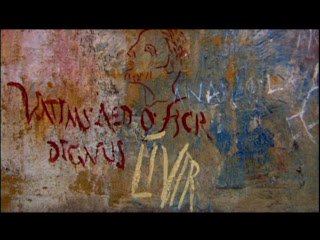

To frame this paper, and where it comes from: I have become a massive fan of HBO's programming. Beyond my own mere enjoyment however, I believe that it poses a series of questions for the always ongoing mass culture debate insofar as it represents what not long ago would have seemed an oxymoronic concept: intelligent mainstream television, television whose production values--especially in terms of the writing--is of startling quality, and which challenges (or at the very least complicates) a strictly Adornian conception of the culture industry.


I would suggest that this new wave of intelligent, well-written and well-made television poses interesting and important critical questions for film and media studies, and cultural studies more generally, which can in one way be summed up in the question I have posed students in my popular culture classes: Can television be art? And if so, how does that change our perception of art? My consideration of Rome today emerges from an ongoing engagement with such questions: I am seeking to read in the series a subtle counternarrative to the generic conventions of the "historical epic" and the received history of the Caesarian narrative. And to that end, I will be looking at that apotheosis of low cultural expression--graffiti.


Yup, my paper was all about graffiti -- Roman graffiti that is, some of which in the series is really quite filthy and obscene (to which end, I now have the distinction of having used the phrases "giant ejaculating penis" and "Atia fucks everybody" at the Canadian Congress of the Humanities and Social Sciences -- truly, I have arrived).

Anyway ... I'm happy to be done, pleased with the reception my paper received, and relieved that I can now truly relax for the remainder of my time here. I will post pictures when I'm back in St. John's ...

Monday, May 28, 2007

Congress diary, part two

Well, our good weather gave out for about half of the day -- gray and rainy this morning, but the sun's trying to burn through. Not that that's too much of a burden: even rainsoaked, this campus is still quite lovely.

And it has a great gym! I was proud of myself that I managed a workout this morning, making it in at 7:15 to do some weights and a short run on the treadmill ... which unfortunately had left me a bit dehydrated, so that I'm dying of thirst by the end of the sessions I've been sitting in on (though the fairly constant beer intake might also have something to do with that).

It's been wonderful seeing people I haven't seen, in some cases, in a number of years ... and also kind of pleasing to see some former students, now doing graduate degrees, presenting quite accomplished papers here. Andrew deWaard and Aimee Mitchell, both of whom took classes with me at Western, are here presenting at FiSAC (Film Studies Association of Canada) ... and if that's not enough to make me fee old, I recognized a woman whom I had TA'd in my first ever year at Western -- ten years ago! Ack. Still, it makes me feel sort of fatherly. Or at the very least, sort of big-brotherly.

More later ...

Sunday, May 27, 2007

Congress diary part one

Greetings from Saskatoon! I flew in yesterday morning and have been reconnecting with many many people I haven't seen in ages. It's sort of Old Home Week. So many academics all concentrated in the same place. At Pearson Airport yesterday morning, waiting for the plane to board, I played "spot the academic" in the departure lounge. Conservatively, I think half the plane were Congress-bound types, at least gauging by the number of people feverishing still working on papers.

Not me this year ... I decided that this time I wanted to have my paper done well in advance, principally so I could enjoy my time and see friends. I still have a few sentences to write in conclusion, but that's always the case. I'll talk more about my paper in my next post.

For now: I have to say I'm pleasantly surprised by Saskatoon, and floored by just how beautiful U of Saskatchewan's campus is (I'll try to post some pictures soon). The weather has been beautiful, and they certainly don't exaggerate about the prairie sky.

That's it for now -- just a quick teaser. I'm off to see a friend's paper, and then to lunch.

Friday, May 11, 2007

Mutual of Omaha presents ...

Today, a treat for my gentle readers: the first in our series of English Professors Observed in Their Natural Environments: Burrows.

Yes, the burrows of English professors (or "offices" as they insist on calling them) are as varied and idiosyncratic as the individuals who inhabit them. Consider for instance the burrow of the Nancy Pedri (Comparatus Wordnimaginius), a recent newcomer to the hills and dales of Newfoundland:

Note the spare, even Spartan arrangement of space, the careful placement of discrete objects; the Nancy herself sits poised in imitation of the image on the wall behind her to confuse and intimidate possible antagonists.

Conversely, we consider the burrow of the Andrew Loman (Hawthornica Americanus), also a species only recently introduced into this environment. Note the barricading effect of the books and papers that the Loman surrounds himself with, a labyrinthine defense that only the deftest of predators can negotiate:

Tune in next time as our intrepid wildlife photographer attempts to enter and photgraph some of the more dangerous burrows in this remote wildlife preserve.