Showing posts with label film. Show all posts

Sunday, June 10, 2012

Prometheus: a review

In the interests of keeping this blog more active, I’m hoping to post more regularly on topics of quasi-academic interest. I have a few posts on contemporary fantasy I’m working up as a sort of Game of Thrones postmortem, as well as some thoughts on the ever-expanding zombie genre.

But I thought I’d start with a film review. I saw Prometheus last night, which counts as my second-most-anticipated summer film (big shock: The Dark Knight Rises takes first place). And wow, it was a train wreck.

And yes: spoilers to follow. Lots and lots of spoilers.


I should know by now not to get my hopes up too high when a new Ridley Scott film comes out. I imagine it must be frustrating for him to have done his best work early on—Alien and Blade Runner, those two mainstays of film classes (I’ve lost count of the number of times I’ve taught them) were his second and third feature films, respectively. Since then by my count he has had one unqualified success (Thelma and Louise), two flawed but powerful films (Black Hawk Down, Gladiator), a number of much more deeply flawed but still watchable films (Black Rain, G.I. Jane, American Gangster), and a host of unmitigated disasters (White Squall, Hannibal, Kingdom of Heaven, Matchstick Men, Robin Hood).* He also directed Legend, which falls into that odd category of being something that isn’t probably nearly as good as we remember it, but we all saw it at the age of eleven, so for some it gets a pass.**

On the whole, not a great track record. But here’s the thing: the great films are so great that they come very close to balancing the sheet, and makes those of us who are devotees of Alien and Blade Runner*** live in hope that his next film will match their aesthetic and narrative brilliance (and, let’s be honest, the sheer coolness).


We keep hoping. And keep getting disappointed. But this time, there was renewed hope: Scott was returning to the scene of his first major triumph, and creating a prequel to Alien! At first, there was skepticism … but then, as teasers and trailers started appearing, there was cautious but ever-growing hope. It looked AMAZING, for one thing. And for another, the more we learned about the premise, the better it looked. Never mind that we could pretty much figure out the story from the trailer: an exploration team follows ancient clues promising to unlock our origins as a species to a distant planet, where they encounter some sort of contagion or infection that will threaten our existence, and in a climactic scene the crashed spaceship they discover in Alien, well, crashes.

Whoever did the marketing for Prometheus should quite possibly have written the script—it probably would have been smarter. All of the trailers and ancillary bits of publicity (such as a TED talk done by Guy Pearce’s megalomaniac CEO Peter Weyland, circa 2023) were greater, in the end, than the sum of Prometheus’ parts. There’s a paper to be written somewhere about how skillful viral marketing frequently seems to eclipse the artistry of the film being advertised … but for now, I’ll limit myself to reviewing Prometheus, which I saw last night in IMAX 3D.


OK, so the positive things first: one, it looked every bit as good as the trailers promised. See, this is the ambivalent thing about Ridley Scott’s crappy films: however crappy the story, they always look amazing. So you always see hints of Alien or Blade Runner in his signature style, which makes brilliant use of light and shadow and the contrast between grandiose, totalizing shots and close, claustrophobic terror or anxiety. And you know that, of only the story wasn’t shite, it could be a brilliant film.

Certainly, this was the case with Prometheus. As I said, I saw it on the IMAX screen, and if you’re going to see this film, go see it in the theatre.

Second positive element was the cast. It was both a mitigating factor, and a total frustration that almost every one of the actors was (a) a consummate professional, and (b) someone I just loved watching. Lisbeth Salander Noomi Rapace, Michael Fassbender, Tom Hardy [correction--the actor I took for Tom Hardy is actually Logan Marshall-Green. Properly contrite am I], Stringer Bell Idris Elba, and Guy Pearce (in a whole lot of prosthetic makeup that qualifies as the film’s worst special effect). The one out of place person was Charlize Theron, who just seemed outclassed by the rest of the cast. She played an ice queen executive in charge of the mission, and was so wooden and toneless that I kept waiting for her to turn out to be an android.

On the other hand, Michael Fassbender played an android, and played it brilliantly. One of the best parts of the film is him alone on board the spacecraft while the rest of the crew slumbers in cryosleep. The subtlety of nascent threat he brings to his emotionless robot is easily on par with Ian Holm’s not-dissimilar character in the original Alien.

 But as lovely as Fassbender’s performance is, it is one of the narrative problems: I’ve seen this story before. As prequel to Alien, it anticipates that story; but coming twenty-three years after the original was released, it feels simply derivative. I’m sure there’s some brilliant psychoanalytic reading to be done (“Recursion and Return: The Iterative Narratives of the Alien Franchise”), but really it just sort of feels done. A few elements:

  • A cold and self-interested corporation desires to exploit a discovery on a distant planet, and is willing to sacrifice its crew.
  • An alien species is discovered, all dead through some mysterious plague.
  • A cold and inscrutable android deliberately puts the crew at risk.
  • A not-so-dead alien species contaminates the crew.
  • The cold and inscrutable android gets decapitated.
  • The ship is destroyed to prevent the malevolent life form from getting to Earth.

Sound familiar? It’s understandable to have a certain amount of repetition when producing new films in an established franchise, but really, this just felt lazy.

The premise of the film is this: two archaeologists (Noomi Rapace and Tom Hardy), having discovered the same star system diagram in many ancient texts, convince the head of the massive Weyland Corporation to bankroll an exploratory expedition to the star system. The predictable disasters as partly outlined above ensue. But the larger philosophical/theological question deals with our origins on Earth. The film opens in a primordial landscape atop a massive waterfall. A huge, musclebound albino humanoid watches a huge flying saucer (Ridley Scott likes to work large-scale) depart into the clouds. He (?) then eats a mouthful of grotty-looking stuff, and promptly begins to disintegrate in great pain. The perspective shrinks to the cellular, and we see his DNA breaking apart. He falls into the water, and again, at the cellular level, we see DNA recombine into new strands and then turn into life.

Very obviously, this is the pageantry of new life forming on Earth. Skip ahead millions of years, and our archaeologists make their find. Skip ahead a few more years and the exploratory ship Prometheus arrives at the planet.

"All in the game, baby ... all in the game."

The premise is intriguing and compelling, but not executed well at all. The questions of god and belief, of evolution vs. design, and of parents and children are all handled in terribly hamfisted ways. Eventually it becomes reduced to simplistic paternal drama. Peter Weyland we assumed was dead. As it turns out, he’s on the ship, his presence known only to the android David and Charlize Theron’s robotic-but-not-a-robot expedition leader Vickers. It was made clear earlier that, as Weyland’s creation, David considered Weyland his father, and Weyland considered David his son. In what is perhaps the most unsurprising revelation of the film, Vickers is Weyland’s actual daughter. Weyland has smuggled himself along in the hopes that, in finding the origins of life or meeting its engineers, he might be granted longer life … which, in a particularly hackneyed moment, Vickers complains is against the natural order of succession.

The twist, such as it is, is that our “engineers” were using this planet as a weapons lab—and that they were planning to return to earth and wipe us out (for reasons that are never made clear). The substance they discover in the alien bunker and the underground ship is evidently some sort of agent that mutates DNA in malevolent ways—as Stringer Bell (sorry) observes, it is a biological weapon. And once it gets loose in certain crewmember’s systems, it wreaks its havoc and starts producing monstrosities that only identifiably become the H.R. Giger alien of the earlier films in the final sequence.


It is when the bio-weapon starts making its presence known that the film’s wheels start to come off. Charlize Theron’s wooden acting notwithstanding, the film has a lot of promise early on. Michael Fassbender’s solo sequence in the spaceship in particularly gave me hope … but in hindsight, that was mainly because he didn’t have any lines from the script to speak, and instead was just Michael Fassbender being compelling. The more the script reveals itself, the worse it gets … and Ridley Scott’s reliable standby, his visuals, lose their power once the excesses of the alien/bio-weapon become, well, excessive …

Don’t get me wrong—I like a good gory alien monster flick as much as the next guy (provided the next guy is a total SF nerd), and the Alien franchise has always delivered on that front. Except … well, think of the first Alien. The gore and the horrifying figure of the alien are shocking, but strategically so. The story of how Ridley Scott didn’t warn his actors that he would be spraying them with real blood in the “birth” scene—and so the shock, horror, and disgust on their faces is not feigned—is one of those great bits of film history lore. In Aliens, the gore takes a backseat to the action, but there is enough of it—and the aliens are sufficiently terrifying and repulsive—that we still cringe at key moments.

It’s always difficult to locate that fine line between well-managed abjection and excess, and I suppose it’s always going to be somewhat subjective. But I found Prometheus crossed that line once we got to the scene of Noomi Rapace’s self-administered caesarean (never mind that it isn’t exactly believable that she would sprint away from the surgical pod after having her belly stapled), and then the final confrontation between the engineer and the proto-Giger alien. Perhaps it was the engineer being orally raped—which if it wasn’t obvious enough, the alien then shudders orgasmically and collapses, presumably dead … or perhaps just post-coital, at first it isn’t clear. But … blecch.

"Hm. Yes, I do feel like someone is watching me. Why do you ask?"

Anyway, I’ll leave off with some nerdy nitpicking. First: the basic premise of the film is that the alien species that created us left clues so we could find them. However, the planet to which they send us isn’t their homeworld—it is, as Stringer Bell (sorry again) realizes, a weapons plant remote from their home because, as he observes, you don’t manufacture incredibly dangerous biological weapons in your own backyard. And the film ends with Noomi Rapace leaving with the segmented David in tow on another of the alien ships to find their actual homeworld.

So … why would aliens leave behind directions to their weapons stockpile? Wouldn’t that be like bringing immigrants to the U.S. to Area 51 rather than Ellis Island?

And secondly—and this is the thing I just can’t get past—SO MUCH of this film was obviously designed to cater to diehard Alien fans. Everything about how the film ends sets us up for how Alien begins, except for one utterly baffling discontinuity. In Alien, when the crew of the Nostromo**** enters the alien ship, the first thing they find is the dead alien space jockey strapped into some sort of flight chair. It is long dead, and its abdomen has a hole as if something exploded out of it. After John Hurt’s character has the alien burst out of his belly, we realize in hindsight that the alien space jockey died the same way.


In Prometheus, when David wakes the last remaining “engineer,” the big alien proceeds to kill everyone present except Noomi Rapace, who escapes, and David, who is decapitated but can still talk, and then straps himself into the flight seat to complete his mission, presumably, to wipe out Earth’s population. The alien ship takes off, and Stringer Bell (no apologies) rams the Prometheus into it and causes it to crash … in precisely the position the crew of the Nostromo find it twenty-nine years later.

Now, as I was watching the film—and I’m curious to know if anyone else was thinking the same thing—I kept thinking “OK, so space jockey guy has an alien inside him. When did that happen?” My best guess was that David, for inscrutable reasons, somehow infected him with the bio-weapon … but that seemed far-fetched at best. But then, he leaves his ship to go after Noomi Rapace, and instead ends up tangling with the big-ass mutant alien. At this point I’m thinking, “OK … so he gets impregnated and goes back to his ship to, I don’t know, try to take off again, and THAT’s when the alien comes bursting out.” But no … apparently, he dies when the mutant alien essentially orally rapes him. And then so does the mutant alien. And in the film’s final sequence, the Giger alien (these alien distinctions are getting cumbersome, sorry) bursts out of his gut. FAR AWAY FROM HIS SHIP.

Argh. I can forgive hamfisted storytelling, but not baffling stupidity. It’s as if Scott and his screenwriters (one of whom was Lost’s Damon Lindelof—any comments, Nikki?) didn’t actually bother to re-watch Alien, but just went on vague memory.

At any rate. Bottom line: Prometheus was, to say the least, a massive disappointment … but after so many disappointments from Ridley Scott, I really shouldn’t have expected anything different. That being said, it was a hellishly impressive work of visual art, true at least in that respect to Alien, with many breathtaking moments and subtle grace notes. A shame the story couldn’t live up to that.

--------------------------------

*Then there are the films I haven’t seen, which may include a gem I’ve overlooked. But somehow I doubt it.

**Though perhaps less so now since Tom Cruise detonated his career and retroactively made us see the batshit in all his earlier roles.

***I leave out Thelma and Louise here, because however great a film it was, it does not have the same cachet as the other two. Speaking for myself, I love it, but it inspires none of the fanboyism that Alien does.

****Anyone else wonder why they didn’t give Prometheus a similarly Joseph Conrad themed name? The Narcissus? The Patna? Typhoon?

Monday, February 27, 2012

Oscar who?

I watched the first fifteen minutes of the Academy Awards, and that was about all I could manage. I was past indifferent this year, in part because there was nothing nominated that was truly amazing or shocking, but also because the whole formula has become just so stale. It didn't help to have Billy Crystal back doing his once-hilarious but now tired schtick.

Though perhaps he best summed up the reason for my big yawn with his best line (in the brief time I watched): "Nothing can take the sting out of the world's economic situation like watching millionaires present themselves with golden statues."

Here's a thought: next year, they should change the format to mimic The Hunger Games, and have all the nominees fight each other to the death for their statuette. Considering it's entirely possible that The Hunger Games might be nominated for something, this appeals to my postmodern sensibilities.


**One exception to my above crankiness: I'm so happy Christopher Plummer won for Beginners, and would have liked to have seen his acceptance speech. There's a man with immense talent AND class.

Saturday, January 22, 2011

Watching Dr. Strangelove (yet) again

"I can no longer sit back and allow Communist infiltration,
Communist indoctrination, Communist subversion,
and the international Communist conspiracy
to sap and impurify all of our precious bodily fluids."
—Colonel Jack D. Ripper, Dr. Strangelove

I do so love this film—not only is it easily my favourite Kubrick film (a director whose genius I freely acknowledge while not necessarily loving much of his oeuvre), but it is a fixture in my top five favourite films, period. I've been rewatching it this afternoon and pulling screen captures in preparation for teaching it in my intro to film class this week, and just generally losing myself in it.

Whenever I watch it, my laughter at its hilarity is always slightly checked by an awareness of just how dark and bleak the humour is—or was. The first time I ever watched the film was for a class in my undergrad, in the early 90s. Hence, my familiarity with Dr. Strangelove began after the Cold War had ended, during a time when it appeared to many that the United States was permanently ascendant and American-style liberal democracy had proven itself the acme of societal evolution (see, Fukuyama, Francis: History, and the Ending Thereof). But even now, with those delusionally halcyon days of the new world order rather emphatically behind us, and amidst the hysterical rhetoric of the War on Terror, it is difficult to understand the nuclear paranoia of the Cold War in the 50s and 60s. It is hard to imagine the ever-present anxiety of the spectre of nuclear annihilation; my parents talk about air raid drills as a regular punctuation of their young lives, of being sent home from school early during the Cuban Missile Crisis praying with their families around the radio that they weren't about to be wiped out by thermonuclear bombs. I have at least a little inkling: I remember my father's sombre concern about Reagan's election in 1980 (I was eight at the time), expressed as "I'm afraid he won't be afraid of starting a war with the Russians." I came of age during the Cold War Redux, as we might call it, as Kissinger's détente gave way to Reagan's overheated rhetoric about "the evil empire," and films such as The Day After gave us starkly vivid images of the aftermath of a nuclear war. (I was not allowed by my parents to watch that movie—they did not want me or my brother to have to deal with the anxiety that inevitably came from such a brutal depiction of nuclear warfare—which was, not insignificantly, optimistic in its estimation of human survival).

Once (again, I think I was around eight years old), I quoted to my parents an interesting fact I'd read about the survival talents of spiders: that they would likely be one of the few species to survive nuclear war. To which my mother replied, "No, we'll survive!" I'm not sure what disturbed me more: the vehemence with which my cool factoid was quashed, or the tremor in my mother's voice as she did so. I think I can start charting my own nuclear anxieties from that moment. I remember too the sense of dread I experienced every time they moved the hands forward on the Doomsday Clock—seeing it as I did with the literal-mindedness of a child, believing that when it hit midnight, that was the end.

Even growing up with such anxieties, the nuclear paranoia that was the context for Dr. Strangelove remains hard to fully imagine today. And so it is similarly hard to wrap my head around the audacity of the film's humour. The novel on which it is based, Red Alert by Peter George, is a straightforward political thriller; and Stanley Kubrick's initial script drafts were not humourous or satirical, but essayed a serious and dramatic narrative. But he found that the tone of the story kept running up against the often absurd contradictions of nuclear logic, especially in the premises of mutually assured destruction. "I found that in trying to put meat on the bones and to imagine the scenes fully," Kubrick said, "one had to keep leaving out of it things which were either absurd or paradoxical, in order to keep it from being funny; and these things seemed to be close to the heart of the scenes in question." Hence his decision to make it a black comedy, which was one of those choices that should be enshrined in film history as a turning point into genius. For Dr. Strangelove could not have been the trenchant critique it was had it played it straight: the absurdly amoral discussions in the War Room, in particular General Buck Turgidson's suggestion that they go all in on Colonel Ripper's sneak attack, exactly echo the actual contingency plans of the Cold War.

My favourite line in this scene is Turgidson's caveat "I'm not saying we wouldn't get our hair mussed!", which sums up so perfectly the desperately euphemistic logic of nuclear war: millions of lives instantly snuffed out, millions more suffering the inexorable agonizing death of radiation poisoning, and billions ultimately dying of privation and exposure, neatly divorced from brutal reality with such terms as "acceptable losses." Possibly one of the best discussions of this subject I've read is Martin Amis' essay "Thinkability," which prefaces his 1985 collection of short stories Einstein's Monsters. The euphemisms and clichés of the Pentagon's rhetoric about nuclear war all attempt to hide the basic, inescapable reality of nuclear war, which Amis characterizes as "everything becoming nothing, all at once."

What is less difficult to comprehend and understand today is the culture of conspiracy and paranoia that informs Colonel Ripper's decision to launch his pre-emptive attack. Though framed in the language of absurdity, the figuration fluoridation of drinking water as a Communist plot was not an uncommon meme in conspiracist circles. Some things never change: watching Glenn Beck today (or rather, watching the thirty seconds or so of him I can stand at a time), Colonel Ripper's delusions seem mild. I take comfort in the fact that Beck does not command a wing of B-52 bombers, but it is a sad statement of today's climate when the satirical language of Colonel Jack D. Ripper is mild in comparison to that of the highest-rated news channel in the U.S.

But I digress … I told my students the other day that when we study film, in addition to its aesthetic dimension, we're concerned both with what they can tell us about their historical moment and with what they still have to tell us about ours … and that, ultimately, it's the latter category that tends to most define those films that we return to over and over. Dr. Strangelove never gets tired for me. Hopefully my class feels similarly.

Friday, January 21, 2011

Bad blogger me. Also, film class! And other stuff.

Hello everyone ... I have been a very bad blogger these past several weeks, and now I am back to repeat the cycle of Energetic Blogging Productionà Tapering Offà Long Silenceà Series Of Lackadaisical Apologies For Long Silenceà Renewed Burst Of Blogging Energy. Hopefully this is the sole Lackadaisical apology, to be followed by a new burst of energy.

No promises, considering this term is rather crazy. I have three courses, all of which are full, and one of which I'm essentially building from the ground up. But I am happy to say they are all extremely enjoyable to teach, and my cohort of students this term is rather amazing—they're all seemingly interested and engaged, and what's more, they laugh at my jokes. Which is good, because I'm so busy with course prep that I don't really have to chance to work up new material.

I'm particularly enjoying my intro to film class, "What is Film?" I was set to teach one of our mandatory surveys, "Major British Authors since 1800," but the department head circulated an email asking if someone would be willing to teach the film class.

I don't think I've ever answered an email so quickly. I don't think thirty seconds elapsed between hearing the new message beep and me firing off my reply. YES, I will teach introduction to film, especially if it means I can trade an English survey course for it. Not that I don't enjoy teaching the great swathe of literature since Blake, but come on ... a film course? In which I basically get to choose whatever films I want? Too ... much ... awesomeness ...

Of course, I ran into trouble in narrowing my list down to a maximum of twelve films ... so after finally paring it down to forty-three of my favourite movies, I looked at what I had and broke them up into twelve loose categories. I then posted that as a note in Facebook, tagged a bunch of film enthusiast friends, and asked people to vote for one from each category. Whatever won in each would be on the course.

Sometimes net democracy is your friend—not only for the fact that it took the onus of that final, agonizing decision off of me, but also for the amazing discussion and argument that unfolded in the comments.

Anyway, the final screening list is sort of like a who's-who of my favourite films. We're doing, in the order we're covering them in class, Rear Window, Alien, Dr. Strangelove, Crouching Tiger Hidden Dragon, The Big Lebowski, Citizen Kane, Double Indemnity, Blade Runner, The Good the Bad and the Ugly, Moulin Rouge, 28 Days Later and Pontypool. Again: So. Much. Awesomeness. I am concerned that my lectures will devolve into little more than me geeking out a lot. So far we've done Rear Window and Alien ... and, yes, there have been some moments of total geeking out. But to be fair, that's happened among some of my students too (did I mention I have awesome students this term? And I'm not only saying so on the off-chance they read my blog).

I'm particularly concerned about what my lecture for Crouching Tiger will be like, considering that the sheer beauty of that film reduces me to a quivering pulp whenever I watch it. I expect I will show clips and stills and the content of my lecture will be along the lines of "I mean ... come on ... seriously ... isn't that just ... my God ... it's so ... fuck!" But serious. Please look me in the eye and tell me that film isn't gorgeously made and composed ...

OK. See? This is what I'm talking about! I even veer off into digressive geeking out during a blog post. Must. Keep. It. Together.

In other news, I had my second column in FlowTV.org go live this past weekend. Regular readers of my blog will recognize some of the theme and substance, as it's about zombie films and The Walking Dead—but please go peruse it and leave your comments. And I will soon be a guest blogger on my friend Jen/Nikki's site as she continues The Great Buffy Rewatch, revisiting all seven seasons of Buffy the Vampire Slayer. Apropos of which, I plan to finally conclude the Vampire Cage Matches—seeing as how her blog gets about a million times the readers as mine, hopefully I can pull in the masses to vote for who, in the end, is the most kickass vamp.

And in the meantime, I'll try not to be such a slagabed when it comes to blogging. Scout's honour.*


*I was never a scout.

Friday, July 16, 2010

Big Love, ctd—The Alien connection

As mentioned yesterday, the evil Mormon patriarch on Big Love is played brilliantly by the incomparable Harry Dean Stanton. I looked Stanton up on iMDB.com to remind myself of what else he's been in, and could have kicked myself to have forgotten that he was in one of my most favouritest movies ever—Ridley Scott's tour de force Alien. He played Brett, the unfortunate technician who is the first to be killed by the fully grown alien in what remains one of the most terrifying sequences I have ever seen.
That I had forgotten Stanton's star turn as alien food is odd considering that my seamless enjoyment of Big Love is occasionally disrupted by the unbidden but rather insistent memory of Bill Paxton's role in the James Cameron sequel Aliens—a film that, Avatar be damned, remains the best thing the action-film king has ever made.

Paxton's most memorable moment in Aliens comes when his gung-ho marine suddenly freaks out and very nearly loses his mind for a few minutes ...

Whenever his all-American polygamist in Big Love is faced with a problem, part of me (a rather large part, actually) really wants him to start hysterically shouting "Game over, man!"

Now, if they can just convince Sigourney Weaver to guest star for a few episodes ...

Friday, May 07, 2010

Carpe Jugulum ctd.: Mel Gibson vs. the Nac Mac Feegle

A few nights ago, Braveheart was on television. I can now definitively add that film to my list of dangerous night-time movies—dangerous, because I invariably happen across them at that listless channel-flicking moment when I'm just beginning to overcome couch-induced inertia and go to bed. And then I start watching a movie I've seen before. More often than not, what then happens is I sit up much later than I had planned, constantly thinking "OK, now I will go to bed," but unable to move because I just can't look away.

(Other films in this category include both Star Wars trilogies, all Star Treks except numbers one and five, The Green Mile, Underworld, any John Hughes film, anything involving predators or aliens, and anything starring Humphrey Bogart ... who. it must be said, would probably flinch to be included in the preceding company. However, the all-time winner for repeat offender is Tremors, that wonderfully awful Kevin Bacon film about subterranean carnivorous slugs. What is everyone else's late-night compulsive viewing?)

For the record, I think Braveheart is a terrible film, albeit a very pretty one that makes me want to go back to Scotland. Watching it the other night reaffirmed my original assessment, which was that this unbearably long three-and-something hour historical epic could have been tightened up into a tidy and relatively inoffensive ninety-minute popcorn flick if Gibson had simply played all the slo-mo sequences at regular speed. Seriously. While I love haunting Celtic music as much as the next third-generation Canadian of Scottish and Irish extraction, to say Gibson lays it on a little thick is a wee bit of an understatement. Indeed, to quote the best film review ever written, this film looks down on over-the-top as if from a great height.

(Incidentally, has anyone else noticed that Mel Gibson seems to have a disturbing thing for torture? Braveheart, Payback, The Passion of the Christ, Apocalypto—all films with rather excruciating torture sequences.)

Braveheart was however made more amusing to me because I was midway through Carpe Jugulum when I watched it the other night, and the high seriousness of Gibson's self-consciously epic film was undercut by the thought of the Nac Mac Feegle. The Nac Mac Feegle, or "wee free men," are described in The Folklore of Discworld as follows:

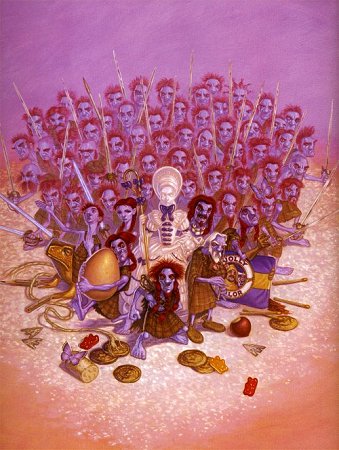
To humans, they are one of the most feared of the fairy races—indeed, they can put trolls to flight, and even Nanny Ogg's cat Greebo retires under the furniture at the sight of them. They have shaggy red hair, and are covered all over with blue tattoos and blue paint, in patterns which indicate their clan. They wear kilts or leather loincloths, use feathers, bones or teeth as decorations, and carry swords almost as large as themselves—though they go in for kicking and head-butting too. They are about six inches tall.

The Nac Mac Feegle make several appearances in Carpe Jugulum. Technically, they are pixies—or, in the proper spelling, "pictsies." Har. They speak—or rather, shout—in a more or less incomprehensible brogue, and steal cattle. Nanny Ogg describes their livestock-thieving procedure:

Four. One under each foot. Seen 'em do it. You see a cow in a field, mindin' its own business, next minute the grass is rustlin'. Some little bugger shouts "Hup, hup, hup," and the poor beast goes past, voom! without its legs movin'. Backwards, sometime. They're stronger'n cockroachers. You step on a pictsy, you'd better be wearin' good thick soles.

The funniest sequence in the novel comes when the Nac Mac Feegle rescue King Verence of Lancre. The main plot of Carpe Jugulum is about a family of vampires who smoothly take over the kingdom of Lancre by essentially hypnotizing everyone they come into contact with. Verence is relegated to his bedchamber under non-vampire but still nasty mercenary guard. The Feegle come to liberate him.

[Verence] could hear very faint voices, apparently coming from somewhere below his pillow.
"Rikt, gi' tae yon helan bigjobs?"
"Ach, fashit keel!"
"Hyup?"
"Nach oona whiel ta' tethra ... yin, tan, TETRA!"
"Hyup! Hyup!"
Something rustled on the floor. The chair of one man jerked up into the air and bobbed at speed to the window.
"Hyup!" The chair and its occupant crashed through the glass.
The other guard managed to get to his feet, but something was growing in the air in front of him. To Verence, an alumnus of the Fools' Guild, it looked very much like a very tall human pyramid made up of very small acrobats.
"Hup! Hup!"
"Hyup!"
"Hup!"
It grew level with the guard's face. The single figure at the top yelled: "What ya lookin' a', chymie? Ha' a wee tastie!" and launched itself directly at a point between the man's eyes. There was a little cracking noise, and the man keeled over backwards.

Now, perhaps I'm speaking just for myself here, but you've got to love dialogue that reads like a Robbie Burns poem.

At any rate, as I watched Braveheart the other night, I found myself giggling every time Mel Gibson intoned one of William Wallace's sententious speeches, as in my head I heard the Nac Mac Feegle saying "Waley, waley, waley! Seeyu? Grich' ta' bones outa t'is yan! Hakkis lugs awa'! Bigjobs!"

I recommend reading Carpe Jugulum, if for no other reason than its efficacy as an antidote should you ever find yourself watching Braveheart late at night. It makes the movie ever so much more entertaining.

Thursday, April 29, 2010

Summer of the übermensch(es)

Two nights ago I went to see The Losers, largely on the strength of three things: (1) the trailer was cool, (2) it had Zoe Saldana, whom I am quite happy to watch in any context that doesn't involve her being CGIed into a giant blue Amerindian cat person, and (2) it featured Idris Elba, who for me will always be Stringer Bell from The Wire. The movie is of the Elite Squad action sub-genre, the kind in which you have a team of soldiers, mercenaries or thieves, each of whom has a particular area of expertise, and who over the course of the film carry off several daring / difficult / impossible missions and/or heists.

Let's be clear: The Losers is an extremely bad film, but fortunately bad in very entertaining ways. This is a film that does not embrace the clichés of its genre so much as immerse itself in them as if in a warm bath. Lots of explosions, fire-fights, and the Elite Squad walking toward the camera in slow motion. Good times.

What is more interesting to me however—honestly, this film does not really rate a mention on this blog otherwise—are the trailers that preceded the movie. First was a film called The Expendables, which stars—wait for it—Sylvester Stallone, Jason Statham, Jet Li, Dolph Lundgren, Eric Roberts, Randy Couture, Mickey Rourke, and Stone Cold Steve Austin ... and with cameos from Bruce Willis and Arnold Schwarzenegger. In other words, pretty much all of the major action stars from the previous three decades. And yes—it is an Elite Squad film about, as iMDB.com sums up, "a group of mercenaries hired to infiltrate a South American country and overthrow its ruthless dictator." As a friend of mine observed, whether this film intends it or not, it will be a parody.

The next trailer featured was for Takers (which also, interestingly, stars Idris Elba—so glad he's getting post-Wire work), a film about an elite group of thieves and their plan to make off with a twenty million dollar heist.

At this point, knowing full well what The Losers is about, I'm thinking to myself "Huh ... I kind of don't have to watch this movie now ..."

It strikes me that we seem to have a critical mass of Elite Squad movies hitting theatres this summer. The Stallone film in and of itself cranks this dial up to eleven, but we also have The A-Team coming out soon ... and I'm kind of happy to have seen The Losers, because after that ... honestly, how bad could the film adaptation of my favourite TV show when I was eleven be?

Don't answer that.

Tuesday, April 13, 2010

I haz seen teh zombiez, and dey is us

Today's main task is to compose my paper proposal for this year's Canadian Association of American Studies (CAAS) conference. When the conference theme was announced as "Health/Care/Nation," my first thought was "Oh, I am TOTALLY writing a paper on zombies."

I've been working at the basic outline of what I want to write, which is going to be a reading of the zombie as embodying the "nightmare of excess" (working title: "The Triumph of Death: Zombies and the Nightmare of Excess"). My thought is that zombies have functioned as ideal ciphers in horror films: they always stand in for something else, be it creeping conformity, communist collectivity, rapacious mindless consumerism, viral pandemics, or stoned slackerdom.

Zombies, in my reading, exert the fascination they do because they are the ultimate embodiment of what theorist Julia Kristeva figures as "abjection"—the abject, she says, is that "which is not-I," something inescapably Other, that which is excess to us. A key example of what she means is our squeamish relation to our own bodily fluids: blood, mucus, excrement, pus, saliva, etc. As long as these are out of sight and contained, we are fine with them; revulsion is however our principal reaction when they become exterior to us, a reaction ramped up even further when they happen to belong to other people. We try to maintain an out-of-sight, out-of-mind relationship to such detritus at all times, and are discomfited when presented with the reality of our own excess—be that our own excrescences or the waste we produce simply as a matter of consumption. Kristeva makes the argument that the ultimate expression of abjection is the corpse, and the more obviously dead (i.e. mutilated or decayed), the greater our fear and revulsion.

Thus, the zombie exemplifies the abjection of excess—and given that excess is the product of consumption, the zombie's mindless drive to eat the living is the ultimate act of consumption designed to transform us into more excess. With this in mind, I have to wonder if zombies have ultimately come to be less ciphers for other fears than simply being the thing themselves. By which I mean they are what my fellow Americanist David Evans at Dalhousie (speaking of trash) calls a "stubbornly senseless singularity"—what Slavoj Zizek terms the "indivisible remainder" and Lacan would probably figure in some terms of a horrifying and inescapable Real (Lacanians, help me out on this one).

This isn't to suggest that they don't also represent all that other stuff I mentioned, but the very profusion of zombies in popular culture recently—an excess of excess, if you like—itself makes this reading rather more convincing. In the last eight years or so, we have reached a critical mass of the zombie genre: the Resident Evil franchise, 28 Days Later and 28 Weeks Later, the Dawn of the Dead remake, George Romero's own recent contributions Land of the Dead and Diary of the Dead, and of course comical takes like Shaun of the Dead and Zombieland. On television, BBC produced a remarkably good miniseries titled Dead Set, in which the sole survivors of the zombie apocalypse are the contestants on the set of Big Brother. There have also been such films as I am Legend, Quarantine, Carriers, and The Crazies, which may not be strictly zombie films but certainly employ the standard z-film tropes; and of course there have been the hugely popular Max Brooks books The Zombie Survival Guide and World War Z: An Oral History of the Zombie War (with the latter currently in film development).

And these are just the mainstream examples. Out of curiosity, and to make sure I wasn't making a claim that simply wasn't true, I found a list of zombie films made since White Zombie premiered in 1932. Keeping in mind that this is a Wikipedia list and thus not ironclad, the numbers are nevertheless staggering. Between 1932-2001, there were 216 zombie films produced, which averages out to about three a year; from 2002-2009 there were 317. Three hundred and frakkin' seventeen! Which means, to put it in perspective, that in those eight years, fifty percent more zombie films were produced than in the sixty-nine years previously—an average of forty per year.

Several things leap out at me here. First and foremost is the timing: when I break down the 2002-2009 by year, I find that 2002 had a paltry eight films, which is of a piece with 2001 (eleven), 2000 (nine) and 1999 (six), while 2003 jumps to twenty-six (with numbers more or less climbing every year to the sixty-four that came out in 2009). Taking into account the time it takes to get a film into production, film it, and release it, this makes the zombie explosion pretty emphatically a post-9/11 phenomenon. As discussed in my previous post about terrorism on the large vs. small screen, Hollywood has largely eschewed representations of terrorism, instead sublimating such spectacles into films like Transformers and War of the Worlds. Do we also now lump zombie films into the morass of post-9/11 anxiety?

It seems an unavoidable thing. The question is, and what I throw out to my loyal readers, is this: what is it about post-9/11 fear and anxiety that inspires this "nightmare of excess"?

Monday, March 29, 2010

Big-screen versus small-screen terror

I'm currently reading a book to review called Firestorm: American Film in the Age of Terrorism. It's pretty good—a decent balance of exposition and analysis, and makes some very useful observations about the often serendipitous relationship between Hollywood and 9/11. One observation it makes, which sort of struck me, is that since the attacks nine years ago, there has been very little in the way of terror-based plots emerging from Hollywood. Certainly when compared to the fairly constant presence of terrorists as ubiquitous bad guys through the 80s and 90s, the absence is rather striking. The author quotes an article written in The Atlantic in 2008 by conservative columnist Ross Douthat, who claims "Even in films that aren't taking thinly veiled jabs at the Bush administration, terrorist baddies turn out to be Eurotrash arms dealers (2006's Casino Royale), disgruntled hackers (2007's Live Free or Die Hard), a sinister air marshal (2005's Flightplan), or the handsome white guy sitting next to you in the airport lounge (2005's Red Eye). Anyone and anybody, in other words, except the sort of people who actually attacked the United States on 9/11." I think Douthat's claim here is inane,1 for reasons I will get to in a moment, but at least has the merit of being correct in the broad strokes: namely, that there have been very few films since 9/11 that have depicted Islamist extremists in any capacity. Those that have I can more or less count on one hand: The Kingdom, United 93, Munich and Syriana are really the only ones that leap to mind (though I suppose you could include You Don't Mess With the Zohan if you wanted to stretch the designation to the breaking point, and Iron Man features bad guys in Afghanistan whom we are meant to understand as either Al-Qaeda or Taliban types).

To clarify what I mean here: there are a host of films that feature terrorism as a narrative element, or which are obviously about 9/11 in displaced form (think of Spielberg's remake of War of the Worlds), but these are not about radical Islamism per se; I also leave off the list films about the Iraq war such as The Hurt Locker, Stop-Loss or In the Valley of Elah. I find Douthat's claim insipid because, of the films he cites, only Live Free or Die Hard can reasonably be called a film about terrorism, and even there the antagonist's principal motivation is to demonstrate to his former employer, Homeland Security, how vulnerable the U.S. is to electronic assault. The other three are, respectively, an overwrought spy film, a really rather incoherent psychological thriller, and a more nuanced and taut psychological thriller. Given that the latter two involve airplanes, I can see the impulse to classify them as Douthat does, but that stretches the definition of "terrorism" to an extent that renders is more or less meaningless.

I would counter Douthat's claim, which attempts to posit this lack of "the sort of people who actually attacked the United States on 9/11" in films as Hollywood being all wimpily PC, with the observation that there have been very few films about terrorism in general since 9/11.2 It's not that Hollywood is reluctant to depict Islamists (Allah knows they were the among the most frequent go-to villains in action films in the 80s and 90s), but that it has become leery of the very subject of terrorism. This is, in and of itself, unsurprising. For all it gets vilified as a bastion of liberalism, Hollywood is actually very conservative—not politically, perhaps, but it is very cautious where the financial bottom line is concerned. Whether or not big-budget, genre movies—and this, really, is what we're principally talking about, not small-scale, independent or self-consciously "quality" films—could sustain audiences if they actively reminded them of the war or terror is an interesting question, but not one that major studios are likely to test at the risk of their profit margins.

All of this, besides offering me an excuse to take a few thwacks at Ross Douthat, is by way of pointing out that while films have been reluctant to depict terrorism since 9/11, Islamist or otherwise, the same cannot be said for television. Indeed, the small screen has been very nearly glutted with narratives of Samuel Huntington's so-called "clash of civilizations," and pretty much every American actor who can pass for "Eastern" has been getting work on 24. Even Kal Penn of Harold and Kumar and House fame has taken a turn as terrorist (albeit a reluctant one). Kal Penn, I ask you! Also that season, Canada's own Sean Majumder played a terrorist as well, casting that is perhaps even more amusing than Penn's.

While 24 is the primary example of TerrorTVTM, it is by no means the only one: besides such short-lived shows as E-Ring, Threat Matrix, and The Grid, N.C.I.S. has frequent recourse to plotlines involving Islamists; season three of The West Wing began with a special post-9/11 episode ("Isaac and Ishmael") in which the characters mused over the nature of the war on terror while in a lockdown, and the second half of the season hinged to a large extent on a plot in which the president must decide whether to assassinate a foreign dignitary who is discovered to be the leader of an Al-Qaeda type group; Showtime produced a two-season series titled Sleeper Cell, about an African-American Muslim working for the FBI who infiltrates, well, a sleeper cell; and the various Law & Order franchises have all featured episodes about terrorism, Islamism, or the new American security state.

I raise this question here because I am curious as to why this is the case—I get why film shies away, but what is it about terrorism, Islamist or otherwise, that television finds so amenable? Is it the small-screen format? Where film is leery of recreating the kind of spectacle of 9/11, is television unconcerned because it can't do large-scale visuals in the same way? Are terrorism plots (in the various senses of the word) better suited to episodic format or procedural dramas? Or is there another reason?

I throw this out to general discussion—I am interested to get feedback. Also, I am sure I am missing terrorism-based films in my short list. If you want to point out anything I have overlooked, that would be super.

————————————————————————

1I suppose I should be kinder to Ross Douthat, given that he is one of a rapidly shrinking cohort of conservative writers and thinkers who actually value intellect and erudition, and overall the article of his I'm quoting offers an interesting reading of post-9/11 film as a self-conscious retread of 1970s Hollywood. His discussions are almost invariably marred however by such tendentious claims as the one he makes in the quoted passage. He pretty much always manages to seriously irritate me whenever I read his columns, less by his politics than the presumptions about leftist and liberal thought that underwrite his arguments. (One way or another, I am deeply amused that Microsoft Word's spellcheck suggests that the word I'm meaning to type when I write "Douthat" is actually "douched.")

2Douthat, incidentally, does not do much to help his argument when he dismisses one of the few post-9/11 films to specifically depict Islamist terrorism—Syriana—as a film that "eschews nuance entirely, tracing all the ills of Mesopotamia to a malign nexus of Texas oilmen, neocons, and a trigger-happy CIA." Omitted from this list, interestingly, are such middle-Eastern regimes as Saudi Arabia, whose systemic maltreatment of migrant workers provides the primary site and source of religious extremism in the film.

Monday, March 08, 2010

On not watching the Oscars


I did not watch the Academy Awards this year. Actually, my Oscars viewing has been pretty sporadic since I moved to St. John's, largely because of the one and a half hour time shift from Ontario, which means if I'm going to commit to watching the whole thing, I'm up to an ungodly hour. It has also been sporadic because so has my film viewing, at least of films that the Academy tends to favour. Of the ten best picture nominees this year (ten! am I alone in thinking that doubling the nominees was an idiotic thing to do?) I'd seen exactly half—Inglourious Basterds, Up in the Air, Up, District 9 and The Hurt Locker. Which, actually, is a better showing than I've had in previous years.

In past years I've gotten a charge out of watching the Oscars, as I think most people do—enjoying the self-indulgent pageantry, the excess, the self-importance of it all, to say nothing of the charade that these were genuinely the best films that had been made in the previous year. It's like mental junk food, and as such I particularly enjoy it when there's a snarky host like Jon Stewart who looks so uncomfortable in his skin to be at the center of all this navel-gazing (I think I'm the sole person in the world who enjoyed Letterman's turn at hosting so many years ago).

I flipped on the television just as the red carpet arrivals started to be broadcast, and surprised myself with the my visceral reaction to it all. For some reason this year I had very little tolerance for the sheer excess on display; I was, to put it bluntly, fairly revolted by it all. I don't know why: as already mentioned, I normally quite enjoy the spectacle. But this year, for whatever reason, I found it distasteful. Perhaps it's that such displays seem in bad taste during times of economic distress; perhaps I'm just feeling the first faint stirrings of my inner curmudgeon, which will blossom as I age and result in me evolving into a stereotypical old fart complaining about kids today and yelling at them to get off my lawn.

Whatever the reason, my heart or my shoes, I flipped off the TV in vague disgust, but was nevertheless quite pleased to discover this morning that The Hurt Locker had beaten out Avatar in almost every category in which they were both nominated (the exceptions being cinematography, which Avatar took, and original score, which they both lost to Up). I was pleased on several levels, the first and most basic being the pleasure one takes in watching the underdog trounce the odds-on favourite—especially when the underdog is a small-scale, thoughtful, well-made film, and the odds-on favourite a massively budgeted behemoth that pairs up spectacular visual effects with a reductive and cliché-ridden narrative.

I should add the caveat that I have not seen Avatar; I have therefore not been dazzled by its visual landscape, to whose innovation and imagination I will in absentia cede the praise it undoubtedly deserves. But until James Cameron pairs his virtuoso cinematography with a good script, I will always be glad to see him beaten out for academy awards by films like The Hurt Locker. Especially by films like The Hurt Locker.

There is a lot to recommend Kathryn Bigelow's film about the Iraq War, from its cinematography that manages to be at once desolate and claustrophobic, to the almost unbearable tension of the bomb defusal sequences, to the way it captures military life as tedium punctuated by terror. What I found most striking however, and most subtly communicated, is the way the film indicts the Iraq War as a conflict marked by a complete and utter lack of any kind of collective national sacrifice.

To back up a bit: in the run-up to the Academy Awards, there has been some interesting discussion of The Hurt Locker in the political blogosphere and in newspapers. The New York Times has been running a thoughtful series of columns on the rendering of war in film; a number of Iraq War veterans have held forth on the film's inaccuracies versus its successes and failures in communicating the general spirit or sense of the war. One fairly common critique (variously positive or negative, depending on the reviewer's perspective) is that the film does not offer a political message about the war, being wholly consumed with the psychology of the soldiers. This I find somewhat odd; the political message is there, but is not overt or explicit, and really only comes into focus in a specific scene.

The scene comes when the main character, played very well by Jeremy Renner, has been rotated home after his tour. He is back home with his wife and young son, and caught up in a series of standard domestic tasks—making dinner, cleaning leaf-choked gutters, grocery shopping. At first, this sequence feels like pretty standard fish-out-of-water fare, the soldier who has difficulty readapting to home life after the stresses and traumas of the battlefield. The key moment comes however when grocery shopping, when his wife asks him to go back and grab a box of cereal. Confronted by a vast selection of breakfast cereal—taking up the entire aisle—he is momentarily at a bit of a loss, staring at the colourful wall of boxes for some time before finally choosing one at random.

It is a beautifully evocative moment that highlights a cruel truth about the prosecution of the Iraq War: that it was fought solely by the soldiers sent there, and demanded no collective sacrifice of the U.S. citizenry. The Iraq War is unique in this respect, in the way it has proceeded in a sort of out-of-sight-out-of-mind manner, which is not to suggest that there has been no media coverage. Rather, it has been orchestrated in such a way that has placed no demands on anyone but the soldiers fighting it and their families. The war effort has been a huge contributor to the current U.S. deficit, as the Bush Administration made no attempt to pay for it by either raising taxes or cutting spending (indeed, part of the swelling deficit under Obama is an optical illusion brought about by the fact that his administration now includes the cost of the war in the visible budget, something Bush never did).

The Iraq War is sui generis in the last hundred years of American warfare in this respect. All of the major conflicts of the twentieth century were, to a certain extent, experienced collectively by the nation, through conscription, rationing, the demand for volunteerism, the selling of war bonds to pay for the war effort, as well as the often propagandistic effort to include the nation as a whole in the war's narrative. This collectivization could result in national solidarity, such as in the Second World War, or in a national argument, as with Vietnam. Even the first Gulf War was a collective experience, however facile—the spectacle of the five weeks of bombing followed by a short, swift ground assault gave the home audiences the illusion of having some skin in the game.

Aside from the initial attack in spring 2003 (capped by the "Mission Accomplished" photo op), the current Iraq war has made minimal demands on American attention and wallets—by design. As with the immediate aftermath of 9/11, the duty of the people at home has been to consume, to extend credit to do so, not to sacrifice. The cereal aisle facing Jeremy Renner's scarred soldier appears in The Hurt Locker as the film's greatest obscenity. Which, now that I think of it, might have been in the back of my mind when I turned off the red carpet spectacle in disgust last night.

Wednesday, January 20, 2010

Speaking of fantasy ...

OK, so the story of Robin Hood isn’t fantasy per se, insofar as it lacks magic and magical beasts, and besides which is ostensibly historical ... but it certainly satisfies in the same way that fantasy writing does—i.e. it is medieval in its setting and sensibility, it employs such fantasy staples as castles and knights and swordfights, and it above all provides imaginative escape from such onerous modern trappings as indoor plumbing, antibiotics, and regular bathing.

I mention this because when I found the Clash of the Titans trailer on YouTube for my previous post, number one in the “related videos” listing was the trailer for the new re-booting of the Robin Hood legend—starring Russell Crowe as the man himself, Cate Blanchett (sigh) as Maid Marion, and directed by Ridley Scott. One of the good things about having Scott as the director is that even if the film totally sucks (what was he thinking with G.I. Jane?), it is going to look amazing.

But from a local perspective, the new Robin Hood is going to be an EVENT, because the guy playing the musician Allan A’Dayle (the giant chicken in the Disney version) is none other than Alan Doyle, aka the lead singer of Great Big Sea. Whose name, seriously, is already so close to the character he’s playing that I’m already thinking of him as Alan A’Doyle. As it falls out, Doyle is, like, totally BFFs with Russell Crowe. Who knew (well, besides everyone in St. John’s)?

As with Clash of the Titans, the Scott/Crowe Robin Hood has the advantage of a low bar. Because, seriously: just how many snafus and fuck-ups during the writing, casting, and producing of a film about Robin Hood would you have to have to make it worse than Robin Hood: Prince of Thieves?

And another advantage of having Alan Doyle involved? It radically lowers the chances of having Bryan Adams on the soundtrack.

Monday, January 18, 2010

Return to Olympus

In the Interesting Trends In Upcoming Films category is an apparent resurgence in interest in Greek mythology. Well ... I say “resurgence,” but really it’s just two films, which is nevertheless two films more than we’ve seen in some time (since the god-awful Troy in 2004, at any rate).

Behind door number one we have a remake of Clash of the Titans, with a pretty impressive cast of players—and impressive not so much for its “bankable” stars as for the fact that they’re all really good actors. Liam Neeson plays Zeus, Ralph Fiennes is Hades, Danny Huston is Poseidon, Polly Walker (Atia from Rome) is Cassiopeia, and Alexa Davalos (yes, please!) plays Andromeda. Sam Worthington plays Perseus, and the only thing I know about him is that he’s the main guy in Avatar (a film that seems less and less likely I will go see the more I read about it). Also in the film, based on my exhaustive thirty-second internet research, are Peter Postlewaite, Gemma Atterton and Jayson Fleming. So they’ve managed to assemble a pretty promising team.

They’ve also definitively updated the special effects. Remember the kitschy stop-motion animation of the first one?


I have to say it, because it is a timeless truth: giant scorpions are cool. Especially when they sting the ground in time to the soundtrack’s rhythm.

I suspect this film will be a great mindless pleasure—I get to see some of my favourite actors chewing the scenery, in a story where I don’t have to worry about subtlety or nuance. That was what ruined Troy for me—if you’re going to adapt the Iliad to film—and leave out the gods, no less!—have an eye to the story’s details. But no. Fortunately for Clash of the Titans, the original was so cheesy and bad, they can only go up from there.

The second film is adapted from a series of young adult novels in which a teenager named Percy Jackson discovers that he is the son of Poseidon and gets embroiled in the affairs of the gods (along with a cadre of other offspring of the Greek Pantheon). My question is: where were these novels when I was twelve?

Again, the film boasts a pretty impressive cast, with Uma Thurman (Medusa), Rosario Dawson (Persephone), Pierce Brosnan (Chiron), Catherine Keener (Percy’s mom), Sean Bean (Zeus), and the awesome awesome Kevin McKidd as Poseidon.

(Can I just observe as an aside that I think Sean Bean has a weakness for wearing breastplates and/or chain mail? Seriously: Odysseus in Troy, Boromir in The Fellowship of the Ring, Zeus, and Ned Stark in the upcoming adaptation of A Game of Thrones on HBO. Does his agent put these scripts in the “automatic yes” pile?)

So, Percy Jackson and the Olympians is a little glitzier in its casting, but still pretty solid. And it looks pretty good too, and doesn’t seem like it’s taking itself too seriously:


I’ve been idly thinking lately about a trend in which science fiction is waning and fantasy is waxing—at least, that seems to be the consensus on a handful of literary blogs I follow, confirmed by book sale numbers. I did a public lecture last term about the conservative and regressive tendencies of fantasy as a genre (one of the many things I neglected to blog about), and will be rehashing that it in a guest lecture for our Masters in Humanities program in February. That fantasy is trending up and SF down is an interesting phenomenon at the present moment, and these Olympian films would seem (on the surface) to correspond to this tendency.

My thoughts on this are still somewhat inchoate, and I’ll return to this topic in the future. One suggestion I will make however is that part of what we’re seeing is a disenchantment with technology—not so much in nihilistic terms, such as marked the post-WWI generation, but in terms almost of boredom. I think there’s a certain sense that technology has caught up to, and indeed in some ways surpassed, the imagination of the future. The golden age of SF up through the 60s and 70s was largely enamoured of technology and science’s potential, something epitomized by Star Trek’s utopian vision; what we’re seeing now, however, is increasingly dystopian or militarized SF (think the new Battlestar Galactica), as well as an interesting trend in “literary” fiction to appropriate the trappings of dystopian SF while stubbornly resisting the label (such as Margaret Atwood’s latest offerings, and The Road by Cormac McCarthy).

Again, these are just early thoughts. Does anyone else have any ideas about this trend?